


VW had a problem – one of its own making.
It had a very successful small crossover – the Tiguan – that was the only German-brand crossover in its class. The Tiggy has always been a little more upmarket-feeling than the other crossovers in the compact crossover class, which were (and still are) Japanese, Korean and American.
Then VW brought out the Taos, which was very close to the Tiggy in many ways – except in price. It cost thousands less than the Tiggy and so pirated sales away from the Tiggy.
Its success came at the expense of the Tiggy’s.
The fix?
Put some distance – between the Tiggy and the Taos. As by endowing the Tiggy with available luxury amenities that aren’t available in the Taos, such as massaging seats, real wood trim, quilted leather seats and a larger, stronger engine.
What It Is
The Tiguan is a compact crossover that can be described as a compact-luxury crossover lacking only the badge (and price to go with) of a comparable Audi, Mercedes or Lexus small crossover. It is a little larger than the Taos – which is also a compact crossover – but what separates the two is what you can get for the money.
The Tiggy – which stickers for $31,670 to start for the S trim (vs. $25,495 for the Taos) – comes standard with a larger, more powerful engine than is available in the Taos and a fully digital (LCD) 10.25 inch main gauge cluster and an even larger 12.9 inch secondary LCD screen. It can be optioned with features such as the already mentioned quilted leather upholstery and massaging seats; these high-end features are not available with the Taos.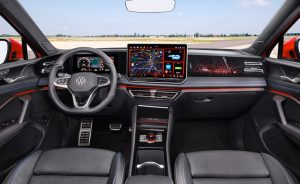
In addition to the base S trim, there are also SE ($34,470), SE R-Line Black ($37,640) and top-of-the-line SEL R-line ($41,930) trims. The latter comes standard with the AWD that’s optional with the other three trims, plus adaptive headlights that turn with you in the curves, the seat massagers, 20 inch wheels, a Heads Up Display (HUD) and a panorama sunroof.
Something else that’s nice about the Tiggy (and the Taos, for that matter) is that neither are hybridized – so there’s no down-the-road worries about spending a small fortune on a replacement hybrid battery pack
What’s New For 2025
The 2025 Tiggy has been heavily updated for the new model year.
What’s Good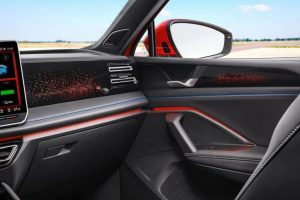
Clear separation between the Tiggy and the Taos has been established.
Base S trim is much less expensive than small, luxury-brand crossovers such as the $39,800 to start Audi Q3 yet compares favorably with them on the merits.
Available massaging seats are an impressive feature to find in a vehicle with a price tag under $60,000.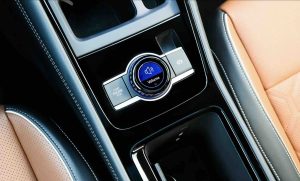
What’s Not So Good
Previously available third row option has been dropped.
While the output of the standard engine has been increased, a bit more power (and performance) would put more separation between the Tiggy and the Taos.
While cargo space behind the second row has been increased (by getting rid of the third row option) total cargo-carrying capacity is less than it was previously.
Under The Hood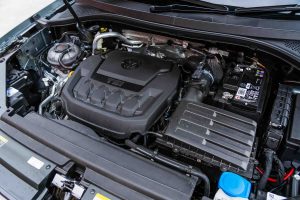
The Tiggy has always had a larger standard engine – a turbocharged 2.0 liter four – than the Taos, which comes with a 1.5 liter four. The problem – for the Tiggy – was that its larger, 2.0 liter four hardly made more power – 184 horsepower – than the 174 horsepower made by the smaller engine in the Taos.
VW has just remedied that by upping the output of the ’25 Tiggy’s still-standard 2.0 liter four to a more appropriate 201 horsepower. However, even with the larger engine and more on-paper power, the Tiggy isn’t quicker than the Taos. Both of these small crossovers take about eight seconds to accelerate to 60 MPH.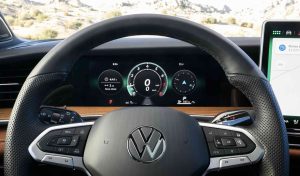
Why the disparity? Better stated, why the similarity? Well, the bigger-engined, more powerful Tiggy is several hundred pounds heavier (3,975 lbs.) than the current Taos (3,305 lbs.) and that several hundred pounds’ difference effectively negates the horsepower difference. An 8 second-ish 0-60 time is on-par with other small crossovers in the same price range as the Taos, such as the Subaru Crosstrek and Mazda CX-30. But the same time in the Tiggy’s price range is on the slow-ish side. An Audi Q3, for instance, touts 228 horsepower and can get to 60 about 1 second sooner. It is, however smaller and less spacious inside than the Tiggy – and massaging seats are not available.
VW will address the power/performance problem in 2026, when a high-performance R-Line Turbo trim will be available.The current (2025) VW Golf GTI touts 241 horsepower out of the basically-the-same 2.0 liter four (courtesy of more turbo boost and related tuning) so the pending R-Line Turbo trim ought to be in about the same ballpark and the addition 40 horsepower should push the Tiggy’s 0-60 time closer to 7 seconds.
The Tiggy’s 2.0 engine is paired with an eight speed automatic and either FWD or AWD. There are driver-selectable modes, which alter the feel of the engine’s responsiveness. Gas mileage with the FWD version of the Tiggy is 26 city, 34 highway; with AWD, it decreases significantly, to 22 city, 30 highway.
You can hitch a small trailer to the Tiggy, which is rated to pull up to 1,800 lbs. (FWD models). AWD models are rated to pull up to 1,500 lbs.
On The Road
The new Tiggy is built on the same EQB Evo platform as the current Golf GTI and that imparts noticeable athleticism – in terms of handling. It tracks where you point it, without feeling lurchy.
What’s lacking is the power to go with it.
When you’re just driving, it’s not noticeable as the 2.0 four is a torquey and smooth engine and it has enough power to keep up with traffic without feeling as if it’s struggling to keep up. But when you floor it from a dead stop, there’s a momentary lag before the Tiggy’s engine responds and so you kind of lose a step before you begin. Passing power is adequate, but the Tiggy deserves better-than-that. Put another way, a near-luxury crossover like the Tiggy ought to easily outpace an entry-level crossover like the Taos. The soon-to-be-available Turbo R-Line version of the Tiggy will do that but its performance will likely cost well over $40k.
The available massaging seats do make up for this in that it’s hard to be in a hurry when you’re getting a massage. The massagers are top-shelf, too – both functionally and ergonomically. They aren’t like the barely-can-feel-it massagers found in some other vehicles – all of which are also much more expensive than the Tiggy – and they’re super easy to activate. Just reach down to the left side of the seat cushion and push the button. Most other vehicles that have massaging seats (such as the Toyota Sequoia, reviewed here) have LCD embedded controls that make you tap/swipe through various menus to access/turn on the massagers, which is not relaxing to do when the vehicle is moving. VW also provides a timer function that lets you specify a longer or shorter massage; most of the others have a pre-set timer and most of them automatically turn off the massage before you’d like the massage to end.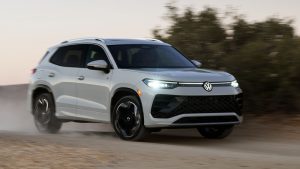
It’s unfortunate VW chose not to be guided by the same ergonomic form-follows-function discipline as regards the Tiggy’s climate controls. If you want to increase or decrease the temperature settings or fan speed, you have to use a finger-swipe/slide interface on the big LCD screen that can be awkward and frustrating to use; much more so in any event than an ergonomically smart knob or up/down button. The interface looks great. So does a supermodel. But is she the type who’ll rub your neck or cook a great supper?
Probably not.
At The Curb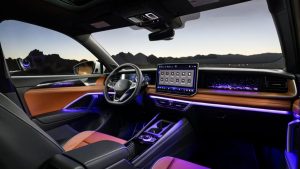
The ’25 Tiggy is the largest – the longest – Tiggy so far. It’s 184.1 inches end to end and so about six inches longer than the Taos, which is 175.9 inches long. Both are still within the parameters of the compact class, however.
What makes the Tiggy different is its now noticeably higher-end ambience inside. The “digital cockpit” treatment that was offered on higher trims previously is now standard and has been upgraded with a larger 10.25 inch main instrument panel with an even larger, almost 13 inch secondary panel to its right. The SEL R-Line gets a an upgraded 15 inch secondary screen with rich-looking, almost 3D graphics.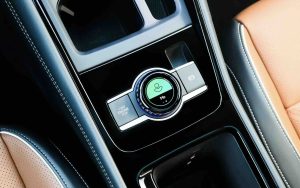
One of the smart design features of the latter is large font displays for such things as the radio station you’re listening to (and so on) that make it easier to read at a glance, which helps you keep your eyes on the road. There is also an integrated mood-lighting system that can be tailored to suit your preferences, along with what appear to be real wood trim inserts. If you removed the “VW” badge on the steering wheel hub and replaced it with the Audi discs or the Mercedes three-pointed star, nothing would seem incongruous.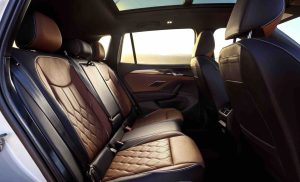
But the previously available third row is gone.
The decision to nix this useful and unusual in this class option is interesting because it eliminates an available feature that the Taos never offered and that very few other compact crossovers do, either. The Tiggy’s previously available third row was not exactly spacious but it did give this compact crossover the capability to transport up to seven people. For the most part, if you need a crossover capable of doing that, you’ll have to move up to a mid-sized or larger crossover, which means having to spend thousands more (usually) and also having to live on a daily basis with a larger vehicle, which some people might prefer not to.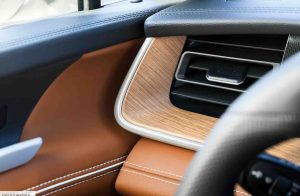
With the third row no longer an option, the Tiggy’s available cargo carrying capacity behind its second row does go up to 26.5 cubic feet, a significant uptick from the previous model Tiggy’s 12 cubic feet. There’s also generous second row legroom – 40.2 inches – which is identical to the legroom up front and significantly greater than the 37.9 inches of backseat legroom in the Taos.
However, total cargo capacity (second row folded down) decreases to 58.9 cubic feet from 65.3 cubic feet previously and the current Taos has more room behind its second row (27.9 cubic feet) and with its second row down (65.9 cubic feet) than the new Tiggy does. The latter is without doubt the nicer crossover now – but the Taos is the more practical.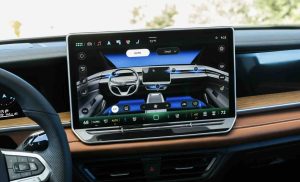
The Rest
VW might have given some thought to making some of the standout luxury items that are standard in the SEL R-Line such as the massaging front seats and heated rear seats as well as the excellent 12 speaker Harmon Kardon audio system available as options in at least some of the other trims. But if you want any of the just-mentioned, you have to spring for the top-of-the-line SEL R-Line. Given all you get, it’s still a relative bargain vs. the equipment-equivalent crossovers with luxury-brand badges – but it’d really take the wind out of the sails of those luxury-brand crossovers if similar equipment were available in a VW that could be purchased for say $35,000 or so.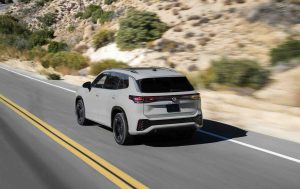
The Bottom Line
The new Tiggy puts some much-needed distance between itself and the Taos in every way except as measured by the stopwatch.
. . .
If you like what you’ve found here please consider supporting EPautos.
We depend on you to keep the wheels turning!
Our donate button is here.
If you prefer not to use PayPal, our mailing address is:
EPautos
721 Hummingbird Lane SE
Copper Hill, VA 24079
PS: Get an EPautos magnet or sticker or coaster in return for a $25 or more one-time donation or a $10 or more monthly recurring donation. (Please be sure to tell us you want a magnet or sticker or coaster – and also, provide an address, so we know where to mail the thing!)
If you’d like a Baaaaa hat or other EPautos gear, see here!










My kids pounded on me to buy a newer car. Then my mechanic’s nephew started work at the local VW dealer. Finally wore me down and I bought a used 2022 Atlas Cross sport with VR6. It’s ok. I like the room and it’s a lower trim level so I mostly have knobs and screen is not big or as annoying but my son jokes that my old Jetta TDI will still be around when Atlas is gone. He could be right. My Jetta TDI is still young at 210,000 miles. Tiggy or Taos would have been fantastic with a TDI.
I hope I’m misreading this. Even for a chick, you seem kinda pathetic:
“My kids pounded on me to buy a newer car.”
“my mechanic’s nephew…”
“Finally wore me down and I bought…”
“my son jokes that my old Jetta TDI…”
Fuck, them. Let them make the payments.
But, it’s too late.
…Or, you could try to get them to pay. …Wouldn’t they be happy & willing to do so? …Go Fund Me?
Hi Jetta Girl,
Hang on to that TDI Jetta; it’s a keeper. I wish I’d had sense enough to buy one back when I still could have.
I have owned 5 new TDI’s over several decades (Jetta Sportwagens and Passats). I sold my 2013 Passat SEL TDi back to VW following the scandal and purchased the exact color and optioned gas powered 2018 Passat SEL. I still have the 2018 and use it only to drive to and from Florida every year from Pennsylvania. It has about 41K miles currently. While I miss the 50+ mpg of the TDi, I get an honest 38-40 MPG on route 95 (70-85 mph) and the cargo capacity is unmatched in any current sedan and it holds 18 gallons providing excellent range. The trunk is cavernous! My problem is this, there is no sedan on the market that can match the Passat on any level. My wife drives an SUV but I want nothing to do with them. I thought about a final year Lexus ES350 but the rear seats do not fold down thereby not allowing me to place my bicycle in the trunk. The Lexus also only has a 16 gal tank with a range of about 450 miles. Bottom line is that VW will never see another dollar from this family as the Jetta is no Passat. They killed the Passat, CC and my loyalty. I would like to move into a new sedan in 2026 but have no earthly idea of where to go. First World problems.
Passats were nice. Love Jettas and not giving up TDI wagon ever. My son’s TDI beetle is approaching 500,000 miles.
‘a fully digital (LCD) 10.25-inch main gauge cluster and an even larger 12.9-inch secondary LCD screen’ — eric
It’s hilarious that auto makers consider these to be attractive features. Let’s try them in a different context:
‘a fully digital virtual girlfriend with an even larger waist size’
*screams and runs*
Fully concur with Klink that ‘VW is possibly the saddest story in the automotive world.’ If VW dies, will anyone even notice?
Hi Jim,
Yup. The damage done by the cave-in over the “cheating” business is both tragic and probably irreparable. Those TDI diesel-powered VWs were unlike everything else and that made VW unlike everyone else. Now it is the same as everyone else.
And it’s like you said, Eric, VW didn’t even fight. Best freaking motor ever, that’s why my family isn’t giving up the TDIs we have unless forced to. I’d feel differently about VW if they would have fought tooth and nail but now I just feel sad about them; it’s pathetic.
The Taos is a Chinese designed model for the US. Was supposed to satisfy those who liked the Golf. From what I’ve read it’s littered with bargain basement parts to get the price down. I believe even the Tiguan has a plastic oil pan. Wouldn’t want to own either one of these vehicles out of warranty. VW is possibly the saddest story in the automotive world, especially here in the US. In other parts of the world, they still offer a few decent choices.
the VW Tiguan has used plastic oil pans on many models, particularly from the 2018 model year onward, though this can vary by year and specific vehicle. These plastic oil pans have been a source of problems, including leaks and cracking, and some owners opt to replace them with metal alternatives for greater durability – per google
I ain’t paying no $41k for a plastic oil pan
Hi Dan,
Pretty much every new car has an engine with a plastic intake; I’d much rather have aluminum or even steel as these last essentially forever (especially steel, which is almost impossible to hurt). Plastic is for cheap toys and other throw-away items, which is just what cars are now.
I need to change careers and be the dude who creates car names. Tiguan? Tiger Iguana. Got it.