


One of the great scams used to get people to pay for repairs their vehicle probably doesn’t need – at least not right away – is to point out to the owner that the engine is leaking something, usually oil. But is that something to worry about?
Sometimes yes. Sometimes, no.
Lets start with an important fact. All engines – and transmissions and any other part of the drivetrain that holds liquid – will eventually leak a little. Seep a little is the better word. This happens – inevitably – because some of the liquid (such as engine oil) inside the case or casting eventually seeps through the gaskets that are in between mated surfaces, such as the oil pan that bolts up to the engine – or the transmission pan that bolts to the transmission.
Other areas where seepage occurs include the intake manifold – which is bolted to the top part of the engine – and the rear axle or front transaxle, usually around the areas where parts of the cases are bolted together. What happens is that – over time – the gaskets shrink a little and become a little more brittle, due to aging of the material and the expansion/contraction that happens as a result of the cold engine getting hot – and then getting cold again, when you shut off the engine and park the car for the night.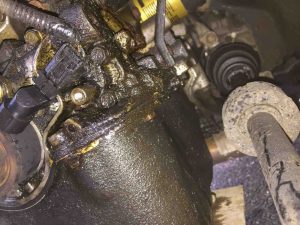
So – inevitably – your car’s engine or some other drivetrain part will seep a little. There may even be some drips on the floor of your garage, though that has been hidden to a great extent by the now-widespread use of underbelly catch-pans that make it appear your vehicle isn’t seeping even a drop of oil. This can actually lead you to believe your vehicle’s engine isn’t leaking when it is – and you ought to be worried about it.
You may not realize there’s a significant leak until you see the light come on in the instrument cluster that tells you the oil level is low. The thing is, those lights generally don’t illuminate until you’ve already lost a couple of quarts of oil, by which time your engine is running low (obviously) and you may not be able to quickly correct the problem by adding oil (because you haven’t got any in the trunk and there’s nowhere nearby to buy any).
That’s the kind of leak to be looking for – and worried about. You can look for them by checking the dipstick (engine oil, automatic transmission, power steering fluid) regularly to make sure you’re lot losing oil/fluid).
Seeps are not necessarily anything to worry about or do anything about – at least not right away. A seep can and sometimes does portend a leak, especially if the area of seepage is around a pressurized area, such as a rear main seal (or a radiator, water pump and hoses). Those kinds of seeps ought to be looked at more attentively. It might be necessary – or more finely, smart – to fix the seep so as to avoid the leak, which could be more catastrophic than just a little messy.
But a little seepage around valve covers – as a for instance – may be and probably isn’t something to worry about much. Especially if the cost to replace the gaskets is high, which it can be if the job requires taking apart most of the top-end of the engine before the valve cover can be taken off (as in the case of transversely or sideways-mounted V6 engines that have two valve covers, one of them almost impossible to get at because the engine on that side is snugged up against the firewall).
You can wait – and watch.
It might not be necessary to pay to have those seeping valve cover gaskets replaced right now – or even this year. Same for oil pan gasket seeps, even if there’s a drop or two on the floor where you park. It’s not a big deal – until the drops get bigger and form a puddle. When you see that, it’s time to pay attention – and get what’s now a leak rather than just a little seep fixed.
Same as regards transmission fluid seeps – and leaks. A drop or so of red (the usual color of transmission fluid) on the floor is probably nothing to worry about, unless it gets worse. Check the level regularly – and check the floor, too – so as to keep abreast of any changes. It’s changes that ought to draw your attention more than just a drip or two on the floor – which you’re going to get with every vehicle, eventually. Just the same as we’ll eventually develop a tendency to seep a little bit, too.
This is a normal part of the aging process – both for us and our rides.
. . .
If you like what you’ve found here please consider supporting EPautos.
We depend on you to keep the wheels turning!
Our donate button is here.
If you prefer not to use PayPal, our mailing address is:
EPautos
721 Hummingbird Lane SE
Copper Hill, VA 24079
PS: Get an EPautos magnet or sticker or coaster in return for a $25 or more one-time donation or a $10 or more monthly recurring donation. (Please be sure to tell us you want a magnet or sticker or coaster – and also, provide an address, so we know where to mail the thing!)
If you’d like a Baaaaa hat or other EPautos gear, see here!










I like leaks. Especially rear main seal leaks. I drive old trucks and leaks help undercoat for winter season driving. Years ago I had a cj7 that rusted away except for the floor pans that the leaking oil coated down the center of the undercarriage.
I change my oil every fall and use that oil to undercoat my truck for the winter. I break out the harbor freight spray gun and have at it ever season . 1992 c1500 with no rust on the frame. Body panels not so good but who cares. No fashion show for me.
“A seep can and sometimes does portend a leak”
It’s my experience that it’s not “sometimes” but “eventually” leaks. Nothing is supposed to weep or leak, so if you do see them it’s a warning. Sure, you can judge severity to decide when to fix it, but it’s never an if. At least assuming you are keeping the car.
Now that said
“You know what it means when your Land Rover stops leaking? You’ve run out of oil.”
Or
“You know why Lucas never made a desktop computer? They couldn’t figure out how to make them leak oil.”
What finished off Old Yeller my beloved 79 Gran Prix, the years long minor trans leak became a gusher and I barely made it home. My daughter claims
I lost track of odometer turns, she may be correct that it made it to 355,000
I know at least 255,000. Trunk rusted, AC finally dead, we all cried when Old Yeller died. She was 4 when we got it used in ‘84, learned to drive in it at 16, drove it to work instead of her prized ‘94 Camaro at 21.
PS: The ‘79 Gran Prix was on the consumer mags “don’t buy list” for used cars, in ‘84. What a pearl clutching bunch of morons. I had many years of comfortable miles in that quiet smooth long hooded machine.
The bane of older rolling stock. I’ll emphasize the pressure vs non pressure leaks. Transmission, oil cooler, power steering, brake system lines = pressurized, time to fix if there are leaks! Valve covers, oil pans, front/rear seals, splashed not pressure, meh unless it gets really severe. Old Yeller my 79 Gran Prix leaked like sieve, the starter never failed probably due to being oil cooled from the valve cover leak above.
The other pressure system is coolant, I will not tolerate ANY seep, drop, weep due to the danger to animals. I’ve got a herd of curious cats here.
It can be deceiving if the engine is modern enough to have PCV. You can get a leak in a place that is unusual like a valve cover if the PCV valve itself is clogged. It doesn’t take much pressure to cause a oil to push past a seal that’s intended for no pressure like that. That’s gotten me a couple of times over the years.
Just had the main gaskets, intake and manifold, done on my 2001 Chev Impala (with the 3800 V6). It was a 25th anniversary present for the vehicle which just crossed 250,000. The issue was a minor external coolant seep that was slowly turning into a proper leak that triggered the final decision. The job also found a couple of other smaller issues that were addressed while the engine was apart, mainly new hoses. Not a cheap job and it took a couple of days, but still cheaper than replacing the old car with a similar one (with unknown problems).
I figure that it isn’t bad for an engine to go that long without any major problems or breakdowns and hope that this will extend the life for another decade or so, or until salt finally eats the rest of the car.
Maybe, by then, they will have fixed the regulatory and design idiocy and will start making proper reliable cars, again. (One can dream…)
Two CAPTCHA sliders now. Spam must be getting heavier now.
In one of my comments earlier in the year I mentioned that one of my old cars was dripping tranny fluid but still shifted properly but had a problem with an internal seal and to fix the leak the tranny would have to be removed from the car to be repaired. Eric’s advice was that as I liked the car, didn’t drive it in winter/ salt to have it repaired if I could afford too. The seal leaked about 1 quart in about 500 miles. Irritating as all get out but manageable if you have extra fluid on hand.
Shortly after posting that question I saw one of Scotty Kilmer’s videos on mechanics secrets where he mentioned AT205 Reseal to fix seal problems. I asked my mechanic if he heard about it and he said yes but had never tried it even though they had been given a bottle of it. They gave it to me, no charge and asked me to let them know if it worked.
Before pouring it in the tranny it would leave about two dozen quarter sized drops every time you drove any sort of distance. On Mother’s Day I poured in one bottle (sufficient according to the tranny’s fluid capacity) and drove to the cemetery to put flowers on Mom’s grave (40 minute drive). Afterwards I drove to the Home Despot (20 minute drive) to get some stuff and when I left there was only three drops on the ground!!!
After a month or so it stopped dripping or even seeping. I neglected to take a picture of the oily mess before pressure washing the worst of the leak but it was about a quarter inch thick on the tranny and crossmember. I’ll update in the spring after I take the car out again.
Project Farm on YouTube did a test on stop leaks and AT205 Reseal wound up in third place. As it is a polymer do not get any on your car’s paint as it may damage it.
I would use the product again but remember it works on hardened or shrunken seals. It won’t work on cracked seals or rusted out metal pans. I would still recommend an actual repair if cost efficient and easily accessible though.
We always jokingly talked about self-changing oil. Top it off. It’ll be fine.
Toyota 4 cylinders had this feature since the turn of this century.
Hi Horst.
You’re close. The older 2.4 liter Toyota engine does not have an oil use problem. It started around 2010 in engines with the low friction piston rings combined with extended oil change intervals. If you have this problem you can try Hot Shots Stiction Eliminator which has been know to help. Best bet is don’t go more than 5,000 miles on an oil change and you should be good. 3,000 miles might be better if you only do city driving.
Toyota made the problem worse by saying that it was OK to change oil every 10,000 miles instead if 5000. Also Uncle made them specify 0W-20 oil instead of 5W-30 – or better yet 10W-30 since the rings were worthless crap.
If you’re going to buy a 21st century Toyota, best to stick with their naturally aspirated V6s or V8s. And not the crappy V8s that were in the Lexus GX that actually used timing belts.
The timing belts on the 4.7s are simple to change. They are 500,000 mile rock solid motors. Some of us prefer a belt over a chain, especially on OHC V8s.
Stretched chains and broken plastic guides are a thing.
I had a 22R timing chain break on me. This is not a mythical maybe, it can happen. It wasn’t my first rodeo with a Toyota R series engine, I actually preemptively replaced the timing before the guides broke. The 84-95 22R is a timing chain, but single row and uses nylon guides instead of metal. It’s not supposed to be a wear item but they of course do, so you’ll get some slap that sounds like a diesel engine rattling when they wear through or break. I thought I was being proactive doing them at ~100K before they got to this point.
My failure was not using OEM or equivalent parts. The aftermarket tensioner failed, which led to a quickly cascading failure. The tensioner in this case has a strong spring for initial force until oil pressure builds, which is the main operating mode. The piston shaft is a hard chrome, or at least is supposed to be. Apparently the aftermarket tensioner was not well made. It looked fine, a nice bright chrome when I put it in but over the course of just 18,000 miles it had developed scoring and pitting to the point it would not move smoothly. I had no way of knowing this visually, the chain seemed tight but I only do valve lash checks every 3rd oil change, so roughly every 10K. It was due for the second post replacement valve lash on the next oil change.
The chain I surmise started flapping, which flexed the tension side (driver in the US) guide until it snapped above the top bolt, which then gave the chain enough slop to jump on the crank gear and that was all she wrote. It all happened while driving. I’d have noticed the noise otherwise. I was lucky that it seized pulling away from a stoplight rather than at high RPM.
Bottom line, the block and head casting survived. Bent a couple of valves and ruined one piston. I was able to rebuild the engine, which has just recently turned over 300K, approximately 180K of those on the rebuild I did … with factory parts.
Just throw on a filter every 5000 or so…
Eric, my 3 litre diesel f150 is seeping oil around the turbo.I noticed it two oil changes ago and have not had to add any oil between changes yet. Any thoughts would be appreciated.I am going to let it seep for the time being.
Hi Nova,
How much seepage is important! If it’s just a little grimy, I wouldn’t worry. I’d be watchful, though. Your turbo may have an oil cooling system and that is – obviously – critical to the health of your turbo. When the engine is stone cold, you might try using some aerosol brake/parts cleaner around the area where you’re seeing seepage, so you can better see exactly where it is seeping and how much (as by checking again after you drive the vehicle for a day or two).
Thanks E. There is a small diameter pipe connected to the turbo appears to be seeping around that. Unfortunately I don’t have a hoist to get a better look. Will have to go to my repair guy when I get enough coin in the bank.
All across Europe there are bi-annual inspections were any oil leak is cause for failure. Garages often have high pressure spray halls to wash the engine and hide oil leaks. Garages have a steady income stream and support these regulations.