


The nice thing about engines – well, one of the nice things about them – is that they work just as well when it’s bitterly cold as they do when it’s warm. Well, assuming you have a healthy battery to start the engine.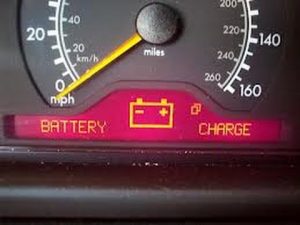
As most people know, bitter cold weather is very hard on starter batteries. More finely, bitter cold makes it harder to start a car, because the battery’s ability to crank the engine over diminishes as it gets colder. How much is that, exactly? Well, at 32 degrees, a fully charged battery loses 20 percent of it’s cold-start cranking power. If it’s zero outside, the loss is 50 percent. That’s why a battery that’s a little aged and weak to begin with may not be able to start your car’s engine at all when it’s bitterly cold out.
Most of us have found this out – the hard way – at some point in our lives.
EV owners are probably finding it out right now. The same physics that negatively affect an engine’d car’s 12V starter battery also negatively effect an EV’s battery pack. But the consequences are different and more serious.
Let’s begin with the engine’d car. Once it – the engine – starts, it will run as it always does. If may even run better, because cold air is denser than warm air and that can increase power and efficiency (it is one reason why turbocharged cars often have intercoolers). It will certainly run as far as it would have if it weren’t cold out. If you have a full tank and your car normally goes 400 miles before the tank runs to empty, you will be able to drive the same distance when it’s cold out. No one worries about the range of their engine’d car, in other words – unless of course they forgot to fill up and the tank is close to empty already.
You can also crank the heat – and defroster – without any effect on the engine’d vehicle’s range because use of the heater and defroster uses heat generated by the running engine, a kind of freebie you get with an engine’d car in that it doesn’t cost you anything (range-wise) to use the heater vs. not.
The owner of a battery-powered vehicle, on the other hand, has at least two problems on his hand when it is very cold out. The first is that even though his device will turn on, it will not go nearly as far; see that part about charge loss resulting from very cold weather. EVs do have what’s called a thermal management system that keeps the battery warm while it’s cold out, but that burns electricity – which depletes the battery’s charge. You can avoid that loss by plugging the EV in while it’s parked – but only people who have a place to plug in (such as a garage or single family home/townhouse) can do that. If they don’t – and leave the EV out all night in the cold – they may discover they have lost 20 or 30 miles of range just from sitting in the cold overnight.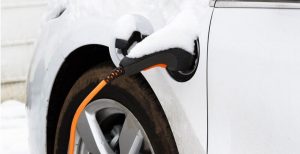
But that’s just for starters – pun intended.
As you drive – a device – in very cold weather, you will notice that it bleeds charge (and so, range) much more rapidly. Precisely because it is cold. The battery is doublewhammied by environmental factors – the cold – and by the draw on the weakened battery by the thermal management system, which burns electricity trying to keep the battery warm. Since you can’t plug in and drive at the same time, you find you can’t drive nearly as far as you might have been able to when it was warm outside.
It gets worse if you use the heater – which uses electricity to keep the car’s cabin warm.
In very cold weather, an EV’s normal driving range – in warmer conditions – can plummet by 40-50 percent. If you started out with a less-than-fully-charged battery, you may not be able to drive far enough – as to to a place where more charge is available. Or where there is heat – so you don’t freeze to death in the cold.
Some will remember the blizzard that snowed-in much of the Northeast a few years back, at the very beginning of EV Fever. It cured that right quick as people found of what happens to an EV’s range when it is cold out and what can happen when you run out of range before you can reach a place to get more (or get warm).
You might not even be able to charge your EV if you do get to a place to charge it – i f the charger isn’t working. That happened during that blizzard, too. It is probably happening this week as well.
Meanwhile, if you find yourself caught in a blizzard in a car with an engine – and a full tank of gas – you’ll be able to stay warm for a day or more (if need be) by running the engine, to create the heat. An EV might be bricked – and if it’s very cold out, you might be, too.
Whereas even if you have a dead battery – in a car with an engine – all you need is a set of jumper cables (and another car to jump-start yours) and you’re good to go.
There’s no jump-starting a croaked EV. And even if it were possible to do that, you’d only be able to drive it as far as the cables reach.
. . .
If you like what you’ve found here please consider supporting EPautos.
We depend on you to keep the wheels turning!
Our donate button is here.
If you prefer not to use PayPal, our mailing address is:
EPautos
721 Hummingbird Lane SE
Copper Hill, VA 24079
PS: Get an EPautos magnet or sticker or coaster in return for a $25 or more one-time donation or a $10 or more monthly recurring donation. (Please be sure to tell us you want a magnet or sticker or coaster – and also, provide an address, so we know where to mail the thing!)
If you’d like a Baaaaa hat or other EPautos gear, see here!









[…] https://www.ericpetersautos.com/2026/01/27/its-good-to-have-an-engine-this-week/ […]
I just read that Germany has forced lexus to update its cars so that the remote starters wont work anymore. There is a prime example of what can be done with new cars without the owners consent. Now you would have to walk out to your car and physically be inside to warm it up in the norths -30’s weather.
Saw two EV’s charging in the parking lot yesterday. It was well below zero. If they are lucky said EV drivers will have enough juice to drive home. Having a heated cabin along the way may be optional. Gets me to wondering if that is the point? You can own an EV, but no heat or air conditioning for you. It’s baaaad for the environment.
Owning an EeeVee builds character. As does wearing a hair shirt, plunging into an icy lake, and sleeping on a bed of nails.
No pain, no gain! 🙂
Worth mentioning is the benefit for those with gas engines of battery maintainers. A small, inexpensive ($20) CPU-driven device that plugs into an AC outlet and attaches by a connecting cable to the car’s battery, it maintains the battery at 100% charge when the car is not being used, regardless of temperature. In very cold weather, the car starts the day with a fully charged battery. By keeping the plates charged at 100% when the car is not being used, batteries last far longer — I have been getting 8-9 years before a battery gives up the ghost.
So much for global warming, huh?
Yep. And the UN narrative of “Global boiling” as pushed by its Secretary General a few years ago.
I guess global warming can be chalked up to Horton’s Law. Politicians always keep their bad promises and never keep their good ones.
They keep promising us global warming. I suppose we’ll get it with the Epstein files.
I was thoroughly enjoying the global warming here at the tail end of December with record highs, but then here comes January dammit with highs in the single digits. Mother nature… always spoiling the machinations of politicians.
Its almost like the temperature averages are the result of highs and lows. Wild, huh? But I’m sure if puny humans try hard enough by repenting of burning their masters’ hydrocarbons, that they can lower that average.
The TV told me that if I eat bugs and pay more money to the government the weather will be gooder.
https://img.ifunny.co/images/cd8aba113ac74021a3b4b29754cad1de941700a03dac065d85e1b25b1fec71c8_1.jpg
Related only tangentially: you wrote “If you have a full tank and your car normally goes 400 miles before the tank runs to empty, you will be able to drive the same distance when it’s cold out.”
I suffer with OCD (that, or I’m just a retired engineer — same thing, maybe), one of the manifestations of which is that I keep a fuel-and-oil-change login my truck. That’s something I’ve done with each of my daily drivers, for decades now. I’m incapable of gassing up without “taking data,” and every now and then I take the logbook into the house with me and enter the fuel data (date, odometer reading, fuel required to fill, and dollar cost) and enter them into my spreadsheet. There’s some “noise” on the gas-mileage-versus-date plot, but the trend is clear and consistent: fuel economy is better in warm weather, worse in cold. Not a lot, but it’s there, year in and year out. It’s been consistent as my daily driver has changed from vehicle to vehicle, including the current ’96 Ranger. I’ve never been able to explain the variation to my own satisfaction; in cold weather, more oxygen is in the combustion volume due to the higher air density, which might make the mixture effectively leaner, unless the engine electronics, which in ’96 were probably fairly simple, compensates for that. What do you think — why does this happen?
Beats me. So I asked AI, which knows everything:
‘Gas mileage is lower in winter—often by 10-15% or more—due to a combination of longer engine warm-up times, colder, denser air increasing drag, thicker lubricants causing engine resistance, and the use of winter-blend fuel with lower energy density. Idling to warm up and reduced tire pressure also decrease efficiency.
‘To maximize efficiency, drivers should minimize excessive idling, ensure tires are properly inflated, and use synthetic oil.’
WHEW — at least AI didn’t snark, ‘Get an Eeevee, dude. Share the collective pain!’
Winter blend fuels make a big difference. More ethanol.
Thanks, guys — it makes sense. More of that tasty, tasty alky in winter gas should indeed produce less energy per unit volume. Better yet, more alky means more water captured from the air, and a better chance of freezing up gas lines. Gee, dot-gov, sure do appreciate you.
A bit off topic but, what about the “starter” battery in a car with Automatic Start/Stop? Will the heat from the engine compartment be enough to reduce catastrophic depletion?
All the contrived complexity for job security to get from point A to B. It’s a sickness not to leave well enough alone.
Just to monitor what the enemy is doing, I’m on the email list of Veloz, Comrade Gavin’s EeeVee-pushing club. Veloz is keeping a brave face:
‘In Q4 2025, California surpassed a significant milestone with more than 2.5 million cumulative new EVs sold since 2011.
‘Sales from the quarter added 79,066 new EVs, representing 18.9% of total light-duty vehicle sales, continuing the state’s steady pace of adoption at scale.
‘Year-over-year, California’s EV market share shifted from 25.3% in 2024 to 22.9% in 2025, indicating relative stability given the federal policy changes affecting both incentives and consumer purchasing conditions.’ — Jan 22 email
You don’t need no PhD in Maff to grok that Veloz is using statissssstics to obscure a meltdown. EeeVee sales and market share got hammered in Q4 2025. The slower-changing annual market share still dropped an ugly 2.4%, and will drop even more in 2026. And of course, cumulative sales since 2011 mean nothing.
Why let inconvenient facts stand in the way of a good story? Gavin is unbowed:
‘The combination of long-term consumer programs, the exponential growth in charging ports statewide driven by public and private sector investment, and the increased availability of new and used EVs, underscores how California’s ongoing commitment to clean transportation continues to foster the EV market regardless of changes in federal tax credits.’
‘Exponential’ is a fancy word that Gavin’s Art History majors like to deploy. But the trend in charging ports has been linear, not exponential. And with federal support withdrawn, growth in chargers is going to drop off the same cliff that EeeVee sales did.
Veloz should change its name to VeLose. 🙂
Great stuff, Jim – both the analysis and the prose! I needed a laugh this morning. The badge-lickers are driving me to the bottle, early.
Wow, those idiots just can’t face reality. EVs might work in California because it’s mostly mild year round. As someone mentioned above, we could really use some global warming here; in the teens during the day and single digits overnight, not to mention a couple feet of snow that isn’t going to melt anytime soon. Luckily I can start (barely, in this cold) and run the heater full blast to melt off the snow while I go back inside and have a second cup of coffee.
In northern Cali and in the many mountains it gets plenty cold. The inbred mouth breathing city dwellers who count the votes are NOT California. I recall many freezing days in Chico and Burney.
The car started and the wood stove is burning wood. Good times.
Still funny that they now insist on naming storms because as a kid we just called it Winter!
Of course one commenter pointed out that when they name a storm this may allow the insurance company to not cover your loss, I don’t see how but then I don’t work in insurance.
The Japanese character for ‘winter’ looks like this:
https://ibb.co/LDs30VdR
Those two little ticks at the bottom represent the tears of an EeeVee Clown. 🙁
Cute. Of coarse if you didn’t know Japanese you might think it was a drawing of a folding chair on rocky ground.