

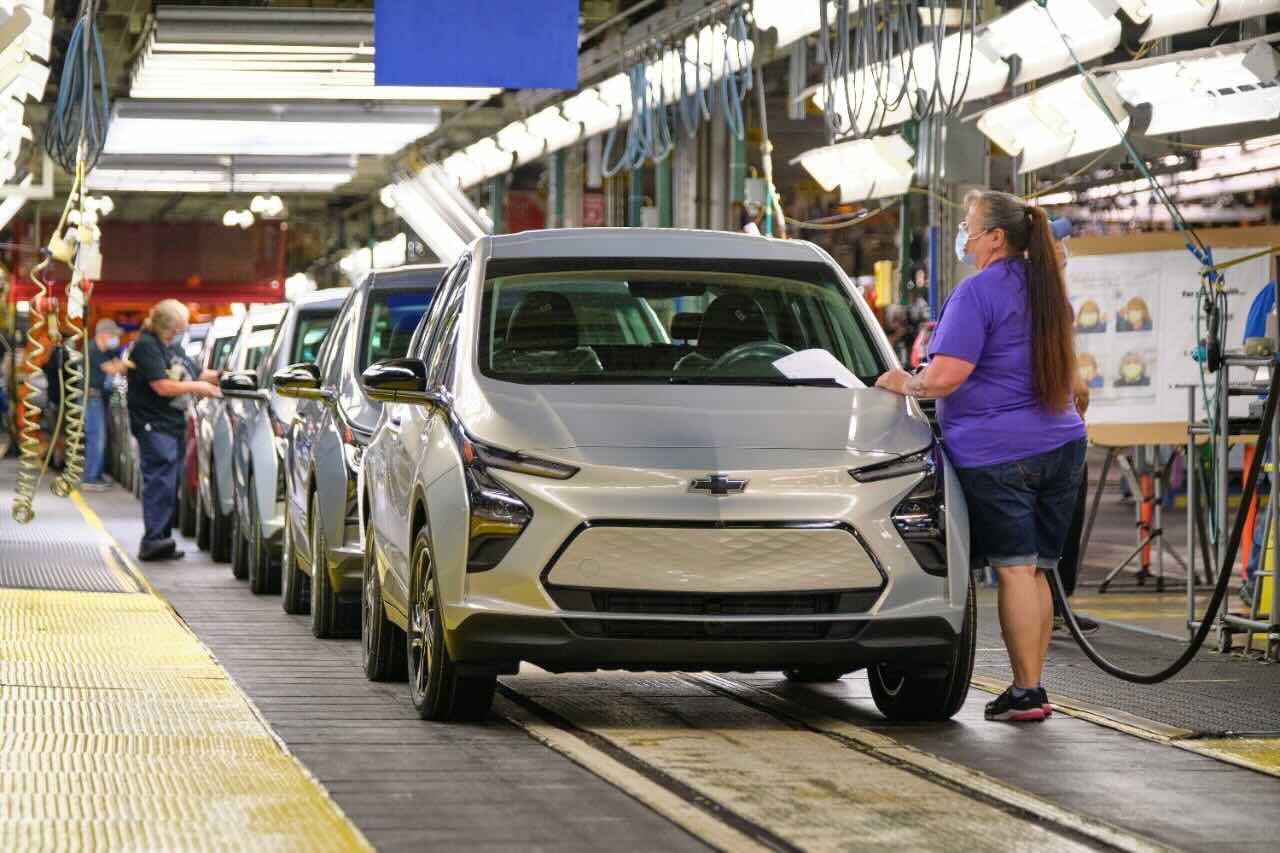

Chalk up another deserved, soon-to-be casualty of Trump’s ending the availability of the $7,500 tax credit that helped prop up the EV “market” by essentially paying people to buy EVs (using their own money, refunded to them after it was taken by the government).
The Chevy Bolt is bolting.
But not right away. GM – having already redesigned this subcompact device before Trump ended the tax creditt program that GM no doubt assumed would still be available to help make the Bolt seem like a not entirely ridiculous vehicle to buy, given what you got for the money – will try to offload a brief production run of these things before the plug gets pulled.
Then the just redesigned Bolt will bolt – for the land of unwanted devices, where it will find its friends the Ford Lightning and the Tesla Models S and X.
GM is paying the price of Compliance Kabuki.
It made the Bolt – and its other devices – based on its estimation that the government would continue to (a) directly subsidize the purchase of EVs via the federal tax credit available to EV buyers and (b) that people would gradually, continuously, be nudged into buying EVs via federal regs that pushed alternatives to them off the market – or out of their means, by making them as or even more expensive to buy than an EV but without any subsidies to offset that cost.
The Bolt – which lists for about $30,000 to start – might make some sense (financially at least) if you got $7,500 tax credit for buying one. Then it would cost you $22,500 – which is only slightly less expensive than the least expensive new vehicle you can still buy – which is the $20,550 Hyundai Venue. But it makes a great deal less sense when you’re looking at paying nearly $10k more – the price difference between the Venue and the Bolt at full price, without the $7,500 rebate.
The Venue can be driven about 400 miles on 12 gallons of gas that takes less than three minutes to pump, spur-of-the-moment and pretty much whenever you notice you need to do that. GM says the Bolt might take you about 250 miles on a fully charged battery – but this assumes conditions are not-too-cold (and not-too-hot) because as everyone knows by now, batteries deplete faster when it’s very cold – or when it’s hot and they are being taxed by increased demand, as for example running electrically powered accessories such as air conditioning and heat. Even if you do get the advertised range out of a device, there is no getting around the time it takes to recover charge. Best case scenario at the fastest of “fast” charging kiosks that are available to the public is about 20 minutes – and that’s for a partial charge.
That has been portrayed as a trivial inconvenience, which is of a piece with the way the definition of what a vaccine is shifted away from something that assures you will not get the sickness you’re being vaccinated for to something that will perhaps lessen the severity of the symptoms you get when you inevitably get sick.
They – the pushers of devices – double-down on the absurdity by touting a wait of “only” ten minutes, to recover say 80 miles of range that some of the latest offer. They ignore that 80 miles isn’t very far (especially when you factor in the practical necessity of always keeping at least 20 miles of range in reserve just in case you discover that the “fast” charger you expected to get charge at is kaput, which happens regularly) and that – regardless – you’ll be forced to stop and wait again, very soon.
Repeatedly.
It adds up to a lot of waiting – and there are very few people who willingly want to wait for something that they do not have to wait for.
The latter is italicized to emphasize a not-trivial thing, which is that so long as people have better options available, most people will choose the better option. Some people will go on and on about how important it is to decrease the size of our “carbon footprint” because the “climate” is “changing” – but not very many of them will personally make the sacrifices that attend their beliefs. This is why the great majority of people who have bought an EV also have a vehicle – i.e., something with and engine and a gas tank – so that they do not have to wait. The device is on hand for when it is convenient.
But when it isn’t, there is a better option.
The Bolt is doubly cursed because it’s not something affluent people want to be seen driving – or waiting in – because it’s an economy-looking thing. On the other hand, it is much too expensive for people who are not affluent to buy and such people still have much better options, such as the Hyundai Venue.
Why spend $10 for a veggie patty “burger” that you have to wait ten minutes to get when you can just pick up a decent steak for less?
The Bolt’s demise is as predictable as it isn’t sad. Like the bulldozing of a termite-riddled shack.
. . .
If you like what you’ve found here please consider supporting EPautos.
We depend on you to keep the wheels turning!
Our donate button is here.
If you prefer not to use PayPal, our mailing address is:
EPautos
721 Hummingbird Lane SE
Copper Hill, VA 24079
PS: Get an EPautos magnet or sticker or coaster in return for a $25 or more one-time donation or a $10 or more monthly recurring donation. (Please be sure to tell us you want a magnet or sticker or coaster – and also, provide an address, so we know where to mail the thing!)
If you’d like a Baaaaa hat or other EPautos gear, see here!










Been hearing reports that Porsche might cancel the planned Cayman and Boxster EVs before they even launch.
These were supposed to be EV only models. However Porsche got lots of negative feedback, added ICE models and now the EV’s may not even get to the showroom to fail.
https://www.unz.com/article/trial-by-jewry-sapiro-vs-ford/
More not-so-good news for EVs…
Recent research from Geotab shows that as more EV users charge their devices at ‘fast’ chargers, this has led to a marked deterioration in battery capacity.
Apparently, after an initial improvement in this indicator due mostly to better battery chemistry, this has now all been reversed and an EV subject to ‘average use’ can expect to lose 2.3% of capacity each year.
How would you like your ICE to lose a quarter of its gas tank volume – with a corresponding decrease in range of course – in 10 years?
And let’s not forget those figures are hopelessly optimistic! Do you happen to live in a hotter climate? So sorry about your battery degrading at yet 0.4% faster…
The impact of colder climates has not been measured..probably with a good reason.
Article here, for those interested – complete with a positive spin on just how ‘good’ the batteries truly are and how it’s not a problem at all for the EV enthusiasts!
https://www.geotab.com/blog/ev-battery-health/
Morning, John!
I am not surprised. Most of us know that “fast” charging a 12V battery will probably shorten its life; that is why it’s smart to trickle charge 12V batteries. I understand that a 12V lead acid battery is different than a lithium EV battery, but I’m betting the basic issue is the same. And if so, then “fast” charging an EV is to be avoided. But in that case, you have to rely on hours’-long charging at home, which renders the EV essentially useless except as a second vehicle that you use when it’s available to be used.
Jesus… look at that picture of that fat-assed sow wearing a covid mask on the assembly line. SMDH, bros…
‘Murica, LOL.
No wonder so many factories moved to Asia — where most workers have normal physiques.
No wonder so many dudes get an Asian woman…
Hey that’s a Seattle 7 or 8!
My ‘80s joke:
“What’s the difference between Shamu the killer whale and a Seattle chick?
“About 40 pounds and the tavern jacket!”
If you’re average and brainwashed, you’ll wonder what we will do in 1000 years or so when we run out of oil.
But that’s so obvious they had to come up with the claim that CO2 is going to destroy earth’s habitat.
Fascinating.
Beam me up, there’s no intelligent life down here.
We will never run out of hydrocarbons…
First of all, let’s get rid of the term “fossil fuels”.
Naturally-occurring hydrocarbons are “abiotic”.
Hydrocarbon products are constantly being created deep within the earth by yet-unknown processes well below the layers that contain fossils. Keep in mind that hydrocarbons migrate upward and pass through “fossil layers” picking up remnants of “fossil” material; hence, the present-day scientists’ stupid, ignorant mistaken assumption that hydrocarbons are derived from “fossils”.
Oil interests are drilling wells at 5,000 feet, 10,000 feet, and 15,000 feet and deeper, and coming up with oil deposits well below the layers and levels where “fossils” were known to exist.
As Russia gained much expertise in deep-well drilling and coming up with oil deposits far deeper than that of the level of “fossils”, abiotic oil at extreme depths was actually a Russian “state secret” for a long time.
“Peak oil” and “fossil fuels” are discredited dishonest concepts that environmentalists and others are latching on to, in order to display their hatred of oil being a renewable resource as well as to push prices up.
Follow the money.
Naturally-occurring hydrocarbons have done more to advance civilization than any other influence. It is the discovery, creation and utilization of ENERGY that propels civilizations upward and onward.
We have more oil underneath our feet than the rest of the world. In fact, we became energy independent under Trump. That trend was reversed with the Biden regime.
In fact, one of Saturn’s moons (Titan) is primarily composed of hydrocarbons (without “fossils”).
For a good treatise on abiotic oil, please google L. Fletcher Prouty. He is a scientist who gives a good explanation of “abiotic oil”.
Great explanation anarchist.
I teach it to any open minded people.
You should see the closed minded people’s reactions. How can they possibly not believe a lie told to them for decades
I call them natural fuels and try in my little world to get rid of the term fossil
I prefer the term natural fuels. And hydrocarbon synthesis is just chemistry.
CO2 mass release may likely become a major habitat problem in 500 to 2000 years. Its def not make believe but is being used to scare us outa money and pursuit of happiness for sure.
What a crock. I could care less about the next millenias issues.
The system will change equilibrium, more CO2 simply means more life and more photosynthesis.
Who doesn’t like a greener, lusher planet?
The anti life.
Caring about the environment is nothing more than virtue signaling writ large. It’s a way for people to forget their own problems.
Control the controllable’s, I think Rumsfeld said that, but I’m pretty sure I also heard it growing up somewhere. All this Co2 horseshit falls under the umbrella of the Bureau of Imaginary Problems. It’s a place mostly habituated by AWFULS who are unable to find love, except with their cats.
The Bolt is actually what EVs should be—small and relatively inexpensive. But even at its subsidized price, there are better options for less money.
You can buy a gently used Toyota Corolla or Honda Civic for half the price.
And the Bolt is well suited for city dwellers who don’t have to drive very far or fast. But once again, there are better options for less money.
These are descent local commuter cars. Stay within 100 miles of home and you’re good. GM is doing another run since these were so well received. With the steep EV depreciation, a used Bolt can be had much cheaper than a comparable used Toyota or Honda in my area.
That’s true, Ben –
I’d still stay away, except perhaps in the case of a very attractive lease deal. Keep in mind that EVs depreciate much faster than nn-EVs, on account of the battery replacement (cost) issue. You don’t want to find yourself holding that bag!
If a product isn’t viable without a government subsidy, then it isn’t a viable product and should not be on the market. Not sure how the execs decided to invest billions into an unstable government policy.
You’ve got that right, Dan. EVs are not economic products that are produced, sold, and bought according to the law of supply and demand, but are political products produced by government fiat.
‘General Motors CEO Mary Barra criticized Canada’s Jan 2026 deal allowing up to 49,000 lower-tariff Chinese EVs annually, calling it a “slippery slope” that threatens North American manufacturing, jobs, and national security.’ — AI Overview
‘National security,’ Mary? WTF?? Stop eatin’ them mushrooms!
Lightning Jim Farley rabbits on this way too. It’s no mystery why EeeVees succeed in China: it’s a quasi-command economy. But Jim and Mary lie awake at night, stewing over getting ‘left out’ of the EeeVee ‘market.’
A lot of good that’s done for their long-suffering shareholders. If elected chairman of GM’s board, I will call in Mary Barra for a performance review.
‘Mary, you know I love you like a sister. But you just ain’t makin’ me any money. So Imo have to fire your bubble butt. Here’s a quarter, call someone who cares.’
I thought the 7500 was a tax credit? Not a rebate?
Did it reduce your taxes paid by 7500, or just your income by 7500?
You are correct, sir!
I just made the edit. This sort of transposition happens sometimes when I’m up at 2 in the morning and working on my 5th cup of coffee!
Hope you can get some better sleep Eric.
So they only save a couple grand.
But it sounds so good, and works both ways, cause now it’s ‘OMG I’m losing 7500’
While I don’t care either way that the Bolt got cancelled; the bigger question should be is why can Toyota make money selling Prius’s and Chevrolet can’t make money selling Bolts?
Hi Landru,
The Prius is a hybrid – and so viable as a vehicle. The Bolt is a device and thus not viable as a vehicle.
Wasn’t the Volt a plug in hybrid? They should have stuck with that.
Morning, Horst!
Yes, the Volt was a plug-in hybrid. It was also unique (at the time) in that the car was propelled chiefly by the electric motors, powered by the battery – which was kept charged up by the engine that served chiefly as a generator. It wasn’t a bad idea. At least, relative to the purely electric vehicle.
IMHO, the Chevy Volt worked TOO well. It gave you the best of both worlds with EV and IC power, plus, it was by no means cheap, but not inordinately expensive at $40K. The Volt actually reduced emissions by burning less
fuel than similar cars—drivers could go weeks, sometimes months, between filling up, such that they had to add fuel stabilizers to their gas tanks.
But the Volt (and the Prius, and Honda compressed natural gas engines, and clean diesel VWs) make no sense if the ultimate goal is not reducing emissions, but reducing mobility.
If we (the lower case car company) had stuck with it, and transferred the tech (which was improving btw) to other vehicle platforms, gm and consumers would be so much better off right now. But Mother Mary killed it , probably to eliminate an alternative to devices, at the behest of her handlers I’m sure.
Friend of mine had a Volt back when they first came out, I was hoping to buy it off him if he ever decided to sell it but unfortunately he got t-boned and the car was totaled. I remember the battery was distributed throughout the car, like a bunch of D-cells strung together, probably why it didn’t burst into flames when he got hit.
Yep, they should have kept the Volt.
Morning Eric.
Perhaps they should look at why their hybrid cars don’t sell as well as Toyota’s do but at this point I doubt if they even make the equivalent size car to a Prius.