


There are car repairs that can make you never want to work on a car again. Here are some, in no particular order of priority:
Broken exhaust manifold bolt(s) –
If you have ever had to deal with this one, your teeth are probably already aching. Maybe you were going to replace the cast iron manifold(s) on your engine with headers, to improve the exhaust flow and get more power and better sound out of the engine. Or maybe you just had to take off the manifold(s) – four cylinder and other inline engines have just one but V6 and V8 engines have two – because the catalytic converter inside of it is clogged and has to be replaced.
Catalytic converters used to be bolted downstream – and still are. But in addition to the cats that are part of the exhaust piping, there are also (in many late-model vehicles) cats embedded in the exhaust manifolds. These are styled close-coupled cats and the idea is to snug them up as close to the engine’s exhaust ports as feasible, so that they get hot as fast as possible, which slightly improves their effectiveness as catalytic converters – which have to get hot before they work at peak efficiency.
The problem arises when they no longer work – because they’ve become plugged up, with carbon. The “check engine” light comes on and you notice a decrease in both engine performance and gas mileage as the engine struggles to push exhaust gasses through the converter. The fix is to replace – and if it’s a close-coupled cat that is embedded within the exhaust manifold, the fix is to replace the manifold. That requires unbolting the old one. The problem that often arises is that the bolts that hold the manifold to the engine – after years of being subjected to extreme heat cycling – break off when you try to remove them.
When it happens, it makes you sit down and cry – because it means you’re probably going too have to remove the cylinder head now – major engine disassembly – in order to extract the broken stud and Heli-coil the thing. It’s either that or JB Weld.
Time for a drink!
Replacing a leaking heater core –
This is perhaps the most daunting – despairing – repair, because it must be done and yet doing it is something comparable to running a marathon with a 50 pound backpack on. In winter. Wearing shorts.
The heater core is what provides heat inside the car, by using the heat generated by the running engine. Warm coolant is routed through hoses from the engine to the heater core, which is buried deep inside the dashboard area (generally). The core looks like a little radiator, which is basically what it is. An electric fan pushes air through the core’s fins and that is what warms up the car’s interior (and works the defroster) when you turn the heat (and fan) on.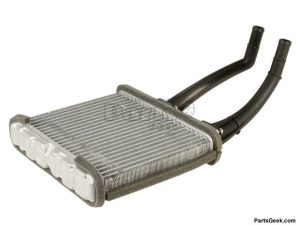
But – just like the big radiator – the little radiator eventually springs a leak (usually in winter) and when it does, you get a steambath rather than heat. The windshield and side glass fog up with a sticky coolant-saturated film and the carpet becomes a soggy, sodden mess that will eventually cause the car’s floorpans to rust out.
The only things you can do at this point are pinch the leak – by cutting off the flow of coolant to the heater core (which is done by disconnecting the hoses that run from the engine to the heater core), in which case the leak will stop but you will have no heat (or defroster).
Or you can replace the leaking core.
The latter often means taking apart the entire dashboard, to get at the core – and that is a job best left to professionals or extremely committed home mechanics with the patience and skill to do the job. The most teeth-aching aspect of this job is that core, itself, is typically just a $100 or so part and – once you take everything else off – it can be replaced in a few minutes with basic hand tools.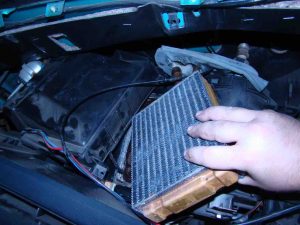
But first, you have to take everything else off. And then you have to put it all back together. That’s why – if you have to pay someone else to do this hideous job – a $100 part becomes a $1,500 (or more) repair.
Fuel pump replacement –
Back in the day – before the days of electronically fuel injected engines – changing out a fuel pump was typically as easy as removing two bolts (to remove the old pump, which was mounted on the engine) and then installing the new pump and tightening those two bolts. The job could be done with basic hand tools in less than half an hour – and for about $40 (for the new pump). 
Well, that’s changed.
Most late-model, fuel-injected vehicles have their fuel pumps located inside the gas tank. This means the gas tank must be removed, to get at the pump. There are work-arounds (if you’re willing to cut a hole in the trunk (or bed, if it’s a pick-up) to get at the pump from the top. But if not, then you’ll have to drop the tank – which is fun in the way boot camp is fun, if you’re into that kind of thing. 
It’s also often not $40 anymore, either. Some late-model vehicles have fuel pump assemblies rather than just a pump. The pump – itself – is usually just a simple electric motor, basically.
But if it’s part of an assembly, then – as OJ used to say – look out!
. . .
If you like what you’ve found here please consider supporting EPautos.
We depend on you to keep the wheels turning!
Our donate button is here.
If you prefer not to use PayPal, our mailing address is:
EPautos
721 Hummingbird Lane SE
Copper Hill, VA 24079
PS: Get an EPautos magnet or sticker or coaster in return for a $25 or more one-time donation or a $10 or more monthly recurring donation. (Please be sure to tell us you want a magnet or sticker or coaster – and also, provide an address, so we know where to mail the thing!)
If you’d like a Baaaaa hat or other EPautos gear, see here!










You want to know what’s a real challenge, changing the antifreeze in a 1967 VW Beetle….you have to buy a special metric/whitworth left handed open end wrench and then just pray….especially if you perform this operation on April 1.
Hi Eric,
These are things we can all agree on!
Question – the greaseman – is that the cover to a comedy special or comedy vynil album? Ive tried searching for the greaseman several times before but cannot find anything.
Here ya go Steve, https://en.wikipedia.org/wiki/Doug_Tracht
He was a radiio personality back in the day. He did silly radio skits. He did not last long in my local market but he had better traction in other areas of the US.
Hi Steve, I always remember this one and say it all time when I see people “waiting for the bus.”
@ 0:52 mark
https://youtu.be/RS8x98rw6Xs?si=lOOyD4Rk4fFy7nK0.
Indeed, Steve!
The Grease – as he was known to those of us who grew up listening to him on DC 101 in Washington, back in the ’80s – was a “shock jock” and one of the greats. Here is an example: https://www.youtube.com/watch?v=vNG47nRQJwE
Some modern special cases; 1). 2013-16 Ford Fusion headlight bulbs, take the whole front end apart. 2). Modern awd ford transit catalyst replacement. 3). Oil pump belt on any engine that uses a belt to drive the oil pump. I’m sure we could list tons of them.
manifold bolts, OMG….. never had a problem with them until all the compliance engines started coming out, around 2005’ish. While your heat cycle mention is accurate, it’s also very much about almost all cylinder heads being aluminum now. Can’t have an alum. stud, so you get galvanic (dissimilar metal) corrosion. One can mitigate this corrosion with a stud coating like anti-seize, but who takes apart a new engine?
Whoever works on old motorcycles will know when taking out a steel/ss bolt that’s into a alum part, it’s going to be coated in a white chalky material which is corrosion. Or if very old it might not come out at all, and it breaks.
On brand new motorcycles, I take out most of the steel or ss bolts that go into alum. (one at a time) and coat them with anti-seize. Takes an hour or so. Whoever buys my used bikes is a happy camper.
And always praying nothing leaks when all done. I’d be totally pissed to find out you got a bum heater core out of the box.
I thought about that, too!
I tried my best to be duly diligent, last time I had to do this job, about the core I bought. But it’s still a roll o’ the dice. The good news is that – having done this job on my old truck – I am now familiar with how to do it on this truck!
The late 70s GM downsized/midsized had a civilized HVAC design. The AC evaporator, fan motor and the heater core were in a box under the hood, not under the dash. The fan motor was out in the open on top, the heater core under a top cover again, once the cover was removed it slid vertically right out of the top. What a smart design.
The Commanders 71 Nova, non AC, was old school. You had to remove the RH fender well liner to get access, then the bolts all around the box, then back inside under the dash for the heater core, what a nightmare.
I changed a heater core on my then girlfriends old Valiant in the 70’s. I had never done one before until then and it wasn’t hard. I was much younger and more limber to lie on my back on the passenger floor board. Here father was some genius scientist who thought I was smart for figuring out how to do this. lol
Some years ago we had just bought a used Ford Escape from a dealer I knew. My wife drove it 90 miles and went to refuel at a gas station. When she filled it, gas ran out all over the ground. She called and asked if she should drive it home. I said HELL NO! It turns out that whoever had it before replaced the fuel pump but never replaced the bolt down top on the tank. YIKES!
To me, working on motorcycles has always been harder due to very cramped, condensed, tight spaces.
Hi Oregon,
Motorcycles are cramped to work on but at least you usually work on them without having to crawl around on your back! Getting a lift to work on my four wheeled vehicles was the smartest thing I have done in 20 years. I don’t think I’d be doing the conversion of my old Trans-Am from automatic to manual without it. Having some room to work when you’re not 20 anymore is priceless.
The problem with motorcycle wrenching, everything you touch is an appearance item. One slip of the wrench there goes a scratch across what was a beautiful chrome part.
When pulling the gas tank I wear gripper gloves and have towels around the “zone” to prevent a ‘slip & scratch’. I have an old cardboard booze box divider as the landing pad for the gas tank, won’t scratch the paint & the odd shape keeps the chrome fuel line bung off the floor.
The biggest pain in the ass has to be electrical short or draining can take all day just to find the circuit then check the entire circuit what a pain.
I had 1993 Lexus SC400 with about 32,000 miles when I bought it. That year car had a problem with the power steering pump leaking fluid onto the alternator and of course the alternator eventually burned out. I didn’t know this when I bought the car because the owner didn’t tell me. I was able to drive the car home but the next day the car wouldn’t start because the battery ran out. I used to charge the battery until I got tired of this procedure.
Anyway I decided to fix the power steering pump myself with an O ring kit. This didn’t work so I bought a new pump form Lexus for $450. Getting the pump off was a struggle as I had to buy an 18 inch breaker bar in order to get enough leverage. The 12 inch breaker bar didn’t do it. I worked on this fix for four weekends.
Some one in the neighborhood apparently called the police on me for operating a repair shop out of my garage. I told the police woman that this was my own private car and the car was always entirely inside the garage.
Some one also called the police on me when one of my cars was parked on my garage apron in the alley. I did go to court and won so did not have to pay the $150 fine.
Wow europeasant! Youhave some serious Karen infested HOA.
My pet peeve is replacing a headlight when it inevitably burns out. I have made that my “test” as to whether or not I buy a new transportation appliance. If I can’t change it in a 1/2 or less I will not buy the car. I guess it goes without saying that I have not bought a new car in years. Anybody know of a new or within a few model years transportation appliance with simple/easy to replace headlights?
I’ll give one more PIA repair that will make a country preacher go into a cussing tirade. That would be trying to locate parking lights shorting out every time a car hits some rough pavement.
I had that happen on my first car. My father and I tried for quite a while to trace the short with no luck and the parking lights kept on grounding out.
The day we found it was when my father out of frustration smacked his hand on the radiator reservoir mounted on the inside front passenger fender and the parking lights blew out.
The wire that ran to the parking lights had rubbed the insulation off and was grounding to the fender.
That’s hilarious, Allen!
I’ll raise you: I once owned a ’69 VW Squareback with the Bosch fuel injection system. This was I think the first mass-produced/mass-market FI systems offered – and it generally worked pretty well. Until it didn’t. My VW would sometimes just not start – and then it would. I couldn’t figure it out. One day, it would not start and I needed to get somewhere and in pissed exasperation, I kicked the mo’ fo’ hard in the driver’s side rear quarter panel. It jiggered/reset something and the VW started! I never figured out why…
I had a similar problem with my ‘91 Honda Civic, there was a relay under the dash that powered the fuel pump; drove me nuts until I found it and the cure was to flip the ignition on and off a couple times in quick succession and then it would make contact and run the pump.
That’s where the computer was. And those early Bosch systems could be stopped by being too close to a radio signal…
Getting to the back spark plugs on a transverse mounted V6 is a real PITA too.
And I swear Chrysler built the K-car around the oil filter.
The K car was pretty bad. I was a mechanic at the time, and had to cut out a frame member support to get the steering rack out. Welded it back the best I could, but that car did not have much longer to live anyway. And in those chrysler buyout days my hands always came out bloody because they just left the metal stampings raw and sharp.
I general any work on a car is a pain in the ass I got to do some soon not looking forward to it but at least the fuel pump was easy panel in the trunk lift it up and pump is right there cost $60 for complete assembly but the frame mounted filter was a bitch.
Many years ago, I did a heater core on a rotted-out ’81 Fairmont I got for $400. The job itself was a bitch, but was exacerbated by the fact that I did it in 5 degree weather in January in an unheated garage.
Fuel pumps vary in difficulty. On small pickups, it can be pretty easy if you unbolt the bed and move it out of the way. Larger trucks and cars where you have to drop the tank are much more grief.
Substandard conditions make many jobs worse than they already are. Cold, inadequate light, and lack of a lift can make working on cars suck. Rust can make even easy and straightforward jobs almost impossible, as you have to deal with rounded or seized fasteners, and you need to ad acetylene heat to the equation. You really don’t want to be torching off rusted gas tank straps to pull your tank to do your fuel pump in the middle of February. Plus the shit gets into your hair, eyes, etc. The other thing that sucks is when you NEED the car ASAP, so you are under pressure to fix it. If you are able to wait for favorable weather, and wait for a relaxing time to get it done, even challenging jobs can be rewarding.
Heater core in a non-air conditioned Fox Mustang is a 15 minute job through the glove box. A/C car – days….My ’89 is a “Summer Only” car as it failed but the AC is ice cold. My ’88 had the core replaced but now the AC leaks out in about 2 weeks after a charge, so its a Spring and Fall car ;).
For what it’s worth Steve, I’ve seen more than a few YouTube videos where they refill the system with propane. It does work but you need some accurate thermometers in the vents to hit the sweet spot but that will be your cheapest option. As for the leak; the appropriate dye and light/ glasses should let you find it. As it’s a slow leak it might just be an O-ring.
My ‘64 C10 heater core represents the pinnacle of automotive technology – the core and blower motor reside in their own separate box mounted to the firewall, requiring removal of a couple dozen sheet metal screws, and almost half an hour to replace either one or both.
Why the automakers cannot recreate 60+ year old technology simply eludes me. The literal worst job I’ve done with this truck was replacing the clutch, which took almost a full weekend working by myself with a really sketchy jack setup.
Yes, I did it on my 86 K5, 3 bolts holding the heater box, 2 hose clamps, 2 control wires for the manually activated flap. Very easy to do. I don’t have A/C though.
I changed the heater core in my Chevy (AC equipped) almost 40 years ago and everything still worked afterwards! To make it easier label each side of all electrical connectors and as digital cameras are now commonplace take lots of pictures so as to be able to route everything correctly. I’ve pulled fuel tanks from trucks before to change the pickup/ filter assembly and I highly recommend you make sure the tank is empty as it’s heavy when full….
My mechanic has said some car’s get scrapped if they need a tank and filler neck replaced as it can cost more than the cars worth.
Another “fun” job is wheel bearings in Subaru’s………..