


It’s gotten so that you almost can’t find a standard (or even optional) V6 engine in a new mid-sized pick-up anymore.
The Honda Ridgeline is one of just two that still comes standard with one. The rest no longer even offer one. And the Ridgeline’s not really a pick-up. At least not by the usual standards.
But that’s not necessarily a bad thing.

What It Is
The Ridgeline looks – and functions – like a mid-sized truck. It has a four-door crew cab and a standard five-foot bed, like most of the other mid-sized trucks currently on the market, including the Ford Ranger, Toyota Tacoma, Chevy Colorado/GMC Canyon.
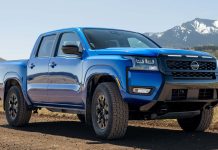
The Nissan Frontier is the only currently available mid-sized truck that’s still available with just to doors and a six foot bed.
But unlike the Frontier and all the others, the Ridgeline isn’t body-on-frame or rear-wheel-drive, with 4WD available – i.e., the things that traditionally define what a “truck” is. Rather, it shares a platform with the Honda Pilot, which is a FWD/AWD crossover – not that there’s anything wrong with that.
Unibody vehicles weigh less and so feel less heavy and they usually burn less gas – even with a bigger engine – by dint of that. And while 4WD is nice to have when it snows, FWD is pretty good in snow, too – and AWD is better in the rain than 4WD.
Still it’s nice to have a bed for carrying things around that would not fit inside a crossover or which you might not want inside, with you – such as a wet dog. And the Ridgeline’s standard V6 and 5,000 lb. tow rating give it most of the real-world capability of a body-on-frame truck without the feeling that you’re driving a heavy/ponderous truck.
Prices start at $40,795 for the base Sport trim, which comes standard with a 3.5 liter V6 paired with a nine-speed automatic, a class III hitch for towing and a five foot bed for hauling and standard AWD. The italics are to emphasize that 4WD costs extra in all of the Ridgeline’s mid-sized pick-up rivals.
There are five other trims – RTL ($43,595), TrailSport ($45,995), TrailSport with HPD wheels ($47,195), Black Edition ($47,395) and Black Two-Tone ($47,895) – which all come standard with the 3.5 V6/AWD. The RTL gets a standard sunroof, leather seat covers and a power sliding rear window. The TrailSport gets upgrades such as skid plates and all-terrain tires to give it some additional off-road capability. This trim also gets special orange interior stitching and navigation, among other upgrades. The HPD has a set of special Honda Performance Division wheels.
Top-of-the-line Black Edition trims get special black-themed styling tweaks plus heated rear seats, am upgraded audio system and red interior accents.
Though the Ridgeline can be compared with other mid-sized trucks, its unique layout makes it different enough to be considered in a class by itself.
What’s New For 2026
Other than a two-tone paint option (Black Edition) the Ridgeline carries over unchanged from last year.
What’s Good
Does most of the things a truck can, without actually being a truck.
Standard AWD gives a price (and traction) advantage over RWD pick-ups that cost extra with 4WD.
Standard V6 engine.
What’s Not So Good
AWD isn’t 4WD (no Low range gearing).
Can’t pull as much as a Ford Ranger or Chevy Colorado.
Honda Sensing “driver assistance” tech is standard, including Lane Keep Assist – which uses electric power steering to “correct” your steering when the system thinks it needs to be corrected. Some people understandably dislike this “assistance.”
Under The Hood
Every Ridgeline comes standard with Honda’s 3.5 liter V6, paired up with a nine speed automatic and standard AWD. This V6 – which touts 280 horsepower – is considered one of the most reliable and durable engines of the past 25 years, along with Toyota. 3.5 liter V6.
Interestingly, the Ridgeline – and the Pilot it’s related to – is the only new Honda still even available with a V6. The 3.5 liter V6 used to be optional in the Accord sedan, just as the Camry sedan used to be available with a 3.5 liter V6. The Accord is now four cylinder-only and the Camry is no more, having been replaced by the Crown – which comes standard with a turbocharged/hybrid-augmented four.
Even more interesting is that most of the mid-sized trucks the Ridgeline competes with are also four-cylinder-only now, including the Ford Ranger and Chevy Colorado and the Toyota Tacoma. These fours do make V6-comparable power – but only because they are boosted (by a turbo) and that means they are under more pressure to make comparable power, which usually doesn’t do a great deal for long-term durability. Honda’s 3.5 V6 doesn’t need boost – a turbo – to make the power that it does, so it is under less pressure and that probably has a great deal to do with the reputation it has earned for being an engine that can be counted on to run reliably for 250,000-plus miles if you change the oil regularly and don’t abuse it.
So why would Chevy and Ford and Toyota drop their comparably reliable V6 engines, which used to be available in trucks like the Colorado, Ranger and Tacoma? Well, because the turbo fours do better on the federal government’s fuel economy and emissions certification tests – because smaller engines, when not under boost, flow less air and so burn (and emit) less gas and that helps Chevy, Ford and Toyota comply with the federal regs. It is also why Honda no longer offers the excellent 3.5 V6 in the Accord – because the fewer such engines it offers, the better its Corporate Average Fuel Economy (CAFE) score – which is how the government measures compliance with the regs.
So why does Honda still offer the 3.5 V6 in the Ridgeline? Inertia, basically. The 2026 Ridgeline is basically six years old, having last been significantly updates back in 2017. Don’t be surprised if Honda replaces the 3.5 V6 with a turbo/hybrid-augmented four the next time it’s updated – which could be next year.
The only other vehicle in this class that also has a standard V6 is the Nissan Frontier. It’s anyone’s guess how much longer it will have it.
The Ridgeline is rates to pull up to 5,000 lbs. – which is not quite as much as the 7,500 lbs. other mid-such pickups such as the Ranger can pull – but it’s comparable to the maximum tow rating of the compact-sized trucks you can’t buy anymore (because no one makes them anymore) and sufficient to pull a medium-sized camper and so on.
On The Road
What makes the Ridgeline unique in the class is not that it’s the only one that isn’t really truck. It is that it doesn’t drive like one.
Much progress has been made toward getting a body-on-frame pickup to ride and handle more like a passenger car but so long as they are body-on-frame, they will likely always feel beefier, which of course has both good and bad aspects – functionally, too.
The reason why the Ford Ranger can tow as much as 7,500 lbs., is because what’s being pulled is hooked to a girder-like steel frame that is much harder to pull out of shape than a welded-together body and frame (i.e., a unibody). But body-on-frame vehicles are more prone to body movement when stressed – because the body rides on biscuits that sit on the frame as opposed to being a welded-together unit.
Truck suspensions are also truck suspensions. The Ridgeline’s is more crossover-like and that’s just another way of saying more car-like. It has struts up front rather than shocks and coils; there are also coil springs in back rather than leaf springs and solid rear axle, which allows the Honda’s rear wheels to articulate individually and also isolates pothole shock to the wheel that hits the pothole.
The downside – if it is one – is that the Ridge is not as sturdy as the body-on-frame/solid axle trucks it competes with. This doesn’t mean it’s fragile. It just means it’s not as hypothetically capable of absorbing extreme conditions, such as off-roading. If you don’t need to crawl up boulder-strewn fire roads, it’s not an actual weakness.
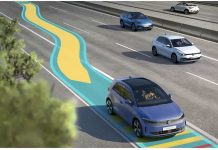
Arguably, the Honda’s only real-world weakness is its unavoidable (because standard) suite of “driver assistance” tech, especially Lane Keep Assist. This system is meant to keep the vehicle from wandering out of its travel lane, perhaps because the driver isn’t paying attention. But if you are paying attention, it can get annoying to feel the steering wheel regularly pulling against you when the system thinks you’re getting too close to a painted line – or because you didn’t signal before you began to turn off the road (or attempted to pass a slowpoke).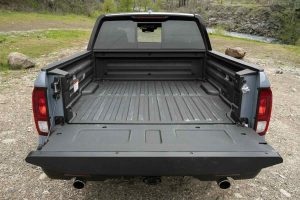
At The Curb
In at least one way, the Ridgeline is more truck than most of the others in the class: It has a larger, more useful bed. Not su much because of its length but because of its width and because of what’s under it.
That being additional (hidden) storage. 
Because it is not a truck, it does not have the usual humps on both sides of the bed that “real” trucks” have, to accommodate the rear tires – because it does not have the solid rear axle that “real” trucks have. These humps are why you cannot lay cargo as wide as the bed is flat in the bed of “real” trucks. But you can lay them flat in the Ridgeline’s bed, which makes it possible to carry more stacked things in the Ridgeline’s bed.
The bedwalls are also lower than the bedwalls of other trucks, making it easier to load and unload the bed.
And the bed covers another bed, which can hold additional cargo out of sight – and out of the weather. The spare is also in there, where it’s easier to get to. No need to crawl around on the dirt underneath the bed to get to the spare after lowering it down to the ground – as you have to do with most trucks, that have their spared mounted underneath the bed.
The Ridgeline’s cab is similar to other trucks in that there are four full-size doors and there’s a similarity to older trucks in that there’s still a dashboard with round gauges (speedometer and tach) rather than an LCD display, as all the newer-design trucks now have. It’s not as fancy but that’s arguably what’s appropriate in a truck.
Also bucking the trend is the Ridgeline’s face. Its not trying to look like Mount Rushmore bearing down on whatever’s in it path. People who are perhaps weary of the over macho’d Big and Bold look that has become common may prefer the Ridgeline’s less steroidal styling.
That said, like other mid-sized trucks, the Ridgeline’s (relatively) short bed in relation to its relatively long, crew cab body looks a little unbalanced. If Honda wanted to score some points, it might consider extending the bed to six feet – which is as long as the beds that came standard with compact-sized trucks used to be. This would even out the cab-bed proportions and give the Ridgeline significantly more everyday functional truck capabilities than its short-bedded rivals with the big humps in their beds.
The Rest
The Ridgeline’s secondary touchscreen is more user-friendly than many because the icons are very large and that makes them easier to tap while you’re driving.
The other nice thing about this truck in-all-but-fact is that Honda includes not just AWD as standard but also most of the features most people want – including a wireless phone charger and multiple USB power points – so it’s not necessary to pay extra for a more expensive trim to get them.
However, if you want navigation, you have to buy the Trailsport – along with all the additional off-road features (such as skid plates, off-road suspension tuning) and all-terrain tires that you may have no use for.
The Bottom Line
It’s not really a truck but in some ways it’s a better truck than the ones that are.
. . .
If you like what you’ve found here please consider supporting EPautos.
We depend on you to keep the wheels turning!
Our donate button is here.
If you prefer not to use PayPal, our mailing address is:
EPautos
721 Hummingbird Lane SE
Copper Hill, VA 24079
PS: Get an EPautos magnet or sticker or coaster in return for a $25 or more one-time donation or a $10 or more monthly recurring donation. (Please be sure to tell us you want a magnet or sticker or coaster – and also, provide an address, so we know where to mail the thing!)
If you’d like a Baaaaa hat or other EPautos gear, see here!








The Hondel Camino. I will pass.
At least this one made no bones about being a plain old passenger car, with an ample 6-foot bed out back:
https://hips.hearstapps.com/mtg-prod/65bdd7b30322270008fa6795/1959-chevy-el-camino-left-profile.jpg
Where would you like this load of plywood set down, guvnor?
Morning, Jim!
Yup. And the El Camino actually was a truck – in that it was body-on frame and RWD and V8 up front!
‘In December 1958, Ray Brock, HOT ROD’s technical editor, was in Chevy’s all-new 1959 El Camino for a comparison test with the Ford Ranchero.
‘While El Caminos could be equipped with any passenger car engine down to the 135 hp Stovebolt Six, Brock’s tester had the hottest motor available: a 348-cubic-inch W-series engine with 11:1 compression, a performance cam, and triple Rochesters, making a rated 315 hp and 356 lb-ft of torque. Backing that motor was an optional four-speed manual that came straight out of the Corvette parts bin.
‘That engine and transmission combo turned the El Camino into a “tiger,” Brock wrote in the Feb 1959 issue. At the Santa Ana dragstrip, the Camino clocked a 16.0-second quarter at 90 mph, though Brock figured that with steeper gears and Positraction the truck could trim two full seconds off the e.t. and add 10 mph.
‘Brock described the truck’s ride as “soft” and “easy” on average roads, though the “soft springing will allow the El Camino to lean in an alarming manner on corners.” But, he pointed out, “after reaching a heeled-over position, the El Camino will get a good grip on the road and go through the corners with good control and feel.”
https://www.hotrod.com/features/1959-el-camino-road-test
‘Heeled over,’ heh! Like a blowsy girlfriend. Yeah, that’s how I remember these old barges. Any econobox today could blow them away in a straight line, much less the curves. But a 348 c.i. V8 with three deuces suckin’ air and a 4-speed manual are a whole other story when it comes to FUN. That ain’t allowed no more. 🙁
I would never buy a new Honda seen a passport trailsport about shit $56k for a Honda and they still use a belt on that’s expensive to replace and only like Honda brand fluid there living of the name form the old days .
Musing on the cars that I’d had, that Honda 3.5 V6 brought a smile to my face when I recalled the experience driving my 2007 Acura TL. I’ve come to own more expensive and sophisticated cars than it and enjoyed driving them a lot, but that Honda engine, so eager to rev and to pull strongly, was a gem and only brought me joy. And, in case you’re wondering, no repairs for over the 130,000 mls. that I put on it.
One other reason for the V6 is Honda’s cylinder deactivation system. When cruising the engine will close the valves on two cylinders turning it into a V4. This means the engine is very unbalanced and requires active vibration dampening mounts. It was fairly common for the mounts to fail leading to an expensive repair. And because the deactivated cylinders are still moving, the vacuum created encourages oil to bypass the rings, leading to oil consumption. When I was looking at buying one some drivers were reporting up to a quart every time they filled the gas tank. Honda told them this was “normal.” Someone came up with a cheat attachment that would fool the computer into keeping all 6 pistons active all the time but I’m sure someone would question such a device if there were ever any warranty repairs needed.
After I found out a few years ago that Toyota was going full-hybrid on the Sienna van, I thought about replacing our 2004 Sienna with a Honda Odyssey, which still, at that time, had a V6 – no hybrid. I didn’t know about this cylinder deactivation system, and it sounds like nothing but trouble. Guess I’ll keep our Sienna until it can’t be fixed!
In that vein, does anyone have any thoughts on getting an older vehicle “restored” – essentially, gone over to determine any potential problems, getting them fixed, etc.? I am not a “wrench turner” so that’s not something I want to take on as a retirement hobby. Given the cost of a new vehicle, spending a significant amount to restore the vehicle to “near new” might be worth it. Especially given that I really like it!
B4lion,
Just my opinion – there is always a risk with used, but if a GOOD mechanic looks it over and can give you a list of pros & cons about a specific vehicle, engine & trans, I think used is always smarter.
Look for one with a history of reliability, with plenty of replacement parts that is easy (cheaper) to work on and treat it well. The sweet spot was late 90s to 2010 or so for many cars that would go 200,000 without serious issue.
Those are old now and hard to find in good shape. Even if you had to have a new engine & trans put in just to start fresh for $15k, you are still way under the price of a new car.
Thanks. That’s the problem – finding a good mechanic. My wife has always insisted on taking our vehicles to the dealer for service – but even she has of late become skeptical of their “scheduled maintenance” “advice.” They lost me when they wanted to change my power steering fluid – and I told them that my car has electric power steering assist and doesn’t have fluid! I let my son do minor maintenance now, such as changing the oil.
It may only be an anomaly, but we bought our 2011 Honda Pilot in 2012 with 25,000 miles on it. Over the years, after 200,000+ additional miles of vacations and kid hauling, I can honestly say that the only expenses I’ve ever incurred with this vehicle is an alternator replacement, general maintenance and a paint refresh. It doesn’t drip a drop of fluid and the oil is always close to full at every oil change.
I’m finally starting to feel it’s age while driving it, and it saddens me that it will have to be replaced some day. It’s been the most reliable damn vehicle I’ve ever owned.
‘Honda … might consider extending the bed to six feet.’ — eric
What a shame that every pickup truck manufacturer has coalesced on a ‘one size fits all’ configuration of 4-door crew cab and 5-foot bed.
I have zero use for a 4-door crew cab. A 2-door cab with 6-foot bed works for me. But no one will sell me a new one anymore.
So the old pickup, which also has a 5-speed manual, will soldier on, as I disdainfully turn up my nose at shiny new commoditized baubles like the Ridgeline that I don’t want, don’t want, don’t want at any price, including free.
Take it away!!
You can still get full size trucks like this. I’ve been thinking my next truck might have to be a F250 regular cab, 8 foot bed, 6.7L V8. You get your choice of axle ratios and locker.
With 4WD and XL trim it comes to $51.5K which is around $10K premium over the Ranger XL with optional locker but is a real truck at least.
I used to have a regular cab 1992 Toyota pickup with the long bed, which was only 7 feet. It was small, I don’t miss it all that much. I have an XtraCab Tacoma now and the 6 foot bed is barely useful.
Small trucks are small trucks, there’s no way around it. They’ve always been fine to carry dirt bikes or for weekend homeowner stuff, what I’d call “lifestyle” trucks rather than real trucks.
I’m curious why you compared it to the Ranger and Colorado instead of the Maverick and the Santa Cruz?
Hi Chris,
The Honda is mid-size; the Maverick and Santa Cruz are compacts! I wish the Maverick were available with a base (no turbo, no hybrid) four and a six speed. Sell it for $20k like Ford originally said they would…
ohhh, sorry, IDK the Honda was bigger than those. They look about the same size to me. Thx
That’s a common thing to do based on size. The Ridgeline is a unibody truck and despite the size it’s two different classes comparing it to the Frontier/Tacoma/Ranger segment in my mind. Might be biased but I think a truck should be body on frame. Although the commercial vans like the Ford Transit are unibody and they seem to be fine.
I didn’t even know the transit is uni-body and we’ve owned one for a year! I guess I don’t get under them anymore.
And we’re very impressed with it. We got the mid length, mid height T250, 3.5T, awd. The darn thing handles, rides good and is pretty quick. Somewhat old school inside but a breath of fresh air.
Will it go 200k miles? I doubt it.
At 41 grand, it is almost as expensive as a 3/4 ton base Silverado, standard cab with an 8 foot bed and 400 cubic inch LT.
Yeah, the price set me back on my heels. Low to mid 30s, I was thinking. But that’s so 2023! 🙁