

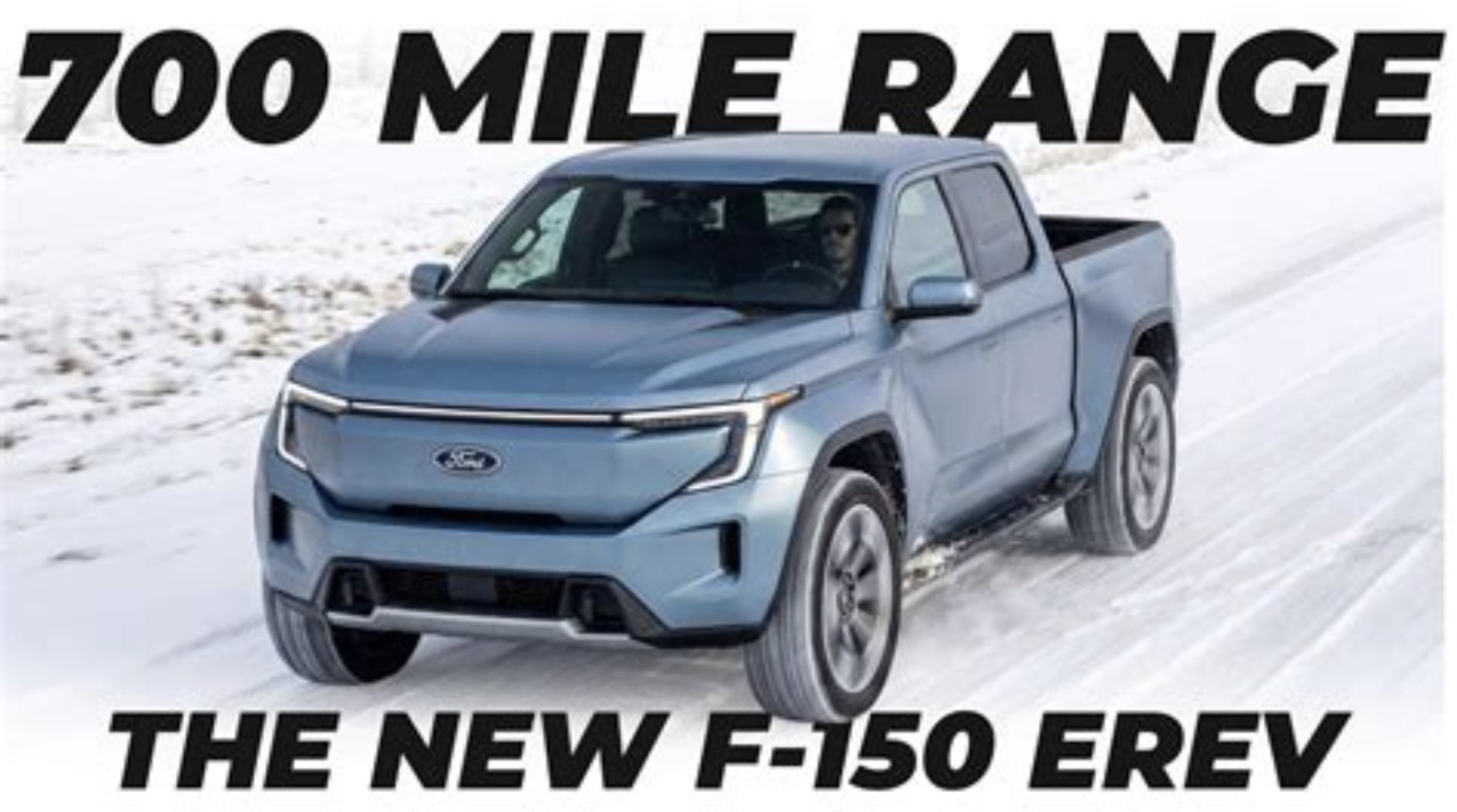

Does it make any sense – economically, even “environmentally” – to lug around several hundred pounds of gas-burning engine (plus, of course, the gas) in order to reduce the amount of gas you burn in a three-ton vehicle? When put this way, it doesn’t sound like it does. So Ford – and it’s not just Ford – puts it a different way.
Extended Range Electric Vehicle – EREV, if you prefer the acronym.
According to Motor Trend, “Ford says its next-generation F-150 Lightning will come equipped with an EREV powertrain that will utilize a large battery pack, electric motors, and an internal combustion engine as a power generator.”
Italics added.
Lugging around an engine will “solve” the problem that beset the Lightning that Ford just cancelled after a debacle-icious three-year production run that saw many built but few sold (and every one that did eventually get sold cost Ford about $20,000) by enabling the “next generation” Lightning to at least be used as a truck more than intermittently, in between long periods of inertness while it gradually recovers charge. 
When Ford sent me a Lightning to test drive (reviewed here) I tried to use it as someone who bought a full-size truck that touted its ability to tow might have used it – to tow stuff. So I hooked up a trailer and drove a car onto the trailer and took the Lightning down the road. I didn’t get very far down the road. About 100 miles before getting close to “e” – which in an EV means something different than it does when you’re running low on gas. I spent about an hour at a commercial “fast” charger and in return I got about 100 miles of range (charge) back. More would have taken longer.
You see the problem. Well, one of them.
The pending F-150 EREV will supposedly be able to go much farther – up to 700 miles is the word. That would be farther than a gas-engined F-150 can go, so adding several hundred pounds of gas burning engine to the mix does solve that problem, in that now at least it’s no longer an hour-or-longer wait to get back on the road again. You can pump gas into the EREV’s tank just as quickly as you could pump it into the tank of any other vehicle with a gas tank.
The range problem is also addressed in that you’re not tethered to a cord anymore. An EREV is basically a plug-in hybrid that plugs into itself.
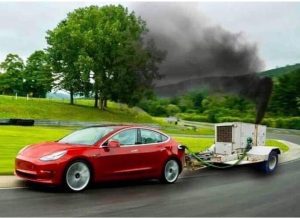
But Ford could have just increased the F-150’s tank capacity to 30 gallons and accomplished the same thing without creating new problems, the first of which is the several hundred pounds of engine that is in fact a portable generator that will have to be lugged around, in addition to the weight of the EV battery pack.
This increase range, yes – but it also reduces efficiency. It means burning more gas and more electricity, which seems contrary to the (supposed) object of this exercise. If that object is to decrease rather than increase the overall consumption of energy – as well as resources.
It also seems at odds with the supposed object of “electrifying” a vehicle, which was – so they told us – to reduce exhaust emissions to zero. As by eliminating exhaust (at the tailpipe, at least). EREVs will sport tailpipes. Granted, they will not be as big as the tailpipes (plural) of a big V8 – which is what you’d typically use to power a big truck – but a tailpipe nonetheless. There will also necessarily be oil – in the engine – and other such things that, as in any vehicle with an engine, will need to be changed out periodically. Brakes and tires will likely have to be replaced sooner, too – on account of the additional weight.
There is also – of course – the cost.
This was one of the kiboshed Lightning’s biggest problems – after the range/recharge (time suck) problems. It cost around $15k more to start than a non-electric F-150, which matters to most people because most people need to worry about money. Well, how much more will it add to the cost of the “next generation” Lightning to embed a gas-burning engine and all the peripherals (i.e, everything associated with the fuel system, including a gas tank and lines, etc. as well as an exhaust system and a cooling system, plus the wiring and peripherals)?
It won’t be nothing, that’s for sure.
If it seems like a problem in the making, you’re not alone in thinking that. It is a “solution” to a “problem” of Ford’s own making – that being pretending it is good for the environment (that it is necessary, for the environment) to make vehicles that are overweight and overconsumptive of energy and resources. 
There’s a better solution.
One that would not create such problems. One that would actually be good for the environment. Ford could build some lightweight, high-efficiency vehicles – like it used to, in the Before Time. A truck like the Ranger that Ford used to sell as recently as 2011, for instance. It weighed less than half what a Lightning did and so wasn’t as wasteful of either energy or natural resources. Best of all, it only cost about a third of what a Lightning does. So lots pf people could afford to buy them.
It had a tailpipe, of course. But it also had a small gas engine – sort of like the one in an EREV but without the 1,500-2,000 pounds of batteries to lug along. Ford used to sell hundreds of thousands of the old Ranger, which meant lots of people were driving efficient, good-for-the-environment vehicles that had the added virtue of lasting for 20 years or longer, which is also very good for the environment.
Assuming, of course, that’s the object of the exercise.
. . .
If you like what you’ve found here please consider supporting EPautos.
We depend on you to keep the wheels turning!
Our donate button is here.
If you prefer not to use PayPal, our mailing address is:
EPautos
721 Hummingbird Lane SE
Copper Hill, VA 24079
PS: Get an EPautos magnet or sticker or coaster in return for a $25 or more one-time donation or a $10 or more monthly recurring donation. (Please be sure to tell us you want a magnet or sticker or coaster – and also, provide an address, so we know where to mail the thing!)
If you’d like a Baaaaa hat or other EPautos gear, see here!










[…] https://www.ericpetersautos.com/2026/04/21/how-not-to-save-gas-or-the-environment/ […]
Is it my overactive imagination, or does that F150 look like it’s wearing a mask over it’s “face”? It covers the grille, which an ICE vehicle uses to “breathe”, and partially covers the eyes/headlights.
More and more, I’m not compatible with the modern world.
Indeed, as if ashamed of what he’d become.
Oh mang, I was shocked to learn the 2010 f-150 had air bags in front, on the sides, and in the friggin’ ceiling. Like ants, or termites.
Oh boy, and don’t even get me started on power steering assist on 2011 and up, …let alone A.S.S.
The A.F.M. infected so many others,… it’s Tribbles, only, it’s Not funny.
I can’t wait to learn about the other un-fun ruinous shit I didn’t know about which they imposed upon us.
It’s only about efficiency insofar as it affects operating costs.
These EREVs are targets towards commercial users and with fleet vehicles fuel costs are your biggest operating expense.
At residential rates here running a vehicle on electricity costs under 1/3 versus gasoline, and commercial rates are even cheaper.
Looking at a recent reddit thread, the current F-150 gets a whopping 16-19 mpg city depending on the engine chosen…and for commercial use I wouldn’t pick EcoBoost.
As long as paying the extra upfront cost saves enough gasoline over the truck’s life it is absolutely worth it to pay more upfront for an EREV with a big battery and an electric generator tuned to run at optimal efficiency versus a naturally aspirated engine whose efficiency varies widely over the range of output it has to produce.
Gents, the hybrid diesel electric has already been made and sold in Europe…..
How successful it is at efficiency is another story..
Buy one now!…
https://www.cazoo.co.uk/cars/hybrid-diesel/
Now if we can only invent a car engine that can run on a politician’s bull shit? We would never run out of fuel.
OK, gasoline – around 33.7kWh equivalent per US gallon, weighs about 6 pounds – 5.6 kWh/pound, or 12.4kWh per kg.
Lithium ion batteries – 0.150 kWh per kg (for the battery packs used in EVs).
Gasoline contains around 83 times more energy per unit mass than lithium ion battery packs.
The equivalent of 20 gallons of gasoline, about 120 lbs., requires a (new) lithium ion battery pack that weighs at least 9920 lbs. – just the battery pack. 9920 lbs.
Sure, the electric motors are more efficient than internal combustion engines, so maybe you only need a 200kWh battery to achieve the same range that a normal truck gets from 20 gallons of gas. A 200kWh battery pack? Still about 2900 lbs.
Electric and hybrid-electric vehicles are not a solution to anything. They’re problems in search of victims.
The bottom line is that the battery packs simply can’t do the job as well as gasoline or diesel fuel, and there is no suggestion this will change any time soon (if ever).
Good analysis. But while that gas engine is around 35% efficient, and loses a bit due to drivetrain losses and waste on deceleration/braking, the 70-80% efficient electric motor loses a lot more in generation, transmission, and transformation losses. When you work through the whole thing, the efficiencies are pretty much a wash. Plus the actual pollution from running an extra 2-3000 lbs of batteries around on rubber tires. Tire dust pollution is a bigger deal than exhaust by far.
Yeah, overall it’s a wash with efficiency between EV and IC, when you consider the whole generation and transmission chain for the EV.
I was mainly interested in how big a battery you would need to give equivalent range, and just on its face, it isn’t reasonable. As you add in consideration of other factors (tire wear and the like), the EVs look worse and worse.
Eric, I think you’ll find this interesting: https://www.motorbiscuit.com/a-2000-tesla-model-3-became-a-youtube-go-kart-then-the-software-woke-up/
Basically, this guy bought basic Tesla guts for a relatively low price and drove around for a while, but eventually the software “bricked” him
This isn’t unique to Telsas or EVs. Porsche (or someone) bricked all their cars in Russia in December 2025. Gas powered or not when a device can call home it’s possible to brick them remotely and this is a features that dates back to OnStar in Cadillacs back to something like 2009 at least.
Hi Kyle,
Yup. Back in the early 2000s, I was driving a GM press loaner car with gusto up Bent Mountain – a series of “S” curves in my area. I got the tail out a little and was having fun when all of a sudden a woman’s voice intruded – asking whether I needed assistance. It was not my then-wife’s voice. It was the voice of the Onstar operator. The car had registered high G forces and narced on me. It was a very red pill moment for me.
Might as well just put tires on a locomotive 😆. Same principle – diesel engine runs a generator that powers electric motors; just need to downsize it a bit.
At least with that you could ditch most of the batteries (and the weight and expense). They could also have an optional diesel engine too.
Electric motors have plenty of torque and power which would be great for a pickup. They just have to get over the idea that the engine has to be off when it operating. Just let it be on, and ditch the stupid batteries which are the achilles heel of electric.
Guessing even a no battery loco style pickup would still be far more expensive than just having that V8 powered truck.
There is a whole subculture I’ve flirted with where guys put medium and heavy truck diesels in pickups. Dropping a 2500 lb screaming Jimmy in where a 700 lb Chevy rat motor used to live is kind of cool, and arguably more practical than an EV. 1000 plus ft lbs and still mid teens to low 20s for mileage.
If your goal is to reduce emissions, the only way to do this is to Burn Less Fuel.
The 2011 Ford Ranger did just that—from its manufacturing to its scrapping. Being a relatively small and light vehicle, it required a lot less steel, aluminum, glass, rubber, and plastics to build than an EREV truck—and it needed little to no lithium, cobalt, or other rare earth minerals. It easily lasted for 10, 15, or even 20 years, and during that time, it did not burn a lot of fuel, nor did it use much motor oil, coolant, brake, transmission, or power steering fluid. It could be easily repaired, and even an engine or transmission failure was relatively easily fixed. What’s more, any body damage from rust or wrecks could also be easily fixed. It came with only two airbags, both of which were easily replaced if they went off. And when it was time to scrap the truck, almost all parts could be easily recycled.
None of this is true of the EREV.
Rube Goldberg lives!
A 2011 Ranger is way more total efficient and has less overall emissions than these stupid new EV-engine trucks. I wish someone would do research/study on overall total efficiency/emissions on the difference. Everything: manufacturing, owning, etc… Add in reliability and longevity and the old ranger would blow it away even more.
We currently have a stray of execution with some regs being rolled back, but it won’t last if/when the next biden gets in. Manufactures have to play the middle, but also are contempt in playing the lobbyist game to limit competition.
Farley and Mary would have been axed years ago from their first debacle back in the day. Now, stockholders give them bonuses. Every stockholder is like a Minnesotan, getting it good and hard just like they voted for.
I guess this dumb-assery is basically the new “compliance car”….
On another note – Have you seen some of the Chinese cars yet Eric ? Are you guys getting them in America ? While not actually to my taste – i am impressed by some of them, the features, and the price !
Can’t get enough of the photo showing the Tesla towing a trailer with a generator!
What is the difference between an EREV and a Hybrid? Maybe for thinks that changing the nomenclature will result in more slaes?
Hi Steve,
It’s kind of a hair-splitting thing. “Normal” hybrids use the engine primarily to propel the vehicle; the battery/motor side provide accessory power when the vehicle isn’t actually moving and supplement the power of the engine during acceleration, etc. The engine also charges the battery; more finely, maintains its charge. Som hybrids can be charged externally, via plugging them in. But they are still primarily propelled by the engine.
In an EREV, the engine doesn’t actually (directly) propel the vehicle; it is there to keep the battery pack charged.The electric motors are what move the vehicle.
>The electric motors are what move the vehicle.
Well, that is the way Diesel-electric railroad locomotives work.
Somewhere in Heaven; Michael Maltese who collaborated with Chuck Jones the creator of the Wile E. Coyote cartoons are laughing their asses off because the EREV is the sort of thing that Wile E. Coyote would have designed and built. As Ford pats themselves on the back for their latest effort before channeling Rube Goldberg for ideas to improve it further.
Luckily its fuel economy will be low enough that there probably won’t be a problem caused by E15 gas. Too lazy to look it up but since it’s on a vehicle and can power the vehicle is it required to meet vehicle emission standards, in other words might it not need fuel injection, EGR, catalytic converter, etc?
Henry Ford is spinning in his grave even faster now.
Here’s a bet that Ford uses a little 1.2-liter three-cylinder to drive the generator. It’s well-balanced and running at near-constant speed, can be highly fuel efficient with low emissions.
Maybe Lightning Jim Farley will hook up a gas mask to the tailpipe on a flexible hose, and fasten it to his face to demonstrate how clean it is. Go, Jim, go! It’s an idiot’s last stand.
A 1.2L is not enough to power what the truck needs to do (drive-tow). yes it can charge the battery a little, but the needed output of the truck is way more than a 1.2L generator can make.
Ram had? their 3.6L powering a generator in their Ramcharger? IDK if it’s going to be made or not.
I was thinking of a ‘limp’ mode — just enough auxiliary power to propel the vehicle at 60 mph to the next charging station. It would save weight, compared to a big 3.6L engine combined with a 2,000-lb battery.
*smacks forehead with palm*
Oh wait, what am I on about? Nobody cares about vehicles weighing 6,000 or 8,000 lbs anymore!
Why are there so many idiots on this site that speak with authority but have no idea what they are talking about?
A 1.2L engine is capable of 100 HP.
100 HP will easily power a 50-60kW generator which is more than enough to charge any EV battery and to power the electric drive motors simultaneously. You don’t need a 3.6L engine to do this.
Stop being a classic American douche and do little research before posting absolute bullshit that you know nothing about.
Forget the politics, also forget for the moment value and economics.
The current Lightning is said to do about 2.1 miles per kW-hr. For the sake of argument say you do 70 MPH thus need about 33.3 kW-hr per hour.
It takes about 14 HP to generate 10kW so you’d need about a 42 HP engine (or equivalent steam, hydro, nuke, etc work).
There are advantages to doing it this way over a hybrid. One is the ICE is always running at peak efficiency, so you use the smallest amount of gasoline per unit of energy.
Another is an all electric drivetrain has the most torque of any system. Electric motors are highly efficient in this regard, too.
All of this is why railroad locomotives are done this way.
It’s a fair question to ask if it’s worth it for a car like this, though. A diesel-electric locomotive is relatively simple and has an economy of scale. It’s really the only practical way to address the problem they faced.
In a truck like this the torque might be nice. But is it worth the complexity and cost? Total cost of ownership and reliability is very likely not going to work out.
Without all the regulations and politics that cloud the business decision if there was a market reason to do it the essential technology has existed for 70 years to do it but yet it never was.
What I don’t understand is why no one has thought to try this with a very small diesel engine, perhaps a 3-cylinder Yanmar. You’d get well over 100 MPG without a doubt. There might even be a use case for diesel-electric medium and heavy duty trucks, which are not all that different from a scaled down train.
According to Google AI (which, admittedly, doesn’t always know everything), a non-turbo 1.2L engine provides 80-85 HP. A turbo 1.2L provides north of 100 HP.
My question is, why is an “EV battery” needed? Why not just have a standard battery (for starting, accessories without engine running, etc.) and run the electric drive motors directly via the generator? That way, the additional weight of the “EV battery” is forgone (along with the cost of replacing it), which theoretically should provide even better “mileage.”
It should not be necessary to have a large battery if you have a generator that’s sufficiently sized. You need some battery storage to buffer the generator from the load.
There will be times the motor demands a lot more power than the generator can make directly, such as starting and accelerating, and other times the motor will use significantly less. So you need to store energy for those transients.
You also want to be able to store as much of the regenerative energy you can from braking, that’s really a key part of system efficiency over a car that dissipates the braking as only heat.
It would have to larger than what you find in a hybrid but not really that much. The only reason to have a relatively ‘large battery’ is political so it can move completely on it’s own under battery power.
Personal insults aside, yes, I raced 1.0L engines with more HP, so I know a little. To be fair, I didn’t explain why it wouldn’t work, so here it goes. That 1.2L would need to be screaming to do it, and no one would buy a car/truck with it’s ‘generator’ running at 4000-6000rpm to go down the road. It doesn’t work if it doesn’t sell.
And I’ll wager why Ram was considering using their 3.6 NA which could do the deed at 1500-2000rpm and much quieter.
And I won’t even call you a name. Maybe you should do a little ‘research’ on Manufacturing, Engineering, Sales……….. I do all of it, but how would you know? You’d rather bitch than ask relevant questions.
Generators in this class will usually run at 1800 or 3600 RPM due to the fact that these are native speeds to generate 60Hz AC. In this case there’s no restriction to stay to that.
There is an advantage here to diesel because it can make it’s power lower in RPM. Again, I don’t know why no one’s tried to do this with diesel, especially for big over the road trucks it might actually work. Overall a diesel generator would be similar in noise to any other car.
Using gasoline you need the engine RPM to be higher but you can do an inverter instead of a synchronous generator, so you wouldn’t be locked to 3600 RPM and could throttle up and down. Honda does this up to 10kW and their largest generator is around 70 dB at full load. This is without any of the mechanical isolation or muffler that would be used if the engine was placed in a car. Most cars end up around 55 to 60 dB on the highway and there’s no reason to suspect this would seem much different on the highway using the engine as a generator.
In town the noise could be offensive, but having a battery to buffer and an inverter means the engine could throttle down much like Honda does, too. Hard to say for sure since this is all a thought experiment and obviously the market is either true believers wouldn’t care or people who will never buy a gasoline-electric car so even one Decibel over what they have now would be a hard no.
Appreciate it Kyle. My angst was to SMH for bitching instead of having a decent dialog.
Yes, anything is possible, but it’s way more than that. It’s what people will buy too.
Prius is 1.5L 50Kw gen., successful car.
I concede it’s possible with a 1.2L but there would be many compromises such as:
Would it be able to power the car to drive on it’s on on gas (probably not)? And why I said, partially charge.
It limits it’s application to compact cars only, and likely even smaller than a Prius.
Ramcharger was proposed to be 3.6L, 130Kw (to make it drive down the road), as an example of something bigger.
Higher-end commercial generators (yes must be synchronous speeds for 60Hz):
Cummins 50kw LP/NG is 5.9L 6-cyl.
Generac 50kw diesel is 3.4L, 4cyl, 50kw.
A Prius is a hybrid rather than generator-electric. The engine can move the car by itself, so necessarily is bigger.
What you can’t get around is that if you use a smaller engine that never is asked to do 1:1 motivation you must then replace the engine with sufficiently sized electric motor and battery that can. Not suggesting physics still doesn’t dictate.
Still, yeah, it’s a fair assessment but using standby generators isn’t an exact comparison. They’re locked to 60Hz and standard voltages.
These vehicles don’t need to adhere to the grid, which explains why the Prius can get this much energy from 1/4 the space of a Cummins RS50. It’s doing 650V at several KHz, which they rectify into their required DC.
If you run the numbers to keep a F150 sized vehicle at 70 MPH you need about 43 HP, which is roughly 32 kW. If you want roughly level 2 home charging you will have about 18 kW left over from a 50 kW generator. You don’t need 90 kW-hr batteries here. The buffering battery needs to dump 200 HP or 150 kW for 30 seconds to get up to speed. A 10 kW-hr battery gets you 600 kW-minutes and that energy could be recovered completely traveling for 30 minutes on the Interstate.
The generator would be larger than a Prius but would not have to be full industrial/backup sized either. The better physical comparison would 50kW solar inverters.
I’m not disputing your point but neither am I saying 1.2L is absolutely big enough. It seems small if for no other reason from a reliability standpoint it’s asking a lot. The Cummins uses those big engines because it’s very low stress on it and it can run indefinitely (which I do absolutely agree is a concern). As important is they pick off the shelf engines they already make and would have distribution and service channels to support. They’d have a mutiny on their hands if they made a custom engine that walks away from the decades of trucks, equipment and generators already in the field.
Forgot to mention the rest of the thought. That HP number is based on standard assumption for drag and rolling resistance for a 5500 lbs vehicle. If you’re towing, such as you will with a truck, it obviously goes up.
I have no idea if this new “EREV” F150 has any more validity than the Lightning in the real world.
Just saying it’s not necessarily harebrained either. The numbers suggest a modest sized engine into a realizable generator could do this if you have honest expectations. It won’t be a 600 HP monster but it could do the work.
Whether it’s worth it or not, that’s an economic decision. I honestly think it could be for a moving large loads. They waste a lot of energy with big engine to get 80,000 lbs moving and waste a lot slowing it down. They travel long distances at fixed speeds.
It’s literally the same as a locomotive in a lot of ways.
For a general use vehicle I don’t know if the economics suggest it’s worth the cost and complexity. I think Prius hybrid application works better if you want to shave peaks and eek out efficiency.
There really is no world where all electric makes sense in value/performance. It’s only a thing politically. Although there is a case to be made for EV as pollution displacement. It’s actually a complexity reduction to move the prime mover to a power plant with it’s associated catalytic converters rather than distributed on thousands of individual commuter cars. No matter who you are politically no one wants to live with pollution. If they sold them like Leafs based on this and allowed the market to spread the cost it probably would actually favor an EV. But they’d have to remove subsidies and regulations, let power companies figure out the best way to generate electricity rather than some pinhead bureaucrats with no useful skills.
Kyle – appreciate you being a voice of logic, reason, and having some understanding of the technology behind the discussion.
ChrisIN
“ I concede it’s possible with a 1.2L but there would be many compromises such as:
Would it be able to power the car to drive on it’s on on gas (probably not)?”
The Ford EREV is not intended to have the gasoline engine providing any locomotion to the vehicle. The generator only serves to power the battery and electric motors. Regardless of the EREV designation, the EREV is basically a series hybrid.
“ Higher-end commercial generators (yes must be synchronous speeds for 60Hz)”
You are not understanding the technology at play here. EV motors are 3 phase AC. All EV (or EREV) power electronics are producing synthetic power. They take in AC or DC and produce a stable, desired 3 phase AC output. They are not dependent on output directly from the battery or a generator.
Kyle is correct as he’s laid it out. The power electronics can modulate the generator, as well as directing the output current flow where that is from the battery, the generator, or a combination of both simultaneously.
The RAM EREV has a 3.6L and a 130kW generator in addition to a large 90+kW hour battery mainly because it’s trying to produce 600+ HP and something like 615 lb-ft of torque. Not because a truck needs this much power to operate or even tow, but simply for chest thumping that defeats the whole purpose of a work truck or an EV to “save the environment”.
‘For Ford, pivoting to EREVs will mean pivoting away from its all-electric powered Ford F-150 Lightning, our 2023 Truck of the Year, which was recently discontinued.’ — Motor Trend
HA HA HA HA … Motor Trend’s Truck of the Year was discontinued, because nobody wanted it. Effing woke clowns.
‘Keeping the frunk when the EREV arrives will be a challenge. It’s almost certain that the range-extending engine will take up the entire space under the hood.’ — Motor Trend
HA HA HA HA … why do vehicles have hoods? Cuz that’s where the engine goes, effing woke clowns.
‘Once there’s a power generator making racket under the hood, it’ll be tougher to isolate cabin noise, harshness, and vibration when the engine fires up.’ — Motor Trend
HA HA HA HA … a so-called car buff magazine considers the sound of an engine a ‘racket.’ Effing woke clowns.
‘The F-150 Lightning was great at towing—that is for the short distances that it could.’ — Motor Trend
HA HA HA HA … just like I’m a champ marathon runner — until I poop out after the first mile. Effing woke clowns.
‘The discontinued F-150 Lightning came equipped with a standard 12.0-inch digital instrument panel for all trims and a standard 12.0-inch touchscreen. Higher-end models were available with Ford’s vertically oriented 15.5-inch touchscreen. But we’ve found that the system often struggles to deliver consistently smooth animations.’ — Motor Trend
HA HA HA HA … bigger douchescreens! I don’t even know what ‘animations’ means in a pickup truck context. Effing woke clowns.
‘Ford went as far as texturing the plastics [gasp!], which helped furnish the interior with a more stylish appearance. But the overall quality and feel of the materials doesn’t come close to the Rivian R1T. We’d like to see Ford pick up its game inside, especially if the new truck moves in an upscale [sic] direction.’ — Motor Trend
Texture the plastics, bitchez! Then charge $80K for a truck with upscale upholstery. Effing woke clowns!
As a lad in short pants, I grew up on Motor Trend instead of My Weekly Reader. As you can see from the above unhinged rant, it left me with permanent brain damage. Or maybe they are the ones who went psycho. Effing woke clowns!
The good news is that Motor Trend will stay in business, the entire work force is to terminated and replaced by an AI called Motorend.
>I don’t even know what ‘animations’ means in a pickup truck context.
So the (very few) loons who want one can watch Looney Tunes instead of the road?
The human “driver” (still the Responsible Party) can watch cartoons while the AI drives the vehicle.