


Not everyone is a car guy – but everyone who has a car ought to know a few basic things about cars. A little knowledge save you a lot of trouble.
Front brake pads wear faster than rear brake pads – 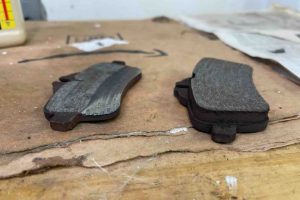
This may seem counterintuitive; don’t all four brakes work to stop the car? Yes. But the front brakes do most (about 70 percent) of the stopping, chiefly on account of the fact that when you apply the brakes, the weight of the vehicle shifts forward; that’s why front brake pads wear out sooner than rear brake pads (or shoes, if your car has drum rear brakes).
And that’s why you ought to remember to check – or have someone else check – your front brakes first. How often? Brake pad life varies from vehicle to vehicle and driver to driver, because there are many variables, including your braking habits – but as a general rule, a set of new pads should last about 30,000 miles. They might last a lot longer – but checking their condition at around that mileage mark is a good idea, to avoid them wearing down to the point that the pads are worn out and begin to dig into the rotors – which are the discs that the pads clamp onto, creating the frictiont hat is what slows and stops your car.
That way you’ll probably avoid having to replace more than just the pads. If you don’t check – of you forget – the brakes will remind you, with unpleasant noises. If you hear them, you’ll probably be paying for new rotors on top of the pads.
Short sidewall “sport” tires can be flat and not look flat – 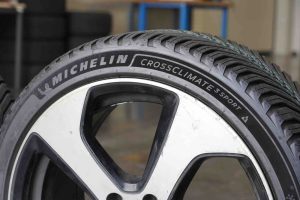
Many modern vehicles have what are called “sport” (or “summer”) tires. These are tires with short, stiff sidewalls, which don’t flex as much as taller sidewalls and that sharpens up steering response and improves handling feel.
One of the downsides of these kinds of tires – in addition to their greater vulnerability to blowouts – is that it’s hard to tell by looking at them whether they’re low on air or even flat. A compounding problem is that while all new and late-model vehicles have tire pressure monitors, these sometimes tell you a tire is low on air when it isn’t, due to a a bad tire pressure sensor or some other issue. This causes people to ignore the “low tire pressure” light that comes on, especially if the tire looks ok. Manually verifying the actual pressure at least once a month with a tire pressure gauge is important for that reason. It’s easy to do and everyone ought to know how to do it. It’s also a good idea to keep a can of Fix-a-Flat inflator in the car for just-in-case flats; finding an air pump is not as easy as it used to be because gas stations are no longer service stations and many just have snacks, not air.
There is no such thing as “lifetime” transmission fluid or engine coolant – 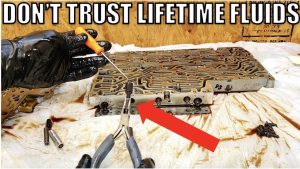
One of the greatest – and greasiest – marketing cons of the past 25 years is this “lifetime” fluids business.
It’s dishonest for the same reason that ads that promise you’ll save “as much as 80 percent” on whatever-it-is are dishonest because probably you’ll be saving a lot less than 80 percent, if you save anything at all. “Lifetime” – in the automotive fluids context – does not mean forever or even the life of the vehicle. It means as long as the warranty coverage lasts. That can be a pretty short lifetime. The greasy part is that they’re trying to sell you on low maintenance costs without telling you about the much higher repair/replacement costs. A new CVT automatic transmission, for example, can easily cost $5,000. Replacing the “lifetime” fluid every 30,000 miles might cost you $150. Same thing applies to engine coolant. It’s a lot less expensive to replace that “lifetime” coolant once every 4-5 years than it is to replace a radiator and water pump after seven years.
There’s probably a manual override (to unlock a stuck gear selector) underneath the trim plate of your automatic transmission’s gear selector –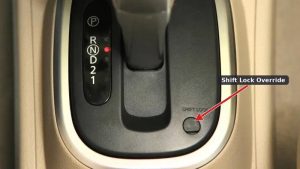
Almost everything in new and recent-vintage vehicles is electronically controlled and that includes the gear selector, usually mounted on the center console. Sometimes, it won’t let you move from Park to Drive. You might be able to fix this yourself – and avoid having to call roadside service. If you can’t get the gear selector to move out of Park, pry up the plastic trim plate around the gear selector; these usually press/snap-fit into place and can be removed by pulling up on them (easy does it). Sometimes, there’s a little tab on top of the trim plate. Use a flat-blade screwdriver os similar to gain access. Once you do, you will hopefully see a little yellow or something like that button.
Push that and the gear selector will (hopefully) unlock.
If the vehicle’s manufacturer recommends premium, it’s not required – 
Lost of new and late-model vehicles have turbocharged engines and some of these come with “premium fuel recommended” stickers.
This doesn’t mean you have to use premium fuel, however. More precisely, it doesn’t mean you’re going to cause harm to your vehicle’s engine if you fill (or top off) the tank with regular. It just means the engine won’t make the peak advertised power. But you will avoid having to spend the 40-50 cents more per gallon that premium unleaded fuel costs.
. . .
If you like what you’ve found here please consider supporting EPautos.
We depend on you to keep the wheels turning!
Our donate button is here.
If you prefer not to use PayPal, our mailing address is: EPautos 721 Hummingbird Lane SE Copper Hill, VA 24079









I took my wife’s Audi TDI to the dealer for a transmission oil service. They tell me, “that service isn’t on our service list, you have lifetime fluids for the transmission.”
I said “you do change/service the engine oil on all of your vehicles, no?” “Why yes sir, we do,” he replies. I said, “what makes your transmissions so special that you’d never suggest oil changes/service – when it’s a friction and wear system just like the engine is?”
He looked at me like I was speaking Swahili. No answer, just reread the screen in front of him, that it wasn’t necessary. Even the manufacturer, ZF recommends the oil be changed at 50K miles. I left in disgust.
The local independent European shop was happy perform the trans service for me. Even saving some of the used oil in a glass jar I left them. It as black as could be. Almost like it needed to be changed!!
Dealer employees seem to lack basic knowledge about certain aspects on cars outside of the size infotainment screen they come with. And manufacturers seem like they’ve thrown in the towel and don’t even care anymore. It’s a sad state of affairs in the car world, as I see it.
Except Ford managed to mess up the break wear with the Ford Transit 350 van. They have it programmed for the rear brakes to activate first and then the front brakes. Of course the rear brakes are smaller in size than the front, and so they wear out very often between 25 and 30,000 miles. That is really frustrating, especially when you expect the front to wear out first like all others. The front brakes last about 55 to 60,000 miles. To add to the frustration, they’ve made it as unfriendly as possible for someone to change the brakes themselves, single use bolts, the axel has to be removed to replace the brake rotor. It has been quite expensive to maintain, and very frustrating for someone who likes to ordinarily do all this work himself.
Most everything in the Ford service manuals says replace the bolts. I rarely do. Never had one break. Use your brain for what can be re-used and it will be fine.
“If the vehicle’s manufacturer recommends premium, it’s not required –”
Living in Europe where auto inspections are a biannual ritual, I think that it is important to point out that premium fuel is more than just “octane”. Usually there are various additives that not only make the combustion more efficient, they also lubricate valves and may leave less soot in the exhaust system – something very important for diesel owners.
After decades of just purchasing the cheapest gas I could find, I have started tanking with premium diesel and petrol in the hope that it might spare me repairs like walnut blasting of intake valves but also catalytic converters and turbo waste gates.
Top tier only regardless of octane rating. Another factor (devil in the details) is fuel/oil mixing in the piston ring grooves. The best gasoline (and I cannot find info for just top tier) contains friction modifiers to decrease cylinder wear from the fuel caused oil dilution in the piston ring grooves. So far what I see are the high octane grades only, contain the friction modifiers. Example Shell Vpower Nitro+ at 91 to 93 octane.
So, top tier for clean, even better is with friction modifiers. Wish top tier would require the friction modifiers as a requirement of the rating in ALL grades.
I think with fuel prices the way they are, it’s cheaper to get high-quality octane booster which will give you higher octane and all the other groovy additives at a fraction of the cost of premium gas.
eric – Speaking of brakes, people should NEVER add brake fluid when the reservoir looks low (assuming nothing is leaking). The fluid level drops as the pads wear. Once new pads are installed, the fluid level will return to its proper level.
Indeed, Art D!
Brake fluid is also a great paint stripper…
I’ve been saying exactly this for a long time. I tell my friends not to refer to it as a “brake fluid reservoir” but rather the “brake pad wear indicator”. That should be industry standard terminology and mandatory info as part of ASE cert.
Brake fluid also makes a great fire starter if you pour a little of it on some potassium permanganate. Potassium permanganate is something everyone should own, btw. Make a little pile of pot-perm, maybe a tablespoon full, make a little crater in the top of the pile, and pour in a little brake fluid. Sit and wait 10 or 15 seconds, and WHOOSH, nice, hot fire that will burn even when wet. Very handy if you don’t want to struggle to build a fire.
Great advice, Eric…with one caveat.
New vehicles can wear out the rear brake pads much faster than the fronts due to traction, stability controls and more.
Here is a video that explains it in detail. Go to 14:40 to see the evidence
https://www.youtube.com/watch?v=SlcZGfjoc6k
Thanks, Mark –
And, hat tip for the tip!
I, like you, thought the same until I saw this a few weeks ago. You might call it Contrived Complexity for Enshitification.
Toyota is having this a-ha moment since the adaptive cruise control feathers only the rear brakes to maintain the vehicle separation. Tundra owners I know are finding that their rear brakes are toast long before the front pads. It’s a cart before the horse issue. Since the long held truism is that you don’t need much rear braking the rear brakes are greatly smaller in size and have been for decades but when the marketing department decided to add features that is the equivalent of constantly riding your parking brake no one told the chassis department the needed to maybe rethink things.
Like trans fluid and coolant, brake fluid definitely does not last forever! I bleed it upon doing the brakes My .02