

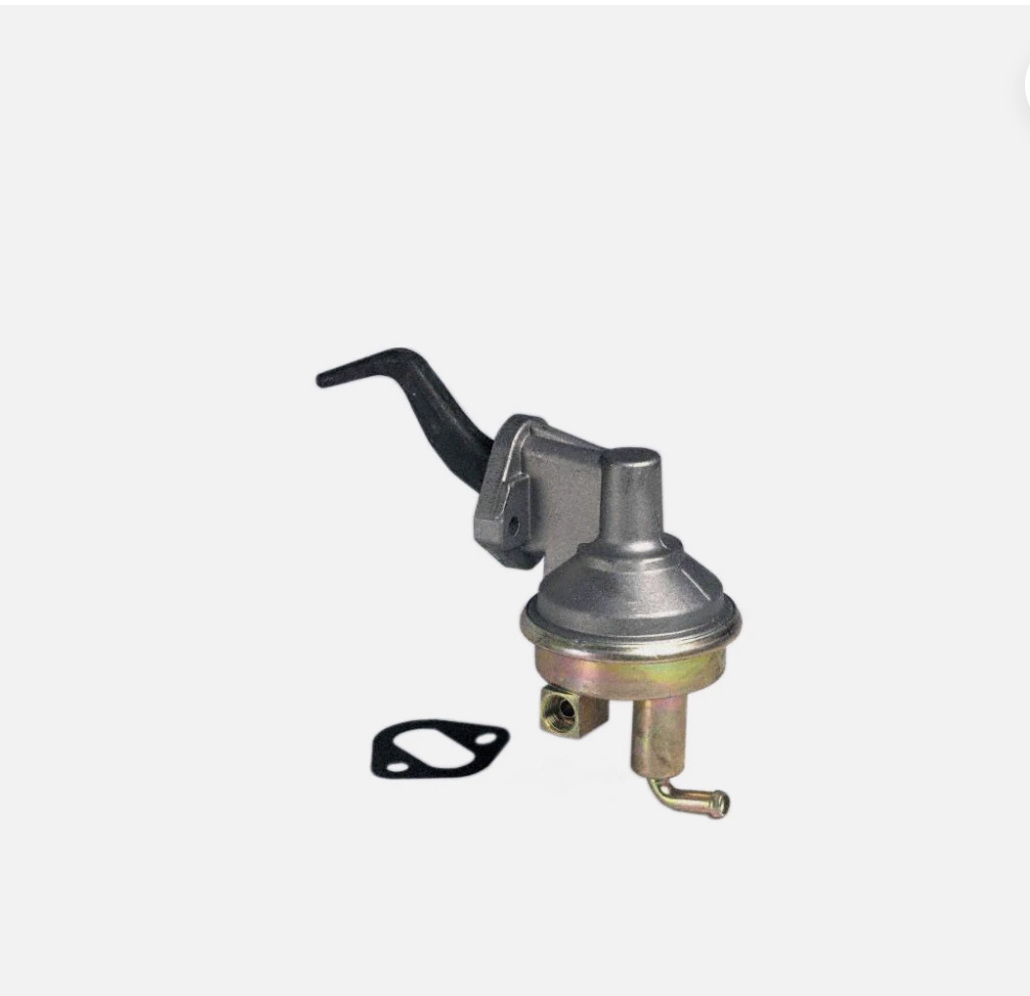

Before electronic fuel injection became the standard fuel delivery system, most cars had mechanical fuel pumps – because electric fuel pumps weren’t necessary. They weren’t necessary because mechanical fuel pumps can deliver the single digit fuel pressure that’s enough to feed a mechanical fuel delivery system; i.e., a carburetor.
A mechanical fuel pump is basically a housing inside of which is a diaphragm that creates suction via the up-and-down action of a lever that is operated mechanically, by the running engine. The pump is (typically) bolted to the side of the engine. There are (usually) two lines that screw into the pump; one draws fuel from the gas tank. The other sends the gas to the carburetor, which feeds the fuel to the engine. This comprises the entirety of the fuel delivery system in a carbureted vehicle.
The pump is generally held in place by two bolts. Undo those – and the fuel lines – and that’s all there is to removing the pump. Reinstalling it is the reverse. It’s only slightly more challenging than removing the wingnut that used to hold the air cleaner lid down (today, there are typically a number of cumbersome clips that have to be snapped open to get the lid off the box). Almost anyone who has two working arms can replace a carbureted engine’s fuel pump is the point. And almost anyone can afford to buy the pump, too.
Even today – even given inflation – I can buy a new replacement fuel pump for a carbureted GM vehicle like my ’76 Trans-Am for about $40.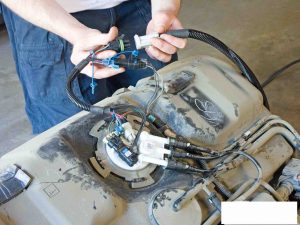
Marvel at what we’ve lost. What was only yesterday inexpensive and simple (and still is today, if you’re lucky enough to own a car with a mechanical fuel delivery system) has become precisely the opposite. To be fair, electric fuel pumps are also simple, but they can be shockingly expensive to install because they are not simple to install because (generally) you’ve got to get them out of the gas tank first. That’s where the majority of modern, fuel-injected cars have their fuel pumps. They are in the tank because the gas serves as a coolant, which is good (for the pump) and for you, because it extends the service life of the pump. Electric fuel pumps generally last longer than mechanical fuel pumps, which – back in the day – commonly needed to be replaced by the time the vehicle had 100,000 miles on the clock and sometimes, sooner.
But – remember – it was easy and inexpensive to replace those old mechanical fuel pumps. What’s $40 or so bucks (and 15 minutes of wrenching) once every five years?
The in-tank pump isn’t easy or inexpensive to replace.
Unless you’re very motivated and physically capable and have more than just a basic socket set and some wrenches, this is a job you’ll probably end up turning over to a dealer. The average cost ranges between $800 and $1,500. Also, you probably will not be able to replace the electric pump in a parking lot. When it fails, you’ll likely have to call for a truck – and a tow. Because dropping a gas tank in the parking lot of a Wal Mart is an unlikely proposition. On the other hand, it was – and still is – easy to change out a bad fuel pump in a parking lot. No need to drop the tank – which requires a jack (gas is heavy). Just a basic socket set and wrenches is all you need. 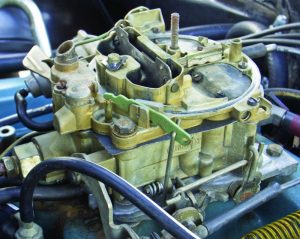
And while we’re on the subject of fuel pumps, consider that the rest of the fuel system – in a carbureted car – can be replaced in about 15 minutes, too. Because that’s about all the time it takes to remove the four bolts that hold a carb to an intake manifold. That plus a few hoses and brackets is all there is to it. Even today, by the way, a brand-new four barrel carburetor costs about $500 – or about a third what it costs to pay a dealer to replace a fuel-injected cars’s electric fuel pump. The kicker? Once you’ve replaced the carb – and the mechanical pump – you basically have a brand new fuel system. The whole thing, in other words – less the lines and tank, of course.
It is true a modern, fuel injected system is “set and forget.” Once installed, it generally requires zero maintenance for a long time. Just turn the key and off you go. But – one day – you won’t go. And on that day, you may wish you only had to deal with a $40 mechanical fuel pump or – worst case – a $500 carb.
. . .
If you like what you’ve found here please consider supporting EPautos.
We depend on you to keep the wheels turning!
Our donate button is here.
If you prefer not to use PayPal, our mailing address is:
EPautos
721 Hummingbird Lane SE
Copper Hill, VA 24079
PS: Get an EPautos magnet or sticker or coaster in return for a $25 or more one-time donation or a $10 or more monthly recurring donation. (Please be sure to tell us you want a magnet or sticker or coaster – and also, provide an address, so we know where to mail the thing!)
If you’d like a Baaaaa hat or other EPautos gear, see here!









Got another fuel pump story. I was at Costco yesterday and noticed a coned off area and a tow truck near the fuel pumps. Turns out a guy was getting his relatively late model Honda Civic towed. I saw a lot of fuel on the ground and asked him what happened. He said he just got to fuel pump replaced, filled the tank and it started leaking badly. So, back to the Honda dealership. They either didn’t install the gasket right or at all, didn’t fully engage and seat the fuel pump into the tank or didn’t properly fasten the fuel lines. Probably one of the first two. Then I told one of the Costco guys I know in the electronics section about it and he told me his Honda story. His ’24 Honda Ridgeline’s ASS is malfunctioning, not restarting like it’s supposed to and the Honda dealership can’t fix it. Turns out it’s a widespread problem with many Honda models, a NHIST investigation and many class action lawsuits. He said his daughter almost got hit in an intersection because his Ridgeline wouldn’t restart. He said he bought a disabling device and is going to install. Pretty crazy.
To add, there is a disable button you have to push every time you start the car, but he says sometimes he forgets to push it. Also, I’ve heard that putting the transmission in sport mode cancels the ASS.
Had to add my in tank fuel pump replacement story. My wife’s ’90 Bronco II EB’s fuel pump was slowly failing. Symptoms were that it starting making a loud whining noise like it was straining, and the engine was running unevenly. Luckily we hadn’t just filled up and were able to run most of the fuel out of the tank. if you have a full tank when it fails you’re in hurt city and have to siphon the gas out. removed the fuel tank skid plate which was dented from 4 wheeling, that’s 4 bolts, and then removed the fuel tank straps, also 4 bolts. Removed the failing pump and replaced it with the new one. Think it was OEM as I had a friend in the Ford dealership parts department. put 5 gallons of gas in the tank with a gas can. Then, per instructions, turned on the ignition and let the new fuel prime the fuel system. After that started right up. Back to 4 wheeling in the worst places imaginable, washing it on Sunday afternoon and my wife going to work on Monday morning in that thing haha. Couldn’t kill that thing and never got a flat on Firestone GTX tires. Pro tip: Always stop when you get back on the road from extreme off roading and check the tires, undercarriage and the overall vehicle before you go back up to highway speed.
Here’s another off road story: Did a FD off road rescue on one of the same rugged roads we off we would recreationally off road on, “Road To The Sea” in Kau district on the Big Island of Hawaii. A couple had bottomed out their S-10 Chevy SUV wagon a high rock outcropping and called 911 via cell phone. We responded with “Utility-11” our Ford Explorer. We got them freed but their fuel tank was ruptured and leaking fuel as no skid plate. We were able to escort them to Highway 11, and a tow truck towed them from there. Otherwise the tow would have been 1200 bucks vs. 400. Moral of the story: Amateurs should not off road.
My great car, the volvo 850 turbo wagon has an access panel to replace the in tank fuel pump…o have done a couple over the years….great article eric. Also when i was 16 in 86 me and my buddy wanted to drag douglas on friday night….but my 70 chev pickup (hugger orange) would not start…my dear dad diagnosed it and swapped the fuel pump really fast and we got to go drag douglas
Thanks, Richard!
I respect any manufacturer that tries to design its product to be more easily serviced. It is egregious to place the fuel pump in the gas tank without providing an access panel. It is something like hiding the oil filter inside the engine, so that you have to take off the intake manifold to access/replace it.
Swedish volvo was a great company and the 850 is a great car….the 5 cylinder turbo….too bad swedish volvo is gone.
On the smart design cars there’s a panel in the trunk that’s easy to remove and fuel pump is there easy job but most new cars don’t have that I got a 98 Rover that has easy panel I changed it out cost like $70 for completely new assembly going to pick up a 74 bug this week as well.
I Keep a spare fuel pump under the seat of my 67 c10. Also a coil and fan belt. Haven’t had to use them yet.
I’ve never experienced vapor lock with old blue either. Inline 6 with 1 barrel carb all original .
c10! That was my favorite truck! Manual, with low speed granny gear. I think it was a ’68. Virtually indestructible. Well, except to when The State system of planned vehicle disintegration system (road salt/brine) ate it.
I bought mine for less than $500 in the 1980’s.
I don’t ever see those here in the Northland unless it’s a dry sunny parade type of day, and they cost ~ $40,000 or more, prolly.
Example, almost $57,000
https://kinionauto.com/vdp/23592574/Used-1969-Chevrolet-C10-Base-for-sale-in-Clarence-IA-52216
I’ve got an ’82 C10. Love the truck, done plenty of work with it in the few years I’ve owned it – bought it cash – on faith – for $3,000 because I was in love. Wouldn’t start, had to have it towed. I gave her new tires, new battery, new coolant reservoir, new carb air filter, oil change, trans change, and what stopped her overheating problem was… finally… replacing the clogged crankcase breather! She blew the water pump belt a few miles from my home on Christmas and I replaced both belts. On one job, reversing to load up mulch, she poured out tranny fluid the whole way. Luckily I had a friend that knows more than I do with me – we plugged the leak with a something from the Lowe’s plumbing section. In the shop now for intake manifold gasket (been burning oil since I bought her) but wasn’t worth bringing it in until I heard a ticking in the engine on my most recent wood-get. Hopefully an arcing sparkplug wire or something in the exhaust…
Love that truck – we’ve been through it.
A fix for the mechanical fuel pump’s penchant for boiling fuel is to run an aftermarket fuel regulator with a return line. It keeps the fuel moving through the pump no matter the demand, so it doesn’t have time to sit and boil.
Some fuel filters also have this functionality, with a vapor separator and return line.
86 GM 6.2 detroit diesel also has the external pump like that, but it’s to bring fuel to the injection pump which increases the pressure to 5k PSI or something like that. If the fuel pump fails, its common to not notice because the injection pump has enough suction to bring fuel from the tank to the top of the engine. But if that high pressure pump fails, you go nowhere and have to deal with metal lines, timing gears, and it costs about $1000 or more for the pump, plus replacing injectors at $70+ a piece. Only good thing is the high pressure pump leaks well before failure, so no leak and you’re good to go
Having wrenched on diesels in the military and at home, the costs involved, for fuel systems, head gaskets, etc, are precisely why I’ve chosen to avoid them for personal use, whenever possible.
But manufacturers seem hellbent on making gasses just as complex and complicated, and expensive, as diesels are today.
However, is this due to government interference and requirements? Safety regulations and Incredibly high and unrealistic MPG for new cars, per CAFE rules, are big drivers here, and sure, Trump has relaxed those rules for now.
But sure as shit, the next “Regime”, whoever (((they))) are, will not only re-instate those rules, but make them more draconian, to make up for the time frame when Trump relaxed the (((rules))).
This is why old cars will be the last stand for having cars that we shade tree mechanics can effectively and affordably wrench on, for parts, labor, and most critically, affordability!!!
We’ll all be the “Red Barchetta”, as Rush sings about…
Oy Vey!!! The Goyims be knowing! Shut it down!
YMMV…
I’ve seen pictures of the 1958 Chrysler 300D with the Electrojector EFI system. There was an access panel in the trunk to allow for easy access to the fuel pump in the gas tank.
Do any cars today have that?
No sheet, “There was an access panel in the trunk to allow for easy access to the fuel pump in the gas tank.”
Why, O-Why, didn’t they ever make an access panel in the beds of pickup trucks? Fuckers.
I had the fuel pump go out on my 2001 Mustang Cobra SVT at about 30,000 miles back about 15 years ago. I was about 100 miles from my place and luckily had it towed to a Ford dealer nearby, It cost about me $1,200 to fix in addition to the computer module replacement which the dealer said failed. It took a week for the fix as the dealer had to find a replacement computer module.
I would hate to see what that would cost these days as the labor rates at dealers run from $150 to $200 an hour.
“in addition to the computer module replacement which the dealer said failed.”
More and more, “technology”, I see, ain’t worth what it is.
Reminds me of the Mac laptops, battery wouldn’t charge, so people thought they needed a new laptop. The solution was, a chip needed, ‘flashed’. As easy as pushing a few keypads.
…So many Billions of hard earned Dollars, flushed down the toilet. As if, it was planned?
Some early 2000’s Ford vehicles had the Visteon “variable pressure” in-tank fuel pumps (motor speed was variable) where you could sometimes end up with vapor lock under the right hot soak or idle conditions. The other issue was the pump motor overheating from running at less efficient speeds with low fuel. I used laugh about this because only Ford could figure out how to recreate vapor lock WITH fuel injection. This was done in the name of a fuel economy improvement (modeled data).
Interesting, that. Also, RE: “The other issue was the pump motor overheating from running at less efficient speeds with low fuel.”
It ain’t just Ford.
There is still a downside to mechanical fuel pumps providing single digit fuel pressure to carburetors…..vapor lock. When the fuel gets hot enough to boil and render your carburetor temporarily non-functional. Modern fuels don’t have the right rvp value to prevent fuel boiling unless using race gas.
Hmm, RE: “When the fuel gets hot enough to boil”.
I’m not sure I ever had that happen here in the Northland. Not even in Summer. Is that just a West Texas kind of thing? Or, heavy, stop-N-go traffic, in Summer?
It was long ago and I suppose I could be misremembering. I just don’t recall ever experiencing it or knowing of it.
I drive a 1982 Toyota pickup with a carb here in Colorado. Vapor lock happens occasionally and always has going back to my younger me cars in the 80s and 90s.
One of the long time fixes was to put an electrical fuel pump on the frame rail near the tank because the problem is usually the inlet side. It is pulling a vacuum to draw fuel out and that makes it more prone to boiling over that long run from back to front. The outlet side is under slight pressure, which naturally helps reduce boiling. Think about another system on your vehicle where this pressure-vs-vacuum phenomenon is important, the cooling system. It is pressurized to depress freezing point and increase boiling point.
Old is just old. Not always better, not always worse. The problem is complexity and quality.
I went back to an old truck because I wanted a truck that pre-dated emissions testing (which is 1983 or newer in Colorado) after my last truck, which was a 1990 Toyota with EFI. There was nothing wrong with that truck, the fuel pump that Toyota put in that thing when it was built 11/89 was the fuel pump that was still in it 273,000 miles later in Dec 2016 when it was hit and the frame irreparably bent by an out of control driver in the snow. I still have that crooked truck, although it’s now lighter by the weight of engine and drivetrain that I have on the stand getting built to eventually go in the 1982.
I don’t hate carb but daily driving one again reminds me why I was also not opposed to EFI in the first place. My 20R has gone through two fuel pumps in roughly 9 years (to be fair the one on it when I bought it was old already, so really it’s only the one I put on it shortly after getting the truck).
The problem is Kyosan Densi was the original Japanese OE supplier for the factory mechanical fuel pump and those good ones have been out of production for years. What’s made now is not made to their standards, so you’re lucky to get a year from them with the crap rubber diaphragms they use coming from India or China or where the hell ever. When a good fuel pump pops up, a NOS or a limited run by a Japanese OE you grab one and put it on the shelf. At my current rate of work (tortoise speed) the one spare I have should hold me until the EFI engine is ready. Fingers crossed anyway.
Remember vapor lock? Lots of cars would stall in the summer heat. I put an in tank fuel pumop on my ’65 v-8 Pontiac for that reason alone.
RE: “Remember vapor lock? Lots of cars would stall in the summer heat.”
No. I don’t. ’66 GTO. Never.
I’ve seen a few failures on F.I. motorcycles. This is why I like carbureted motorcycles, no fuel pump at all, gravity does the work. Think model A ford’s also did not have a fuel pump.
Hmm, have you ever heard of a motorcycle with a carb having vapor lock?
I sure haven’t. But, I’m not a Zen motorcycle mechanic.
The electric pumps submerged in the tank are there mainly for convenience of fuel routing these days. Fuel pressure regulators work by dumping excess pressure back into the tank, and it’s super easy to to make it into one unit in the tank. This whole thing about being cooled by fuel isn’t that important anymore, and the Japanese cars have this figured out. These pumps rarely fail.
Those old engine driven fuel pumps didn’t need to maintain a steady pressure, just fill the basin in the carburetor in fits and spurts, which was a much simpler problem. I get it, that’s your point, things were simpler. If I could choose any one kind of car to drive for the rest of time, it would be an early 2000’s EFI engine. They last forever, don’t stink things up like carbureted engines, and get good efficiency, but don’t have any of the modern complications for squeezing out another couple of mpg.
RE: “This whole thing about being cooled by fuel isn’t that important anymore, and the Japanese cars have this figured out. These pumps rarely fail.”
What year did THAT happen?
I’ve known of a sheet-ton of fuel-injected pump failures. A Ton.
I guess the Keyword is, “anymore”? Idk.
“Anymore” = with A.s.s., and A.f.m. …and with super scary glitchy, electronic power steering assist? Also, with 6 or 8 eye socket-removing airbags?
Yeesh, (not to poke at ya or anything, I appreciate your input) “the Japanese cars have this figured out”
They. Sure. Have. …Six ways, to Sunday.
The 91 Silverado has the in tank pump, inside a big gas tank. Still running the original at 188k miles. I’d do a replacement if it wasn’t such a process. Pick one: drop the tank, unbolt and tilt the bed for access, or cut a hole in the bed floor. Ehh, not pleased at the options and what quality is a 2026 pump vs the 1991 original.
The 03 Ford Escape I’ve done and it’s an easy deal! There is an access panel under the rear seat, a simple tool to unscrew the lock ring, lines and elec connector – done.
The stock pump got noisy at 50k, first “American made” replacement pump had a fuel level sender failure within a year. The ChiCom replacement is quiet and has an accurate fuel level sender, go figure.
The kind of question I ask myself often, “what quality is a 2026 pump vs the 1991 original.”
Just as bad as modern fuel pumps are, we also have to go inside the fuel takn to replace fuel filters. I havent seen an external fuel filter since my dads 86 Taurus and my 87 Integra that I had back in the before times.
’94 Toyota pickup external can be such a bitch that’s it’s often advised to move the location.
…An easy to access external fuel filter seems like it should be a given.
IF, we didn’t live in stupid Idiocracy/bureaucracy/State-controlled…
In 1000 years from now, I do hope, if mankind is still around, there’s true Free Markets.
It’s not that bad on a 1994 Toyota V6, since it’s on the frame rail. On the 22R-E it’s more of a PITA up under the intake on the engine block. Not impossible but not fun. On my 1990 I just did it on principle rather than obvious necessity (it didn’t seem clogged anyway) when I cleaned up the whole intake side. On the 22R-E the rear of the intake manifold and the runners will get nasty from the EGR and PCV systems. I got a wild hair and decided to take it off and have it hot tanked. Put new gaskets in, cleaned the throttle body, had the injectors cleaned too. Engine ran noticeably better.
I bought a new mid-90’s Ford Escort GT back in the day. Great acceleration, great stereo to listen to on my commutes. One day, on the road, I started to feel a slight hesitation through the drive train (it was a 5 speed). The hesitation grew in severity to where I had to pull over. After checking what I could think of could be causing this and finding nothing obvious, I just jumped back in the car. It started right up, and I continued the rest of my journey.
This hesitation business lasted for quite a while, and the Dealer was unable to reproduce it. One day I lost my cool and brought it back to the dealer and told them to drive it at least 70 miles at Interstate speeds without stopping, as that is what I had deduced based on experience.
They gave me a loaner car and called me back the next day, said they found the problem.
The In-Tank Fuel Pump was OVERHEATING and cutting out. They replaced it under warranty, but I have always wondered about the thought process that required submerging a hot electrical device into a tank with gasoline and gas vapor.
Hi TX,
Yup; had that happen once. It’s sound policy to always keep the tank at least 1/4 full – to keep the pump from running hot.
I must have had a bad pump. I experienced the same problem regardless of tank fullness. The trip that did it for me was attempting to travel to Nashville from the DFW area for my Parents 50th Wedding Anniversary, and experiencing the problem inside of 50 miles of departure with a full tank. I turned back after about 150 miles. Parents ended up flying me to Nashville to participate.
Roger that, TX!
Electric pumps are great – until they fail. At least when a mechanical pump fails, it’s pretty easy and very cheap to fix.
OT but I just saw this about a ‘76 TA rotting in a junkyard in PA. It was a 455 with a manual. No engine or transmission in it but the article says the interior is in decent shape. It might have that shifter area trim piece you’re searching for. They want $2900 for the whole rig, though.
https://autos.yahoo.com/classic-and-collector/articles/abandoned-455-pontiac-trans-am-192300123.html
Morning, Funk!
I wept when I saw the picture. I won’t show it to my Trans-Am; a stroke might ensue!
The 2011-2019 model year Ford Explorers still have mechanical fuel pumps, but the mechanism is located inside the engine body, requiring partial disassembly of the engine to replace, as many Explorer owners have found out in the last few years.
$150 part. $3000 labor. I speak from experience.
From what I understand, Edge models of that era and the Flex, which was as a kinda, sort-of crossover on the same 500/Taurus platform prior to 2011, also have the problem.
What is maddening is that owners don’t typically find out about the design flaw until the pump leaks into the engine oil compartment after the last of two seals fail catastrophically. If you have a *very* good mechanic, they will know to get scope or mirror on the “weep hole” between the engine and the alternator at every oil change.
Or, you can get lucky like we did and have an alternator fail when the first of the seals went and leaked coolant out the weep hole.
The seals are hand beaded, not a manufactured gasket. Repair requires a qualified tech at the dealer.
Of course Ford has skated on class action lawsuits.
Cop Explorers of that era, the first to replace the Crown Vics, also have the fuel pump issue.
You’re thinking of the Ford 3.5 V-6 water pump, which is internal. Not the fuel pump. Explorer fuel pumps are in the tank.
Water pump. I had fuel pump on the brain and no food.
Well, that was an interesting detour.
At least, it was noticed.
>Before electronic fuel injection became the standard fuel delivery system, most cars had mechanical fuel pumps
Most American cars, that is.
British cars from the 1950s typically had electric fuel pumps.
That includes E type Jag, AH3000, Sunbeam Alpine, Triumph TR4, MGA & MGB.
Porsche used a mechanical pump in the 356, but switched to an electric fuel pump for the 911.
As for later model American cars, my 1989 F150 has 3 electric pumps.
The primary fuel pump, along with the primary fuel filter, mounts inside the left “C” shaped frame rail aft of the passenger compartment, and both are easily replaced with common hand tools. BTDT. Be sure to depressurize the fuel line before loosening any fittings.
Each fuel tank (my PU has dual tanks) has a submerged combination sending unit/fuel filter/auxiliary fuel pump assembly, accessible from the top of the tank. As Eric said, it is necessary to drop the fuel tank to replace these assemblies.
Since this is a port fuel injection system, there is a fuel return line from the FI fuel rail. The excess fuel must be routed to the tank which supplied it, otherwise bad things happen.
For this purpose, there is a rather complicated valve assembly which routes both supplied & returned fuel. Genuine FoMoCo part is still available, and costs >$500, but has a good warranty. Chinese junk is also available, and is frequently defective as supplied “new”. My advice: pay for genuine FoMoCo.
Also:
If the fuel routing valve assembly fails (unable to switch tanks), replace it ASAP. It is important to keep fuel in both tanks. A fuel tank which is empty for some time will eventually rust internally, and the submerged sending unit/aux pump assembly will fail. That means when you do get around to replacing the routing valve assembly, it is likely you will to need to replace the out of service fuel tank *and* the submerged sending unit/aux pump assembly.
Ka-ching! BTDT. 🙁
RE: “British cars from the 1950s typically had electric fuel pumps.”
I did Not know that.
Also, good food for thought if considering buying an e.f.i. with dual tanks.
On a flathead ford you unbolt it from the top of the engine. The whole job, removing, rebuilding the pump with a new diaphragm, spring, and check valves, and reinstalling takes about an hour with minimal waste and hassle.
When Henry Ford was around, you could do most of the work on his products with a half inch wrench and a straight bladed screwdriver. Not only were the cars affordable, they embodied economy in their operation and maintainability.
Even back then there were control freak jerks who thought motorized travel should be a “privilege” for the wealthy, and they hated the flivvers.
You lost me at, “On a flathead”.
I never owned one, worked on one, nor had a friend with one. I did catch a few tho.
Your description of it sounds nice. “you could do most of the work on his products with a half inch wrench and a straight bladed screwdriver.”
…Could you imagine ANYTHING like that today?
Maybe, just the chain part, on my chainsaw?
Everything was obvious and easy to access on old cars, water pump, fuel pump, starter and spark plugs. Valve cover gaskets were easy to replace. Now what once was easy is a chore.
You summed it up nicely there, Dave.
The same can be said of tractors.
Prolly, motorcycles, too?
Push-mowers?
Washing machines? (Old ones soo easy to fix & lasted a long long time.
Dryers? They lasted, ‘forever’ too!
Don’t Even get me started on refrigerators or H.V.A.C.s
Is it the trying to make everything disposable and short-lived?
I mean, no one takes their TeeVee into the repair shop anymore.
Same with ‘puters, mostly.
All this ‘subscription’ b.s.. Psft.
…Durability and longevity are such nasty words these days, eh?
Money to burn. ?
Or,…”free money” as my real estate friend used to say?
Who cares, so long as, the money is free?
Next, on my, ‘to listen to list’ :
https://usawatchdog.com/iran-bombs-uae-to-trigger-financial-meltdown-martin-armstrong/
Fun Times?