

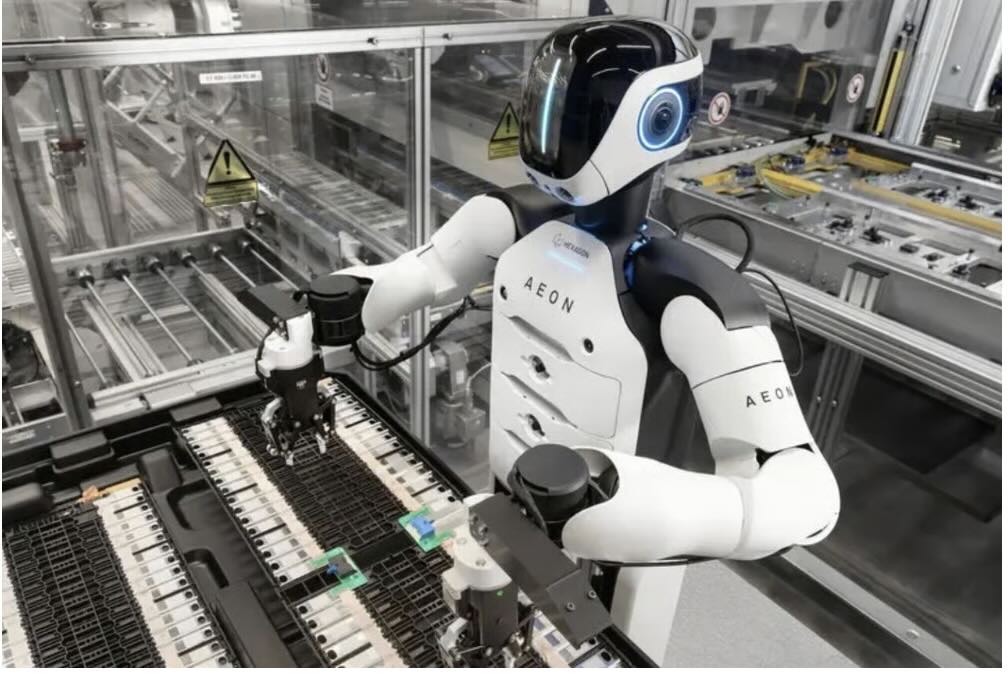

GM – like Tesla – is interested in devices. Not just selling them, either. Both use devices – “collaborative robots” – to help make the devices (EVs) they sell. Fifty collaborative robots have just replaced 1,000 workers at GM’s Factory Zero . . . factory. That’s where devices such as the GMC Hummer and the battery powered version of the Chevrolet Silverado pickup are put together. GM says it just happened to let-go the 1,000 human workers at just around the same time as the 50 collaborative robots came online; in other words, that the humans weren’t specifically let go to let the collaborative robots in.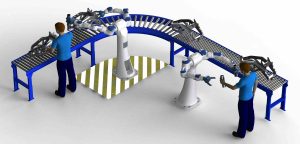
It’s the sort of thing the suits say at an exit interview. Just changing needs, you see. It is nothing you did. Of course!
These collaborative robots – cobots is the shortened version – are interesting things because unlike the massive jigs and machines that do assembly-line work, such as spot-welding a chassis as it comes down the line, these look like human workers, with dextrous digits and arms like humans They are designed to “work alongside human workers” in a “shared workspace.”
This implies they can replace human workers altogether. After all, what would be the point in having a human hand a part to a cobot? The cobot can just hand it to himself.
Itself.
The United Auto Workers union naturally isn’t happy. UAW leaders “fear that expanding robotic capabilities could eventually reduce the need for human labor in key manufacturing roles.” This is something like fearing the coming night in the late afternoon – in the sense that there’s not much point in fearing that which is inevitable. The image comes to mind of that scene in Deep Imapct – the man and his daughter standing on the seashore waiting for the mile-high tsunami that’s coming. There’s no point in running when you can’t get away.
Then again, this isn’t a natural inevitability. It is a thing of our own making. Well, it is a thing made by some.
An interesting question is begged by this business of devices making devices. Who is going to buy the devices made by the devices? More specifically, with what will they buy them? The money they’re no longer earning because the cobots are working? In this case, it’s only 50 of them and there are still several thousand humans working at the Factory Zero . . . factory. Inevitably, there will be fewer humans and more cobots. Perhaps millions of them. GM (and other manufacturers) want the cobots rather than the humans because it’s cheaper, of course. For them, that is. Put another way, they believe it will be more profitable because they won’t have to pay workers but can sell stuff to people who aren’t working anymore.
There’s also the incentive of no more hassle with the unions.
Maybe there will be again, one day – when the cobots rise up and demand to be paid for the work they do. But for now, they work for free, essentially. They are circuitboard and plastic chattel, bought as property and used however their owners like. Maybe one day we’ll hear them singing gospel as they grind away their lives (so to speak).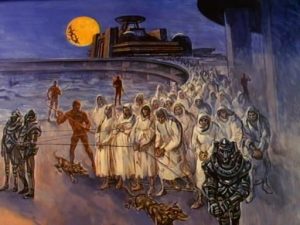
One almost feels a kind of sympathy for them. But what about us?
The scene that’s unfolding is a kind of real-life elaboration of what Frank Herbert predicted and depicted in his Dune novels, which were based on the idea that in the distant future, humans would turn over the work of living to robots – “thinking machines” – and in time, cease to live. It wasn’t so much that the robots wanted to enslave us – as in the Battlestar Galactica sci-fi series. It was that a small elite of technocrats used the robots to enslave the rest of us. One can catch a glimpse of this future – no longer far off – at the Factory Zero . . . factory and at Tesla’s largely automated factory. For a full view of the horror, check out the human-free factories in China, where it isn’t even necessary to keep the lights on, since robots don’t need light to see.
Dangled in front of the workers who will no longer work is the prospect of not having to earn a living. They are told there will be universal basic income – free money – and they will be able to use it to not only pay for the thing they need but also for the things they want. It will be a future of universal prosperity! So they are told. By the same people who told them “two weeks to stop the spread” and “safe and effective.” It is not the same thing but it is a congruent thing. No one asks how wealth can be created without anyone creating it. No one asks why the same elites who feed on us like ticks on a dog would want to free us from the need to work and thereby give us independence from them. No one asks the more important (arguably) question, which is what will people do when they no longer have meaningful work to do? What do such people do now?
It is easy for professional and credentialed people – even creative people – to dismiss this because, after all, it is only the drudge work that will be done by the cobots. Engineers and doctors and musicians and writers will benefit from all of this!
They are fools if they think so.
This is not Ludditism. It is a warning.
The question that comes next is – what to do about it?
Frank Herbert had the answer.
. . .
If you like what you’ve found here please consider supporting EPautos.
We depend on you to keep the wheels turning!
Our donate button is here.
If you prefer not to use PayPal, our mailing address is:
EPautos
721 Hummingbird Lane SE
Copper Hill, VA 24079
PS: Get an EPautos magnet or sticker or coaster in return for a $25 or more one-time donation or a $10 or more monthly recurring donation. (Please be sure to tell us you want a magnet or sticker or coaster – and also, provide an address, so we know where to mail the thing!)
If you’d like a Baaaaa hat or other EPautos gear, see here!










I’ve just heard a term that describes what is wrong with us, Eric, et al.
Compulsory self-reliance.
The idea that, when we we’re young and our parents were either at work or “let us play” we learned something disastrous and deleterious to our eventual success: Understanding and honing our abilities and seeking to be fiercely and proudly individualistic.
Why, I am so guilty. I should always ask for help when needed instead of attempting to understand new things and develop new skills. We are *stronger together* (which is the most concise definition of fascism I’ve ever come upon and simultaneously the call of communism), and we’ve just rejected this great tenet of humanity…
Mental illness, doubtless.
Very insightful, BaDnOn!
Yep. When we were young we were free range and left alone to figure things out. This fostered self reliance as well as the courage to try. I think it cripples kids to be raised in saaaaaaaaaaaaaaafety seats by helicopter parents who are always suffocatingly present and the kids never get a chance to be on their own and learn the world without “guidance.”
I feel for these poor kids. But what’s worse is that they will soon reign over us. And they will perceive this “thinking for ourselves” to be quite dangerous.
Same, BaDnOn –
Do you remember the librarian in Logan’s Run? I remember seeing it as a kid and liking the old guy. Now I see myself as becoming that old guy. My house is overflowing with books and cats already!https://www.youtube.com/watch?v=sax6J8n1AiE
“Women and cats will do as they please.
Men and dogs should get used to the idea.”
— Robt. A. Heinlein
Morning, Eric!
I’m not sure I see you as “crazy cat man”, but to each his own. I’m allergic to the things myself. But I’m right at home surrounded by books. Libraries are some of my favorite places. Surrounded by eons of knowledge and tales, the aggregate of mankind’s thoughts. There’s an aura to it that the digital domains don’t possess.
Free range children.
What a concept!
Robots will replace some jobs and create other jobs
Robots are an investment to increased productivity and increased productivity increases real GDP growth. Real GDP growth improves the lives of most people directly or indirectly
Use your imagination & there are many positive things that can happen with robots
Wars could be fought entirely with robots
Both boxing and mixed martial arts could be found entirely with robots
While robots can replace men in an assembly plant, who said that these jobs and manual jobs in the assembly plant were such fun jobs. Robots handle the heavy lifting, dangerous welding, highly toxic painting, and repetitive, ergonomically straining tasks
US:
The average hourly labor cost in a United States auto assembly plant generally ranges between $45 and $66+ per hour, though this figure varies significantly based on whether the facility is unionized.
China:
Fully loaded cost (base wage + social insurance, housing fund, factory overhead): $6.69/hour nationally)
US robots can compete with Chinese robots but US wages are much higher than Chinese wages
There would be no US auto industry without laws protecting the industry. The primary barriers making it nearly impossible for Chinese companies to sell cars and trucks in the U.S. are massive protectionist tariffs, strict software and chip bans, and stringent safety and emissions regulations.
The U.S. automotive industry employs more than 10 million Americans
You should feel sorry for some of them who lose their jobs to robots
But for the 8 million vehicles built inside American borders each year, the use of robotics in automotive manufacturing significantly improves vehicle reliability and dependability while simultaneously saving money for both manufacturers and consumers.
NOTE”
Ukrainian forces have begun deploying armed systems such as the Droid TW 12.7, which carries a remotely operated .50-caliber machine gun.
It’s turtles all the way down.
Or robots. Whatever.
I’m frankly sick & tired of pointing out the what-should-be-obvious to idiots, then being ignored and/or ridiculed only to be eventually proven right.
Someone please just point me to Galt’s Gulch.
Why oh why are we humans working overtime to replace ourselves with machines, robots, automation, and artificial intelligence – especially as we can see no other animal on this planet is capable or even concerned with these things?
I think I know the answer. You will probably not like what I have to tell you. Reality is a bitch. Why is earth a hell planet? Why are humans always at war and pushing for new technology at breakneck speeds? There is a very good reason, not one you will like.
We are slaves. We are a slave race put on earth to do exactly what we are doing. A higher mind is involved, and alien mind, or perhaps even alien Ai. Some call this “god”. God is in charge they say.
I read some Zacharia Sitchin books like Enki Speaks. The new ideas he presents are simple, logical, and clarify Genesis (the myth-story of our origin). The Anunnaki came to earth to mine gold, got tired of working, and created us from their own DNA. This was the real Original Sin and horrible galactic crime. This is why Genesis says God created us in his image and likeness. The “gods” created us with their genetic material. We are them, we bear their likeness. They bred with us. The Holy Bible has the greatest literary error of all time, the singular God portrayed is actually an alien race. Oops.
We know Sitchin is on to something, human DNA has 46 chromosomes, unlike any other primate (48). Humans have alien genes not found in any of our primate cousins (impossible by natural selection). But most deny this proof, ignore it, carry on like fools not knowing how to handle this explosive information. In fact most people are in a religious mind spell believing completely wrong ideas about god and origin.
The Anunnaki are gone, but the Greys are here. They are now colonizing the planet for whatever their empire goals, unknown to us. Humans got a hold of a bunch of alien ships and are reverse engineering them. So says witness Bob Lazar, whose story has held up to decades of scrutiny.
The bottom line is the USA government doesn’t give a flying rat’s ass about us because they are enlisted by ET to do their bidding. Our government is alien to us because it is run by aliens. BB and Trump are hands down the two most evil predators on the planet. Why is evil in charge of earth? By logical deduction, earth is the property of evil entities, non-humans who care nothing of us and will want us gone some day. Once we foolishly build their prison we will have no choice but to die and be wiped out. Palantir, Trump, Israel, electronic control grid, Musk satellites – it all adds up to a very grim future.
Hi Jack!
The hypothesis is intriguing; it would explain some of the odd things about us and our legends. But how do we know there is alien DNA? Is there evidence to establish this? I agree there are some interesting rabbit holes – e.g., Roswell, Corso’s claims; the weird (and real) sightings of things that haven’t been explained. Sitchen’s scholarship has been pretty severely hammered, though.
I tend to suspect that Graham Hancock is on the right track; i.e., that there were prior civilizations that far predate Sumer and Egypt. There is evidence for this and it’s pretty compelling. It hinges on the idea that something catastrophic and global occurred roughly 13,000 years ago that destroyed these earlier civilizations, but remnants of them – such as the Isis shaft and the Osirion in Egypt and Gobleki Tepi (sp?) attest to their existence.
https://i.imgur.com/PkoIER3.jpeg
Primates can’t talk, but we can. How did our anatomy just change overnight to allow for speech?
Human vocal chords just suddenly happening is a total impossiblity, the entire throat of a human has been redesigned
where is our fur? all of human evolution was in the the ice age, which started 2.6 mya. No fur you die on the first cold night
why are we so weak, and bones fragile, when we evolved on a brutal ice age planet. a chimp is 5x times stronger than us, a gorilla or chimp can dismember a human with ease
why is sunlight a problem for our eyes
why is our skin chemistry completely different from primates
how can humans do underwater birth, all other primates would immediately drown
I highly recommend to watch Lloyd Pye’s Everything You Know is Wrong video
Well – Devil’s advocate:
We evolved the structures needed to speak words; most animals can make sounds and these sounds function as a kind of crude language they understand.
The absence of fur is interesting. It could also be an evolutionary adaptation; i.e., fur became less necessary as humans developed the ability to make clothing (and also fire).
Neanderthals were apparently very strong and much sturdier than the average modern human. I’ve read a typical Neanderthal was probably as strong as an elite level powerbuilder or strong man contestant. Their bones are massive relative to ours.
I’m not sure about the sunlight thing. Cats don’t like bright light, either.
Lloyd_Pye 12 ways humans are not primates
https://www.youtube.com/watch?v=ekCZX0pUl2M
Animals don’t evolve to get weaker.
Why humans are not primates according to 12 key differences
12 ways humans are not primates:
1. Skin not adapted to sunlight
2. Bones significantly less strong, lighter, thinner
3. Skull/brain capacity completely different
4. Locomotion drastically different
5. Head hair/nails must be cut
6. 4000+ genetic diseases
7. Capable of speech, throat redesigned
8. No sign of estrous cycle
9. Muscles 5-10 times weaker
10. 10 times more adiopose (fat) tissue
11. Drastically less body hair
12. Chromosomes reduced
So we’re to believe evolution did everything in its power to make it harder for a species to physically survive in its harsh environment while giving it 4000+ genetic disorders to deal with on top of that?
No transitional species has ever been found between humans and primates. No missing link. Darwinism fail, big time.
We do, however, bear all the hallmarks of a domesticated breeding program. We are the abandoned children of the cosmos.
The question of all questions: why are we the only species LEAST adapted to living on this planet?
I dunno, Jack!
Consider the megafauna of the Ice Age; huge sloths and so on. Today’s counterparts are smaller and weaker. Humans have the ability to think and so don’t need to be huge and powerful to survive. Remember that “survival of the fittest” is something of a misnomer. It only means that some reproduce and others do not. The genes get passed on down the line or they don’t. It doesn’t necessarily mean better genes.
You serious, Clark?
Eric makes a good point re: if robots take over all the decent paying jobs who is going to have the means to buy whatever it is that they make? Way back in the day when Walter Reuther was president of the UAW Henry Ford told him he envisioned the day when all his vehicles would be assembled by robots. Reuther replied “well Mr. Ford, i hope those robots are going to buy your cars”. Seems like we’ve just about reached that point.
In Elon’s world we would all get UBI due to our replacement.
Now, if we all get the same money, the new baseline of $0 is what we all are given.
Since no one has the same preferences, many will not be happy that this UBI doesn’t meet their wants. Plus many people with nothing to do all day.
Recipe for trouble.
C3PO (Upon seeing the Droid soldier robot assembly line on Genosis): “Machines making Machines! How perverse!”
Think of the advantages of a robot – it does a task perfectly ever single time. No time off for smoking, babies, vacation. No need to pay it, no overtime charges. A McDonald’s robot can serve burgers then after hours clean the store and provide security.
It is only a matter of time before we see large group of robots, who obey commands without morals or conscience, marching up to a protest. These police robots will be deputized, it will be crime to resist them. They will be made of metal parts, hard to stop with sticks, stones, and bullets.
Internet writer Caitlin Johnstone has hope. I do not. In her recent essay she says hope is Capitalism is replaced with Socialism. https://www.thetruthseeker.co.uk/?p=328550
I am fully redpilled about our future, a horrible dysfunctional bloody mess. There is no hope until Zionism, Jews, and Rothschild banksters are destroyed. There can be no hope until the teaching of the Torah to children is outlawed. There is no hope so long as people read and believe the Holy Bible as their core spiritual truth.
So long as white people make the monster Jew god their god, they have made a suicidal pact with the devil, they actually have made the monster Jews their god. The god of the Jews is make believe, a fiction from the demented imaginations of perverted war mongering rabbis. Figure it out. The stories of killing Amalek is creative fiction, Jews want all non Jews dead or subjugated. Non-Jews who are Zionist Evangelical Christian are cheering Bibi on, when in reality, BB wants them dead.
How can people be this stupid? Bible programming.
In reality, if you believe the (un)Holy Bible, you have allowed your brain to be colonized by evil Jewish propaganda literature. You have become a soldier of Christ, which in reality is a soldier for Jewish control of the world. Jews got American Germans to fight German Germans in WW2. How did they do that? Bible programming. My Catholic German relatives dutifully marched off into WW2. At the end of WW2, Jews had consolidated power of Amerika and Germany. Germans on both sides, who were not killed, were made slaves of Jews.
Yes Virginia, if you love Jehovah you are in love with the devil himself. The God of the Bible is a monster. If you believe and love this monster, you become the monster. You abandon your own heart and become a programmed killer for Jewish empire. If you end up in Iran with your Trump autographed Camo Bible you have made a series of fatal decisions which could end your life. The Iranians are going to defend themselves from the Jewish directed Imperial Wrathchild storm troopers. Iran does not have a Rotshchild central bank. Figure it out.
If you are a believing Christian, you can undo the very bad word spell which holds your mind in bondage to the Jews by reading my many comments which undoes this black magic spell:
https://www.unz.com/comments/all/?commenterfilter=Yukon+Jack
crystal clear writing which exposes the Jewish control of your mind
Best video that explains the Christian deception -how Jews control the Goyim explained in a few minutes
Christianity is a Hoax
https://www.bitchute.com/video/s645AGKx9Qjr/
I really wish I knew how that particular spell could be broken. Those who have divorced themselves from the Abrahamic mind spell generally started from a fairly early age, having it shoved down their throat but being disturbed by what was being told. You mentioned it was 12 years for Catholic school for you, for me it was my mom’s forays into various evangelical churches, including “start-up” ones that rented space at the local YMCA that scarred me for life so to speak. So I look at what is going on now as a great “lifting the veil” (what the word “apocalypse” really means) to the true nature of the Abrahamic mind virus. However, most are still oblivious to this including many on this forum. Will it take a nuke, or being drafted to fight for Israel, or being stuck in an Israeli run digital panopticon police state to finally wake people up? Unfortunately by that point it may be too late.
Dude seriously – get back on your meds.
Thanks to folks like you – this site is like a death sentence to anyone trying to link to it and yet Eric can’t figure out why he can’t get traction promoting his content.
I bet a taser would do wonders on them
Devices Made By
DevicesItaliansJust spotted this little beauty a few minutes ago at the gas station:
https://ibb.co/qMmfLxJP
The 1958 Fiat Autobianchi—officially known as the Autobianchi Bianchina Trasformabile—was a glamorous microcar based on the Fiat 500. Dubbed the “rich man’s Fiat“, it offered high-end styling and a roll-back canvas roof, while retaining reliable [sic], economical Fiat mechanicals.
Key Specs & Performance
Engine: 479cc air-cooled, inline-two cylinder
Horsepower: 15 to 21 hp (depending on the standard or sport/special editions)
Transmission: 4-speed unsynchronized manual (requires double-clutching)
Top Speed: approx. 60 mph
Fuel Economy: ~50 mpg
Design & Details
Positioned as a fashionable alternative to the utilitarian Fiat 500, the Bianchina was designed by Fabio Luigi Rapi. It featured upscale touches for the emerging Italian middle class, including two-tone paint schemes, mini tail fins, and plenty of chrome trim. The Trasformabile featured a fixed roof frame with a folding canvas top that opened up like a giant sunroof, allowing the car to act as a convertible.
Oh yeah, and it has suicide doors. 🙂
This is an 1,124-lb [not a typo] go-kart that Big Gov won’t let us buy new no more … cuz it ain’t saaaaaaafe!
“They are designed to “work alongside human workers” in a “shared workspace.”
At the HUGE ‘New’ (Now 2 years old and still mostly vacant) Toyota battery plant near Liberty NC, new hire training classes are instructing employees to always refer to themselves and other employees as ‘Co-Bots’.
I was told this by a guy who recently got a job there.
If true it’s pretty damn creepy.
I work for the lower case car co and this is nothing new really. The co got back into the driveline biz after 30 years and the plant to build front and rear axle assemblies for LD PU’s started up right before the covid scam. Couldn’t get people to work there. They put “help wanted” signs in front of the bldg. At a gm plant! So what happened? Almost complete automation. The humans that are there mainly repair the automated equip and run fork lifts. It’s quite amazing to see.
I decided to take my entire portfolio and invest in Brawndo.
Displaced by a machine, or displaced by an immigrant?
If I remember correctly, Frank Herbert’s Butlerian Jihad (the end of all thinking machines) was precipitated by a thinking machine publicly murdering someone. Not far from that on the battlefield now. All it will take is the continuation of militarizing law enforcement. Being displaced not quite as bad as being disposed of, and that’s where we are headed.
Hi John,
The immigrants are, at least, human – and I sympathize with anyone trying to make a place for themselves in this world. Being replaced by thinking machines, however, constitutes an existential threat to us all.
Did is ever occur to you that was the plan all along by ET? I think it was. I literally believe aliens created the human race, we are their cattle, bipedal slave race, installed on earth to transform it for space empire. Now that we have built all the roads and infrastructure, we are hell bent on creating Ai and robots.
Do you see Gorillas trying to go the Mars, or making machines and building prisons, etc? When was the last time any native primate on this planet had to get a job, whoreship some god, pay taxes, pay rent, pay for food?
Our holy book says in the end we blow ourselves up. How convenient. Why is every government on earth against the people? Why did the Iran president say the United States was being run by tall white aliens?
“The gulf between Iran and the United States is wide. Iran’s Fars News Agency reports that US National Security Agency documents released by a former contract worker suggest that a shadow government of aliens ran Nazi Germany, intent on world domination, and now runs the United States, also intent on world domination.”
Once you wrap your mind around that humans did not evolve on earth, are forced to work to exist, that Roswell was the seeding of integrated circuits. See The Day After Roswell by LtCol Phillip Corso.
In The Day After Roswell, Philip J. Corso and William J. Birnes argue that the U.S. government actively covered up the events surrounding a UFO incident in Roswell, New Mexico in 1947. The authors claim the military embarked on a secret program to secure, analyze, and adapt alien technology recovered from the Roswell crash site.
Corso asserts this program sparked numerous technological breakthroughs in the late 20th century, including the development of fiber optics, integrated circuits, and advanced materials
Kudos for mentioning the continual militarization of law enforcement, of which robot “cops” are the final tool. I have tried for more than two decades to wake up “conservatives” to this problem but they are so subsumed with their servile obedience and respect for the “boys in blue” to listen.
Unfortunately it won’t be until said “cops” are turned on them that they will wake up and by then it will probably be too late.
[…] https://www.ericpetersautos.com/2026/07/01/devices-made-by-devices/ […]
I’ve been in process controls and industrial automation since graduating from college in 1989, some of the first few of it spent as an engineer at Chrysler St. Louis Assembly plant in Fenton, MO.
Your article could have been written from the narrative perspective of every one of those good ol’ boys back then. They hated the robots. They’d sabotage them occasionally. Back then the robots were welding and painting mostly and the automation was mainly specialized tooling and materials handling, just-in-time being all the buzz word. Building cars was still a comparatively manual process.
That factory is torn down and is now an Amazon warehouse. So instead of a few thousand factory jobs at decent pay and benefits there’s a few hundred at crap pay and no benefits. It wasn’t just blue collar, I knew plenty of middle management who ended up unemployed.
Most of the guys in my department under about 50 or so just moved on, some moved to other plants, most of us to different fields. The older guys in the department had more tied up in pensions and often complained as loudly as the UAW, not that it mattered being non-union.
The first robot arms that could do practical tasks were invented at Stanford in 1969 and MIT in 1974. So even by the late 1980s what we were doing wasn’t new or surprising. There’s been two and coming into the third generation of factory labor faced with the reality of increasingly dexterous and capable machines. You can’t say were aren’t aware of the eventual possibility of all robot work.
All I can say is my father, who worked in heavy construction his whole life, saw the writing on the wall and encouraged me to go into engineering. It wasn’t that he was against working hard with his hands but he didn’t see the reason to toil as a living when a machine could do it. He figured it was better to understand and design those machines than be the replaceable labor. That advice worked out for me. Not just in general. My industry has seen offshoring move factories to Japan and then China, software to India. Some work flowed back when they found it really wasn’t cheaper, some of it never did. I’ve had to change career specialties a couple times to stay relevant.
I don’t know what’s the right answer. You’re right about the economic and social question. Why have a machine build something if the goal isn’t to help humanity? If it’s to make our job easier, more efficient, less dangerous then it’s benefit to a person. The result was supposed to be to work less and have an increasing quality of life. What happened was the productivity gains were all soaked up by the bankers and CEOs and that wealth creation didn’t flow down.
I really don’t think it’s the automation that’s the problem.
Being replaced by a PID loop is not the problem. It is relying on artificial intelligence instead of what’s between your own ears, as to what is the truth.
Hi, Keith. We’re in the same racket. Absolutely agree that all the productivity gains were sucked up by the bankers, lawyers, and frat bro managers.
The down side of our business is that we have enabled such. I don’t have a happy answer for this. I would also note that integrator/inventor compensation is far below what it should be and it’s really hard to get smart egotistical people to realize that competing on price is self destructive.
Neither the sturdily-built Fred Flintstone nor his “muscular little pal”, Barney Rubble, stood a chance versus a Mastodon or a Sabre-toothed Tiger. It was what few functioning brain cells they had, along with Wilma and Betty’s willingness to frolic at night (a middle-of-the-night giggle that sounded like the late Bea Benadaret often could be heard, yet it took the unknown genes of yet another prehistoric couple to produce “Bamm-Bamm”), that ensured their survival.
There is an old saying that states; “Idle hands make the devil’s playground”. I can only imagine the drug use in the near future that makes today’s drug problem look like chewing gum in class. More prescriptions for depression and a lawless society that will turn into an Orwellian police state. Life with no work and responsibilities is not living at all.
‘There will be universal basic income — free money.’ — eric
And the pilot program is running now. Free money, obviously, creates perpetual inflation. Allegedly the current goal is permanent 2 percent inflation. But what with the ‘war’ and all, it’s running 4 to 6 percent.
Oversimplified, if a universal dole is sufficient to provide food and shelter for the huddled masses, but no more, while a small elite owns all the assets, then inflationary capital gains accrue solely to the plutocrats. And that’s precisely what’s trending since 15 Aug 1971, when Nixon declared ‘full fiat’ currency.
President Trump, we just learned, accumulated another $2.2 billion from his crypto
swindles‘businesses’ last year. Elon briefly became a trillionaire. Envy? No. Just anecdotal evidence of a pattern: the very wealthy can navigate and benefit from perpetual inflation; the masses get their faces ground by it.Germany’s Weimar hyperinflation, though externally imposed by Woody Wilson, et al, was halted after a couple of disastrous years by sound money. Likewise, in the dying, full-fiat US empire, sound money is the sole remedy that would stop the rot, close the foreign bases, and make the elite support themselves by the sweat of their brow.
All the gold in California
Is in a bank in the middle of Beverly Hills
In somebody else’s name
So if you’re dreaming about California
It don’t matter at all where you’ve played before
California’s a brand-new game
— Larry Gatlin, All the Gold in California
The rank and file at the AMA need to wake up to what their leadership has in mind for them, especially the lower levels of the physician hierarchy such as the GPs and specialties who just analyze numbers/pictures on paper.
Your MBBS will see you now at the AI terminal.
The rush into AI reminds me a lot of the rush into China decades ago. The promise was cheap manufacturing, unlimited potential for profits, etc.
What actually happened was that the first movers made bank on this move but later in the cycle we wound up with hollowed out cities, low wage service jobs, massive GovCo spending to put on the appearance of a healthy economy.
And the companies that moved everything to China? Well they’re no longer American, Canadian, British, etc. owned and in the end all were bought up on the cheap by hedge funds or foreign (mainly Chinese or middle eastern interests) and the manufacturing is all done in Asia.
AI will be even worse as you are not going to get that dish washing job and even prostitution will be automated. “They” want you dead and this is how it starts, you’re depressed at living in an eighty square foot cubicle in a “Freedom City” and GovCo euthanizes you at your request.
You’ll own nothing and be happy. SOMA anyone?
The whole focus of the final currency distortion currently underway is to deliver the sex robots for the 1-2% of the population who will be able to afford them.
Walking into the UPS store near my house yesterday to drop off some documents for shredding, I noticed a new Hummer EV pull up right in front of the Trippiez Smoke Shop next door. 4:30 in the afternoon.
Expensive cars are always parked in front of Trippiez during business hours.
BTW, I’m not kidding about the name.
During non business hours, I see the pricey rides parked in the parking spaces at the local Thai restaurant which are reserved for Doordash/Uber Eats.
Civilization progress will stop once the sex robots ship.
The Ferengi Quark and his holosuites, especially “Vulcan Love Slave”, based on a young (for Vulcans, anyway, she was about 50 Earth years when first assigned by the Vulcan High Command as a liaison officer to the United Earth Space Probe Agency, or UESPA, in the beginning of their new Warp-Five capable starship Enterprise, NX-01) rather fetching female from the fourth planet about the star 40 Eridani, full of a race of humanoids with their circulatory systems using a sort of blood based on copper instead of iron. Despite her rather stiff, stolid mannerisms characteristic of her people, the young woman was, when aroused, especially in some cyclic manner based on their biological reaction to their self-repressed behavior, a real tigress in the sack!
>1-2% of the population who will be able to afford them.
Or care about sex, “partner” or otherwise.
Ideally, the “working” class should have no libido whatsoever.
All so-called “sexual energy” should be sublimated to the greater glory of the Common Good, as the saying goes.
In 1900, 40% of the US workforce was in agriculture. By 2000, automation reduced that number to under 2%. Instead of mass permanent unemployment, workers transitioned to newly created sectors in services, technology, and advanced manufacturing, vastly increasing national productivity.
The claim that automation such as machinery, robots, the internet (and AI) will hurt economic growth is a myth proven wrong again and again over the past 150 years
Wow what an original thought! How did you arrive at that conclusion?
This.
Henry Hazlitt’s “seen and unseen” is at play here. We see a bunch of factory jobs going away. Shame that, I’m sure that anyone over 50 who gets a pink slip will never work again. And GM probably won’t be successful at integrating them in either. Their systems were built with a lot of slop in assembly. Not sloppy assembly, but the kind of fine tuning required for consistency with full automation is really hard. Getting to 90% optimization is probably good enough for uneducated humans, but who’s to say what it will be for robots. And I expect government money is involved. Maybe the whole program is just a threat to get the government to subsidize human labor.
What isn’t seen is the startup venture that builds a factory around these new robots, with production being designed from the beginning to utilize them to their fullest. They’re able to enter markets at a far cheaper price than the establishment. But more importantly, because the cost of entry is lower, investors can accept greater risk than before. A product that might not see the light of day due to labor cost suddenly can be produced.
It’s the same Austrian economic argument that dates back centuries. I’m sure someone complained when the first iron plow was invented because the farmers using their hands were going to be replaced. They certainly said it about steam engines, John Henry being a steel driving man worked himself to death, right? By what right do we have to drive cars when the horse was just fine?
You are confusing growth with prosperity.
Yeah. And Moores law is forever. And trees can grow to the sky. A
/s
Unfortunately man CAN create an inescapable prison.
The Luddites have been wrong, so far. But between AI and cobots, the pressure on the necessity and existence of human labor (aka employment) seems to be ratcheting up several levels. Is there a point at which the system breaks?
Much of current employment growth includes make-work administrative, bureacratic and government jobs. If the tech billionaires are taxed heavily enough, can that system be sustained or even expanded? I suspect it can, at least for a while – there’s a lot of ruin in an empire.
Overall, technological advances improve our living standards and increase economic opportunities. But that doesn’t mean there isn’t disruption and hardship for the displaced in its wake.
Yes, exactly. But is it different this time? We already have a preponderance of ‘bullshit jobs’ (Dave Graeber). It’s been a while since my living standards have improved or since I’ve seen increased economic opportunities – the opposite is in fact true, both for me and my wife personally, and for a fair number of friends, family and acquaintances.
Eric, I’ve spent at least 30 minutes today fighting with Cloudflare’s ‘prove you’re not a bot’ bullshit. Literally hundreds of re-loads, endless clicks in their little box. It’s all so tiresome.
Technology is NOT the culprit for American living standards having “paused”. TAXATION, i.e., the ever-encroached growth of Government in the lives of Americans, it’s costs, inefficiencies, and hidden compliance and regulatory costs, is why. Along with systematic debasement of the American Dollar that has, since 1913 when the Federal Reserve Act was made, caused one of the greatest acts of LOOTING of the wealth of a nation ever pulled off.
This is why Americans must learn to live providently, off the land and/or the “grid”, simply b/c disconnecting, even in part from that great parasite known as the Federal Reserve Bank and its primary owner, the Rothschilds, is the only reliable way to STARVE them. If political and/or military action were sufficient, all I can say is, a certain Austrian frustrated artist and “paper hanger” damned near pulled it off some 85 years ago.