

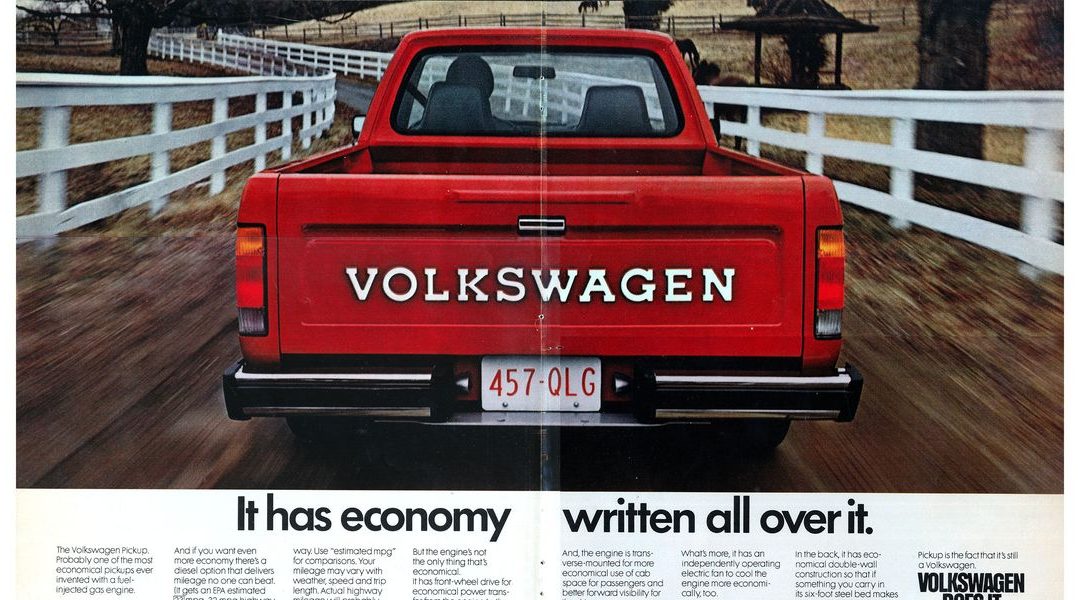

Volkswagen is – apparently – planning to bring a small pick-up to the United States sometime around the end of the decade. If it turns out to be like the pick-up VW used to make, it might save VW – which is currently in a bad way, on account of its badgered-into-it “commitment” to EV-everything it makes. The badgering that arose after the persecution of VW for making lots of low-cost, high-mileage diesel-powered vehicles that threatened to upset the plan to make everything EV (not just VWs).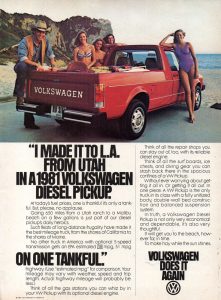
Those had to go – so an excuse was found. VW “cheated” on government emissions certification tests. The “cheating” was so fine the government didn’t detect it, which ought to tell you something about how pedantically trivial the “cheating” was, in terms of the meaningful difference in emissions. It took specialized lab equipment and an Inspector Javert-like determination to find the difference and – voila! – it was found. This became the justification for roasting VW over the coals, frog-marching VW executives before kangaroo courts and – the most important thing – getting those low-cost, high-mileage VW diesels off the market so as to eliminate the possibility of unflattering comparisons with battery-powered vehicles.
Getting back to pickups.
VW used to sell one, back in the early ’80s. A diesel-powered one, at that. It wasn’t really a truck, per se – in that was based on the VW Rabbit, which was a car. So it didn’t have truck bona fides such as body-on-frame construction and its engine was small and mounted sideways (i.e., transversely) and drove the front wheels. Trucks – the “real” ones – are front-engined, but rear-wheel-drive, with 4WD available. The Rabbit pick-up did, however, have a real (six foot) bed – which made it like a truck in that it could be used to carry things back there. Maybe not super heavy things, as a “real” truck can carry. But, nonetheless, things that wouldn’t fit in a trunk or that you maybe didn’t want t carry inside the car, such as a wet dog. The Rabbit pickup was ideal for light-duty truck stuff without actually being a truck, which was a plus for people who didn’t want a “real” truck – and the “real” truck gas mileage – but did need to sometimes carry stuff – such as a wet dog or maybe some bags of mulch.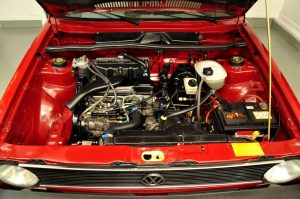
The Rabbit pick-up’s other virtue was that it was available with a diesel engine – paired with a manual transmission, if you can imagine that. It was legendarily slow. Zero to 60 took about 20 seconds, which means it took roughly twice as long as the slowest new vehicle you can buy today takes to make the same run. But it compensated for that by being more fuel efficient than any new vehicle you can buy today that is not a hybrid (with all the added cost that comes along for that ride). The early ’80s Rabbit pick-up with the 1.5 liter diesel averaged 50-something MPG. The brand-new MSRP in 1980 was $6,070. That would be about $25k today.
Do you suppose something like that would appeal, today?
Maybe VW ought to give some thought to that. After all, VW literally translates as “people’s car.” That necessarily means affordable, practical cars. Those are the kinds of cars VW used to sell – and sold millions of. There is, as the saying goes, a market for those kinds of cars. It was until recently the bulk of the market, as most people are not affluent people. What happened to this market? It was abandoned in favor of affluent-people’s vehicles, which have higher profit margins. Fewer were sold but more money was made on each sale. The problem with that – for a company whose very name is synonymous with a affordable cars – is that it is hard to maintain volume sales when there are fewer and fewer sales. A “market” that consists mostly of luxury cars (effectively) isn’t much of a market. It is also one that will necessarily get smaller – and smaller still – as more and more of us slide into non-affluence.
Imagine what might – and could – be. A modern-era VW pickup, based on the current Golf, for instance. Powered by a clean – yes, they were that – diesel engine that could exceed the mileage returned by the ’80s-era Rabbit diesel without needing 20 seconds to get to 60. Or even half that much time. Before VW was forced to take its lineup of modern, low-cost and high-mileage diesel-powered vehicles off the market about a decade ago, you could have bought a diesel-powered Jetta that not only got better than 50 MPG but also got to 60 in just over 8 seconds.
Imagine something like that with a six foot bed. For around $25k.
Do you think it might sell?
. . .
If you like what you’ve found here please consider supporting EPautos.
We depend on you to keep the wheels turning!
Our donate button is here.
If you prefer not to use PayPal, our mailing address is: EPautos 721 Hummingbird Lane SE Copper Hill, VA 24079










[…] https://www.ericpetersautos.com/2026/08/11/the-pick-up-vw-ought-to-make/ […]
As wonderfully as such a truck would be, our (((government))) would never let something like this happen again….the old days really were better….
“Oy Vey, Mosche, we gotta shut it down!!!
The Goyims, they be knowing!!!”
“Relax, Ehud, between Elon running the electric cars scam, and Klaus with the WEF, the Goyims will have nutting and be happy, since the cats will be unaffordable!!!”
Hand rubbing and shekel grubbing ensue ….
YMMV….
Could VW put a gas engine in the rebooted Scout?
Hi Roscoe,
Sure they could! Dodge did that with the Charger (belatedly). VW could do it preemptively and perhaps save itself a real mess.
I bought a 1981 model as a demo. Yes it was slow and cramped but it gave a young married couple an opportunity to have a mostly reliable vehicle. I drove it for 2 1/2 years before trading it for a 1984 Dodge D50 with a Mitsubishi diesel. A really nice little truck
Your jew government does not want an affordable car, truck or house. They want you contained and maintained in a 15 minute city, a mini Gaza. A killing field.
This is kinda interesting as VW makes her list several times. I think she’s wrong on EVs for reasons we all know here in the EP family. Otherwise it’s informative in dealing with dealers.
https://www.youtube.com/watch?v=s16qft6AnqM
Her chat towards the end about how dirty the financing practices are is worth watching.
The Europeans have long had the Piaggo Porter line of small trucks and vans. They had a nice new 1.2 liter turbodiesel engine for a while (P120) – and it was strangled by insane EU bureaucrats, because of course it was.
These were quite inexpensive in the past, but approach EUR30,000, now – about USD35,000. They are reasonably worth less than half this much.
Fun fact: The Porters started life as a licensed version of Daihatsu kei vans and trucks (presuming Wikipedia is correct). Say, where are those American Kei cars we were promised, anyway?
So, we circle back to the foundational problem VW is facing – a regulatory environment that makes it impossible to build inexpensive vehicles, because – at best – the bureaucrats and politicians making the regulations are unmoored from reality.
If you consider that the American economy is incapable of functioning without readily available affordable vehicles, you must ask what exactly are the regulators doing if not intentionally sabotaging the economy? This goes for Europe, Canada, Australia, and New Zealand, as well. Who benefits from this? It’s not Americans or Europeans, et. al..
Had one of the diesel rabbit pickups about 3 years ago. I loved the idea, dragged a rust free one out of a field and got it running (basically replaced the battery and all soft fuel lines). That cab is so small and misproportioned I couldn’t keep it. Made a nice flip though.
Those metal fuel lines in my 80 rabbit diesel were pure evil absolute trash. Every one cracked in the month I suffered the wortless POS.
NO, we dont want a repeat.
Hi Rain,
I meant a repeat – in concept. The TDI Jettas of ten years ago were brilliant. Imagine that with a six foot bed…
What bothers me is that vehicles like the OG iteration of the VW pickup are the kinds of vehicles we really need right now and thus would sell right now. What’s more, today’s technologies, like port fuel injection, overdrive transmissions, and next generation diesel engines and AWD systems, a new generation VW pickup would outperform the original for not that much more cost or complexity—plus it would ride and handle better, last longer, and maybe even cost less.
But that’s not likely to happen, at least not until some time after the next ice age…
Imagine those 80s and 90s cars in concept made with the technology and manufacturing capability now. We’d be living with reliable, simple cars that would get 60 MPG and not be slugs. Nooooo, we’re saddled with junk. Regulations compliance certainly factors in no small part but it’s market, too. There’s nothing stopping any of these companies from making a simple Rabbit that’s compliant, it can be done technically (see cars sold in South America, Asia and Africa). The car companies are run by clueless diversity hires in design and market overseen by MBAs who can only see one quarter ahead in financials.
Lots of legacy automakers have lost their way but VW seems to have taken it to the next level. After dieselgate they moved too far and too fast away from their core buyers. This vehicle won’t help them either. They built a pickup for years for other markets that did well. They replaced it with a rebadged Ranger. Same for the Transporter which is now basically a Ford Transit. Built in Turkey no less. There is no uniqueness left of the old VW. It’s EV or bust for them at this point. And their EVs just aren’t competitive. The Chicoms are already setting up shop in Europe to produce cars.
It will be interesting to see what happens to these companies over the next few years. Some of them are in serious trouble. Porsche seems to be following the VW path. Even Honda is struggling and is said to be reconsidering a merger with Nissan which sounds desperate to me.
>VW used to sell one, back in the early ’80s.
Way before that, there was the Type 2 Single Cab – T1 (1951 to 1975):
https://www.classic.com/m/volkswagen/type-2/t1/single-cab/
I paid $200 in early 1970s fo a 1960 model. Previous owner called it “the Worm” because it was so slow. Naturally, mine got modified so that it wasn’t. With the engine mounted over the rear drive wheels plus a pair of tire chains, it was possible to take it nearly anwhere in mud or snow. There were many custom modificaions of this vehicle, to include even a fire truck.
Over thirty years ago I looked at buying a used diesel VW pickup but passed when the owner said it needed new glow plugs but started fine with a shot of ether. It might not have damaged it but I got the impression that the truck had starting problems for awhile.
I suspect a small, affordable and nanny-tech free vehicle would sell but until things got bad enough in this country they would never allow it to sell. I also suspect that new REO truck will get away with it by limiting themselves to that 500 vehicle limit like Revology does.
Reo! Which reminds me … gotta gin up my own compact truck prospectus, give it a tough but tender name (for the distaff buyers), and start unloading the daily haul of 99-dollah deposits from my p.o. box in a wheelbarrow. I care!
Reo’s $25 deposit sends the wrong message, if you expect to get what you pay for (vaporware). Scout Motors is $100, but it’s a frickin’ EREV if it has an engine at all.
Everybody needs a side hustle, right? 🙂
The current cognitive dissonance in the Western World will soon implode. As Ayn Rand preached, living contradictions will eventually destroy themselves. People who insist you can’t believe your lying eyes will soon depart. Even that gay bastard Lincoln said you can’t fool all the people all the time.
Hopefully, that time is about to be upon us.
As Confucius said roughly 1500 years ago, “The beginning of wisdom is the ability to call things by their right names.” Failure to do so leads to massive cog-diss, exactly where we are today.
Thanks for bringing this quote to my attention, cobblestones.
I like this translation even better:
The original source is found in the Zi Lu chapter (Chapter XIII), where Confucius states: “If names be not correct, language is not in accordance with the truth of things.”
My understanding is that the quote is a sort of amalgamation of Confucian thought, a la https://www.ajayraavi.org/confucius
Link to that original source please?