

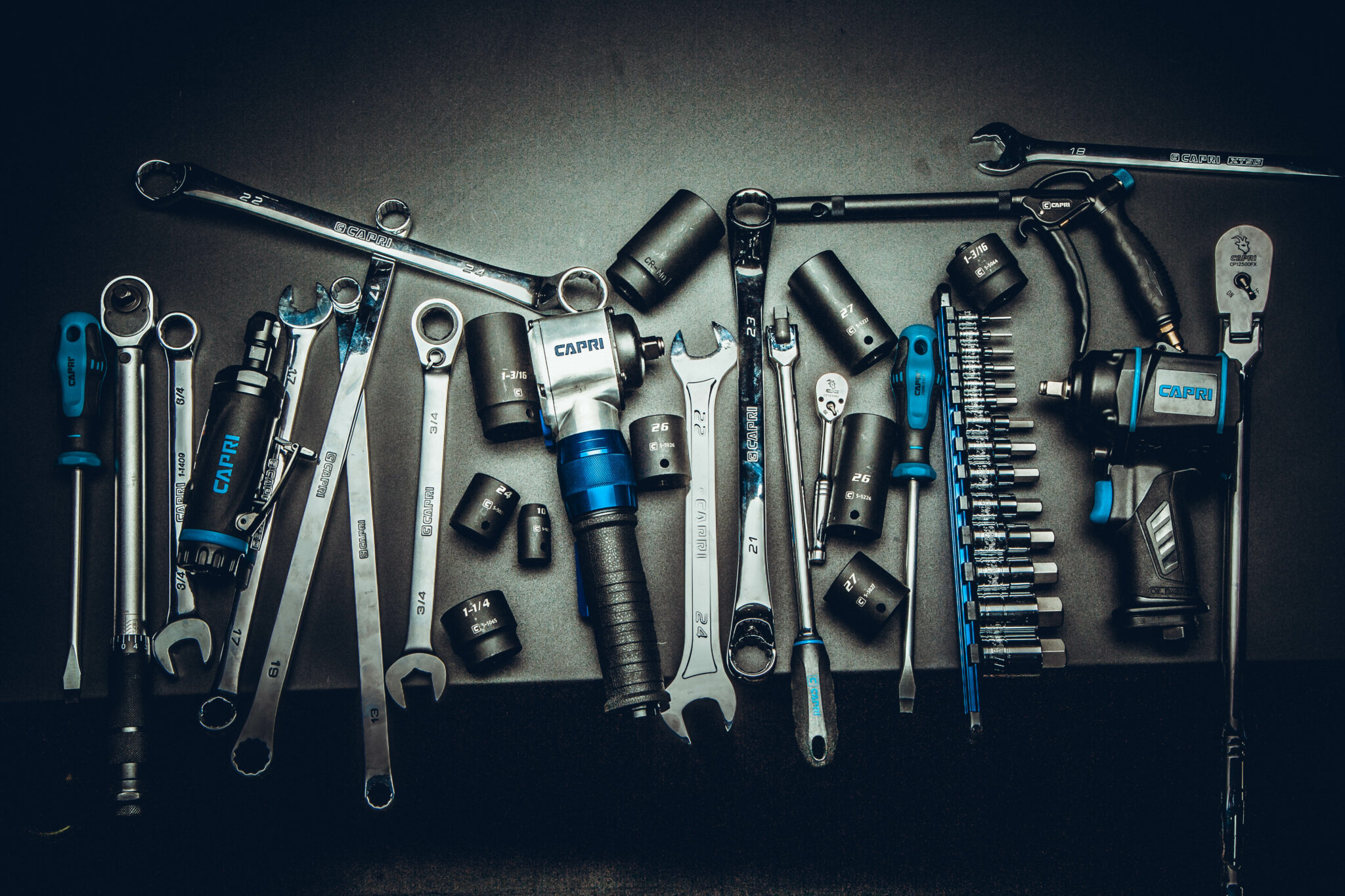

If you work on cars, you probably have tools. And if you work on cars long enough, you will discover that you always need more tools, because there will inevitably be some job that requires tools you haven’t got, even if you already have a lot of tools.
Recently, I had to change out the water pump in a 2005 Toyota RAV4. I have changed out dozens of water pumps over the years but until now, never a 21-year-old RAV4.
Not only did I need some tools I didn’t have – I needed to make some tools to get the job done, because the tools I needed – such as a long 12 mm wrench and a long 14 mm wrench – weren’t readily available anywhere. I tried Home Depot, I tried Lowes. I even tried Harbor Freight, which usually has a selection of Chinesium tools. (I did not get a Chinesiu replacement water pump – because I ‘d like to not have to do this job again three years from now.)
The problem was they were all packaged together. To get, for instance, a long-handled 12 mm wrench I needed to loosen the bolts that hold the pulley to the water pump snout, I would have had to buy a whole (expensive) set of wrenches I didn’t need – though maybe in hindsight I ought to have bought the set so that next time I’ll have a tool I have no idea I don’t need (right now) but will at some point in the future.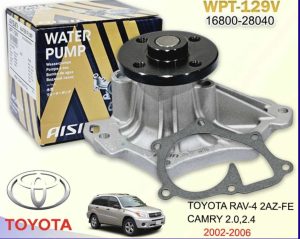
I could use a 12 mm socket, in case you’re wondering, because there’s not room enough to get one on these bolts. At least, not with the ratchet attached!
Sears used to be great for tools you didn’t have but needed right now, today. They had racks of individual sockets, deep and not. Rows of wrenches in various lengths – and you could buy just the one you needed, too. Sears is, of course, no more and now – if you need a specific tool – a specific or oddball tool – you’re probably going to have to go online to get it and that means you probably won’t be able to get the job done you started today finished today.
Unless, of course, you improvise.
That’s what I ended up doing when I was unable to get the extra-long 12 mm and 14 mm wrenches I needed to get the pulley bolts loose and then get enough leverage action on the tensioner bolt to get the serpentine belt off the pulley.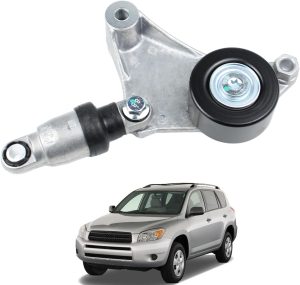
Replacing a water pump is usually a simple and easy job – if the vehicle isn’t FWD/AWD. If it is, the engine will be mounted sideways and the side on which the water pump and all the other accessories are mounted will often be snugged up very close to the frame/bodywork such that you have very little room to work with. That’s bad enough, but when you need to apply a lot of leverage to get a tight bolt off, it can be a whole lotta fun!
The first step with the RAV4 is to break loose the four bolts that hold the pulley on the water pump snout. This is harder than it sounds because there’s so little room to work with and if you haven’t got an extra-long 12 mm wrench you will have a time getting enough leverage to break the bolts loose. As an aside, you do this part before you take off the serpentine belt, which keeps tension on the pulley and prevents it from turning when you try to turn the bolts, to break them loose. In my case, the belt tension was not enough to keep the pulley from turning as I tried to turn the 12 mm bolts. I ended up using a vise grip on one of the four bolts, which I used not to turn the bolt but to keep the pulley from turning – by using the vise grip on the one bot to stop its travel as it wedged up against the motor mount – while I using my 12mm wrench/breaker bar to break the tension on the other three bolts. The I moved the vise grip pliers to one of the other three and loosed the last stuck bolt.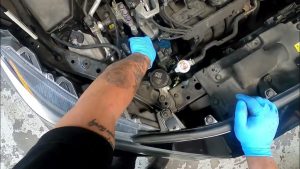
So much for the pulley.
But still needed to get the serpentine belt off. On the RAV4, there’s a 14 mm tensioner bolt you leverage to create enough slack to slip the belt off. But first, you’ve got to loosen another 14 mm bolt that secures the tensioner bracket to the side of the engine. To even be able to see it, you have to be under the car, with the passenger side front wheel and the plastic splash guard in the wheelwell area removed first. The bolt is easy to see then – and easy to reach, too. But you’ll probably need a breaker bar on the wrench to get the leverage you’ll need to break it loose. Once it’s loose, you can use a 14 mm socket and a breaker bar to leverage the tensioner bolt and slip the belt off. There is a special tool for this but you don’t have to have it. The job is easily done from below, where you can apply more force more easily while lying on your back than standing up.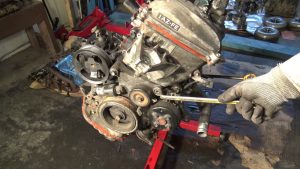
Then it’s just five 10 mm bolts to get the old pump off (you’ll also have to remove two larger, 14 mm bracket bolts to allow the alternator to be moved back enough for clearance). Then reverse everything to finish the job with the new (non-Chinesium) pump. It’s not so easy peasy Japanesey – because of the tight working space that attends the FWD/transverse engine layout. I can replace my truck’s water pump in less than an hour because everything’s accessible and no funky/home-made tools are needed – because its engine is front to back and so the front of the engine isn’t snugged up against the frame, like the RAV4’s is.
At least now I have some of the tools I’ll need to do this job the next time!
. . .
If you like what you’ve found here please consider supporting EPautos.
We depend on you to keep the wheels turning!
Our donate button is here.
If you prefer not to use PayPal, our mailing address is: EPautos 721 Hummingbird Lane SE Copper Hill, VA 24079










After all the frustration, scraped knuckles and cursing, you begin to realize why shops charge what for what they do. This biggest PIA job I’ve done was replacing a heater core in a ‘91 S-10 I used to own. Of course it had to fail in the winter when you needed it.
How long was the task from start to finish to replace the water pump?