

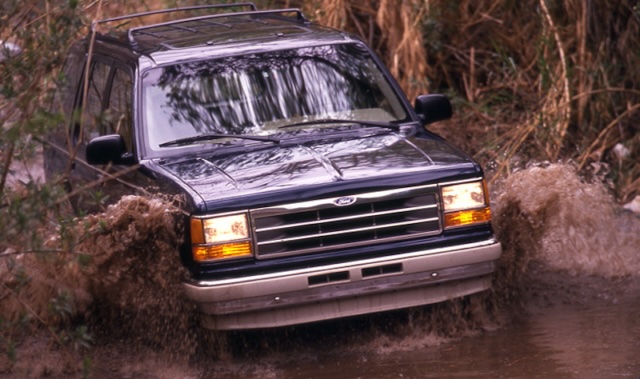

Back in the late 1980s, Ford had a fine idea. This idea took the form of the first mass-market SUV, which it called Explorer. Previously, there were what people called 4x4s – usually said out loud as four-by-fours – which were basically trucks with a camper-style shell over the bed. The Ford Bronco – the one OJ drove, also in the ’90s – was an example of a 4×4. Also the Bronco II, which was a smaller iteration of the same thing that preceded the Explorer.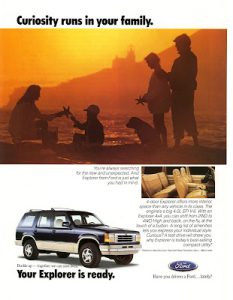
It was probably the success of the Bronco II – which Ford began selling in 1984 – that gave Ford the idea to create the larger but similar Explorer, which debuted in 1991. The Bronco II’s last year was the year prior, so the Explorer can be seen as the Bronco’s replacement. Both were built off the same underlying platform that was used to make the Ranger pickup – which eventually led to a huge debacle for the Explorer (and Ford) in the late ’90s that wasn’t arguably so much the Explorer’s fault as the fault of it being the first mass-produced 4×4.
Prior to the Explorer, 4x4s were niche market vehicles – as muscle cars were – in that relatively few people bought them and most of those who did understood them. More finely, they were aware of their particular capabilities and their particular weaknesses, which were the trade-off you accepted as the price of having the particular capabilities. In the case of muscle cars, you accepted that they were not the hot ticket for snow days; that they got terrible gas mileage and that they were louder than other cars and less forgiving of mistakes or of drivers who lacked the experience, skill and judgment to keep them under control. If, for example, you were someone who did not know how to deal with a vehicle that had an engine so powerful it could be steered with the rear wheels, you were someone who was likely to get in over his head in one of the things.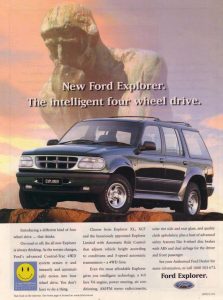
The early SUVs – which were 4x4s, despite the change in marketing nomenclature – were exactly similar in this respect. They were boxed-over trucks and had truck-like suspensions and truck-like higher centers of gravity. This made them more rugged and able to be driven on roads that would impale or otherwise cripple a car that tried to go there. 4×4/SUVs were also much better on snow-covered roads than cars, both because of the additional ground clearance and the four-wheel-drive. Back in the late 1980s and early ’90s, most cars were two-wheel-drive, meaning they were either front-wheel-drive or rear-wheel-drive. The current near-ubiquity of all-wheel-drive was highly unusual back in the late 1980s and early ’90s. 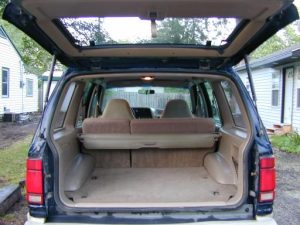
When it came out back in 1991, the Explorer also had room – for both people and for cargo. Remember: This was a decade before the crossover – which is shaped to look like an SUV and has the interior space and configurability of an SUV – began to appear as a mass-market vehicle. Back in the early ’90s, most cars were smallish – a consequence of the downsizing trend that began in the mid-late ’70s as a result of federal regulatory pressure to make cars more fuel-efficient, whether people wanted that being immaterial. The SUV was the answer – for many people who wanted a spacious car that could also pull a trailer if the need arose. The snow-day capability was a huge part of the sell, too. Not so much the off-roading capability except in so far as the image – and of course, that sells also.
You can perhaps see where this is headed. More finely, where it went.
There were a lot of people who bought first-generation Explorers who had no idea what a 4×4 – or an SUV – was, except in terms of the marketing. They did not know that 4x4s (and early SUVs) were much easier to lose control of in the curves or at high speed, when subjected to sudden and aggressive steering/braking inputs. This being a consequence of their higher center of mass – which made them inherently more tipsy. Most also had truck-like, suspension system -including leaf springs in the rear and a solid (or non-independent) rear axle. People who knew 4x4s knew better than to drive them as if they were spoirts cars, at high speeds – especially in the curves. They knew that their handling was more of a handful. Like any tool made to do a specific thing, 4x4s were not very good at tasks they ghad not been designed to be good at.
Well, what happened was some people drove those early Explorers just they drove their cars – at high speeds and in the Explorer’s case, on marginal Firestone tires that were often low on air, because the owner forgot to check and make sure they weren’t low. And they were also just low, even if they were full – in that the specified a tire pressure number was designed to help soften the Explorer’s ride – because most of the people who bought one expected it to ride like a car rather than a 4×4.
Combine the high speed and the low/underinflated-some-more inflation pressure and you get friction, which builds heat and – as happened number of times – a sudden, catastrophic tire failure. When that happened, the Explorer became instantly unstable and – sometimes – uncontrollable. There were barrel-rolls and deaths at the end of them. Firestone got most of the blame but Ford got its share and we all got mandatory tire pressure monitoring systems (that seem to never work).
The Explorer was converted into a crossover for the 2011 model year. It still looked like an SUV but it was now based on underthings more like those of front-wheel-drive cars. This was a better set-up for people who didn’t really understand what a 4×4 SUV is but want something that looks like one.
Then – in 2020 – it became an SUV again, completing the circle. Only this time, it was an SUV that could be safely mass-marketed because it wasn’t dangerous in the hands of people who didn’t know about SUVs. Well, it could be dangerous. Anything can be – in the hands of a fool or a maniac. But the new Explorer could be driven as if it were a car – or a crossover – because it didn’t require any special skill, knowledge or judgment to drive it safely.
The same is true of most other modern SUVs, too.
On the downside, it seems as though – looks as though – everyone is driving one now. Or one that looks like one (i.e., a crossover). Which makes it almost strange to drive a car – assuming you can find one to buy.
There aren’t many of them around anymore.
This is a measure of thew original Explorer’s success – but it is also measure of the consequences of federal regulations. If it weren’t for the latter, in particular, Corporate Average Fuel Economy regulations, it is probable most people would still be buying and driving cars – because there would still be mass-market cars with plenty of room for people and stuff in the trunk that could also pull a trailer because they’d still have V8s and would still be affordable in that configuration. Instead, we’ve got all these SUVs, 4x4s and crossovers made to look like the latter.
You can thank the federal government for that.
. . .
If you like what you’ve found here please consider supporting EPautos.
We depend on you to keep the wheels turning!
Our donate button is here.
If you prefer not to use PayPal, our mailing address is:
EPautos
721 Hummingbird Lane SE
Copper Hill, VA 24079
PS: Get an EPautos magnet or sticker or coaster in return for a $20 or more one-time donation or a $10 or more monthly recurring donation. (Please be sure to tell us you want a magnet or sticker or coaster – and also, provide an address, so we know where to mail the thing!)
If you’d like a Baaaaa hat or other EPautos gear, see here!








I stopped being interested in the Explorer when they discontinued the 2-door version.
Actual cars are getting harder to find. Chevrolet has only one car in their lineup.
Hi ejb –
Yup. The only car Ford still sells is the Mustang – and it is not selling well. The only cars GM sells are a few Cadillacs. Chrysler sells a minivan. Dodge sells devices. And they ask me why I drink…
The Bronco II was known for being “flippy” long before the Explorer – on which it was based – became a headline for doing the same.
Sounds like an inherent Ford specific design flaw, since I have zero recollection of the S10 Blazers having widespread similar issues.
How do you not at least give a nod to the GMC Jimmy ?
I want to know when/why the color pallet looks like every new car is just painted with primer. Horrible greys and teals that are bland and soulless. As if the base model only comes in primer-dull colors with some clear coat.
When/how did the colors get dystopic?
Hi Steve!
I see the same. I think there are a couple of factors. The first is that color is one of the very few remaining ways to make a new car look different. The other is that many manufacturers charge significantly extra for colors other than silver, black and white.
Ah yessum Erk
https://www.youtube.com/watch?v=C6xN6K_X_KI&t=40s
(Top Gear News circa season 9 give or take)
This was a decade or better ago. They made the colered versions brighter, that’s all. But the Honda Accord is not an executive car. I think you can get it in a deep blue or a dark red that’s alright, but that’s about it. I guess car companies not wanting to commit to bold colors that people might not want in the future has resulted in colors that I don’t see us liking right away.
Sorry for the typos, Steve!
This obnoxious wireless mouse I have is extremely sensitive and if not very carefully used will often add a letter/overwrite what I’ve written and if I don’t catch it then you see it in what I’ve written. I suppose it’s better than White Out (for those who remember that).
These are a natural response to the totalitarian police state which we have allowed to be set up around us. Any bright color or attention getting visual is going to attract predators. I’ve driven low observable/stealth vehicles for decades, consistently 8-9 over the PSL, without hassles. Within weeks of picking up a bright red Honda Civic coupe I was robbed by the gestapo for going 62 in a 55 on a lightly traveled rural highway.
Civilization is in retreat, and corrupt officialdom is the only thing thriving.
I drove lots of these types of “trucks” over the years my wife too. The first was a 86 Isuzu Trooper,(loved It) later a first gen Bronco then a 4th gen Bronco….. and a 2nd gen Bronco 2 Then a …Gasp… 2nd gen Explorer sport. 2 door short wheelbase.Never crashed any of them. We drove them hard on the back roads.We both started out on sport cars…Lots of Datsun 240Z…..Glory Days.
A WSJ stenographer writes about the nightmarish car of the future. It does everything you can imagine except, well, … let you drive it:
‘Revamped navigation systems will plan your ideal route, make hotel reservations and even teach you about the surrounding geography. Car interiors could transform into a mobile movie theater. And lie-flat massaging seats will activate during endless highway stretches.
“Your mobile phone will be the center of your digital ecosystem, and will seamlessly transition that information to connect and personalize experiences for each occupant,” Google VP Patrick Brady says.
‘Externally mounted cameras integrated into the car’s saaaaafety systems could project real-time images for passengers to see, alongside reviews or historical details about roadside sites pulled from the internet, according to Brady. The windshield, embedded with augmented-reality capabilities, could act as the screen.’
https://archive.ph/3l7hy#selection-2495.0-2495.316
Yeah, right … who needs to like, see through the windshield, when you can blot out boring reality with a gigantic heads-up Clownscreen?
Here’s how Google’s soyboy automotive manager thinks: “You could say, ‘Find a Mexican restaurant along my route with good vegan options and fast service that’s near an EV charging station,’” says Brady.
HA HA HA … effing clown! You need to move out of your Siliclown Valley bubble and do some time in the real world. Real cars don’t drive themselves, punk.
A few observations:
1. Based on my experience, 4×4 was *any* 4WD pickup, regardless of body style. In the early days, they were indeed niche market vehicles, mainly favored by hunters and others whose activities routinely took them off paved roads. My 1968 IH 1200 step side pickup was such a vehicle (304 IH V*8, one 2 BBL Holley, 4 speed manual, 2 speed transfer case). It was bought brand new by U.S. Govt., for what purpose I do not know. The IH “station wagon” was the Travelall, which was manufactured from 1953 to 1975, and was in fact a passenger car built on a light truck chassis. It competed against the Chevrolet Suburban, which began production in 1935. Both of these were available with 4WD as an option.
Were they “mass market?” Not really. Which just means they were not all that popular.
A co-worker in the early 1970s owned a 2WD Suburban, which was his wife’s car.
2. A 4WD “station wagon” which was considerably more popular was the Toyota Land Cruiser. The J50 series began production in 1967. According to Wikipedia, “Toyota refers to the FJ55G and FJ55V as the first “real” station wagon (now known as a sport utility vehicle) in the Land Cruiser series, thus marking the beginning of the station wagon body style.” My sister drove a J50 (bought brand new) for many years. These vehicles were legendary for their durability and reliability., both desirable traits if you are going off the paved highway. Mass market? Depends on your definition, I guess. According to Wikipedia, the Land Cruiser J60 sold >1 million copies in 1981. I would call that “mass market,” but perhaps others would disagree.
#. So why did Ford, a late comer to the “station wagon on a light truck chassis” class of vehicle, decide to build the Explorer? To the best of my knowledge (and somebody please correct me if I am mistaken), the answer, in one word, is emissions. IIRC, the Fed Gov emissions regulations at the time were considerably less stringent for light trucks than they were for passenger cars. So, building a station wagon on a light truck chassis was a perfectly legal way of “giving the middle finger” to the EPA. For awhile, at least.
Ford was still selling the Taurus wagon at the time, but that was front wheel drive and lacked a V8 option.
The Explorer could pull a boat, which was more important in Michigan at that time than many people imagine.
>Ford was still selling the Taurus wagon at the time
See my comment below.
The US’s FJ55 is affectionately called the iron pig. The styling can be a bit polarizing, although now it’s mostly love. But it was pre-dated by the FJ45LV, the first Toyota 4 door, long wheel base station wagon.
But I’d call both of them still niche vehicles. The Land Cruiser, the Scout, the Nissan Patrol, Jeeps and Broncos were used by hunters, skiers and mountain residents and recreationally for camping. They were occasionally driven daily but it was a crusty old guy with a big beard or a young man.
I’d suggest the first mass market SUV was really the Wagoneer. That’s really here in the mountain West the first vehicle that by the mid 1980s you’d see families driving on a more or less daily basis, housewives didn’t seem to feel intimidated by them like the even more utilitarian options. Maybe that wasn’t true in other places, I can’t say.
The reason I say the Wagoneer is it seemed to spawn all the familiar wagons, the FJ60, which Toyota really hit the mass market with in the FJ62 (EFI, automatic, power windows, etc.) and is the model all the cushy Land Cruisers modeled there after.
The Explorer was Ford’s 4 door answer to what already existed. There’s the Suburban as also mentioned, that was really the grand dad to them all, although it was 2 doors for a long time and later developed extra seating and two more side doors. I’d also maybe make the point that the Explorer was as much a reaction to the 4Runner, which Toyota brought out in 1984 as a lower cost, smaller option to the Land Cruiser. But that didn’t have 4 doors until 1990.
‘we all got mandatory tire pressure monitoring systems (that seem to never work)’ — eric
That’s another perk of my late-Nineties, manual-shift relics: no TPMS. A pressure gauge kept in the glove box tells me what the tire pressure is. Duh, numbers! Maff is hard, especially in Megapascals.
Just because TPMS is technologically possible doesn’t mean it should be mandated. It’s just one of dozens of nanny-tech functions which cumulatively add thousands of dollars and hundreds of pounds of weight to the contemporary fleet of waddling fattie vehicles.
Car buff magazines
should behave been phased out. Current transport appliances can be adequately covered in the scintillating pages of WDD — Washer, Dryer and Dishwasher — ‘your 220-volt connection.’Yeah, my newer vehicle (as opposed to the old one I still have) has the tire nanny. It is hilarious to see it turn on when I first go out to start it in the Winter at -30 below. That is when the nanny really gets its undies in a wad. Everyone has square tires at those temperatures when a vehicle sits outside for any length of time. First time I saw the nanny light on (and saw the tires looked fine-checked them and they were fine), I drove off, only to see about 10 minutes into driving, the nanny light went off. I just shook my head at the stupidity of it all. One day, it will inform me that snow is slippery to drive on. There again with the way people drive in these parts, they might actually need the reminder.
Morning, Shadow!
I drive these new vehicles with tire pressure monitors every week and it is extremely common for them to register inaccurately. Mind, these are brand-new vehicles. After a few years of the sensors being exposed to moisture and heat, etc…. as OJ used to say: Look out!
I remember that there were also quite a few all wheel drive (both part time and full time) sedans and station wagons like the AMC Eagle, Audi Quattro, Toyota Tercel, and Subaru Legacy before and during the debut of the Ford Explorer. They were quite popular in snow country, and in fact more popular than truck-based 4x4s. That’s because they gave you great bad weather traction and handling without the lousy gas mileage and not great on-road handling—which was fine because the owners of such vehicles had no intention of going off road.
Ford played in that market also, with the Ford Taurus, introduced in 1985. Transversely mounted engine powered the front axle. The CV joints were notorious for short lifetime and expensive repair.
The problem was never high performance cars and off road capable vehicles but rather low performance drivers who never took the time to learn how to drive correctly. Now of course with modern technology such as stability control you can drive like an idiot and survive but that does not make you a good driver, just the equivalent of someone who needs crutches to walk.
The Explorer hit right after the soccer mom’s realized that a Chrysler Voyager was just a boring people mover. Third wave Feminism had entered the mainstream, and women were no longer going to accept the patriarchy forcing them into mini vans and monogamy. Boomer feminists were ready to sow their wild oats and act just like another one of the dudes. A macho faux-offroad hot rod was just the ticket.
Mary Richards drove a Mustang. Mindy McConnell drove a soft top Jeep Wrangler. We don’t know what vehicles Kate & Allie drove, because cars are the tools of the patriarchy. If I had to guess I’d say an AMC Pacer and International Scout, just based on the real-life “single moms sharing expenses” in the neighborhood I grew up in.
Jamie Sommers drove a Z. That was huge product placement for Datsun at the time.
Outside of the show credits you never saw Mindy McConnell actually driving the Jeep.
I blame Daisy Duke’s stuntperson for the way women drove Explorers which eventually led to the fiasco. Daisy had a CJ 7 in the later seasons of the “Dukes of Hazard”.
SUVs quickly became empowerment vehicles, long before Brie.
They probably drove Subarus, if you know what I mean.
Jane Curtin drove a 4-wheel drive Mercedes station wagon in the 80s and 90s, spanning her time on “Kate and Allie” and “Third Rock From The Sun”.
Curtin’s “Allie” character on “Kate and Allie” probably drove something similar.
As for “Kate”, Susan St. James drove a classic MG on McMillan and Wife.
I remember my brother-in-law trading in the family hauler Toyota Previa minivan for a new Jeep Grand Cherokee in 1996. The local Jeep dealer had an off road course behind the dealership and gave him a course or two in what the SUV could do. He was so proud he showed us his new Jeep by driving it up and down the hills behind their subdivision.
So it wasn’t all gals that wanted a SUV. 🚙 😉
But yeah, by the 1990s minivans had the stigma of being a “boring family car driven by a boring parent.” Not fair, but there you go.
The 90s Cherokees were eligible for trade in “Cash for Clunkers”.
Not many survived.
The minivan still has this stigma. This fact makes it the perfect stealth vehicle for a smuggler. Be sure to get it in white for maximum stealth.
Minivans are great. Lots of room, excellent ride, they just don’t look kool.