

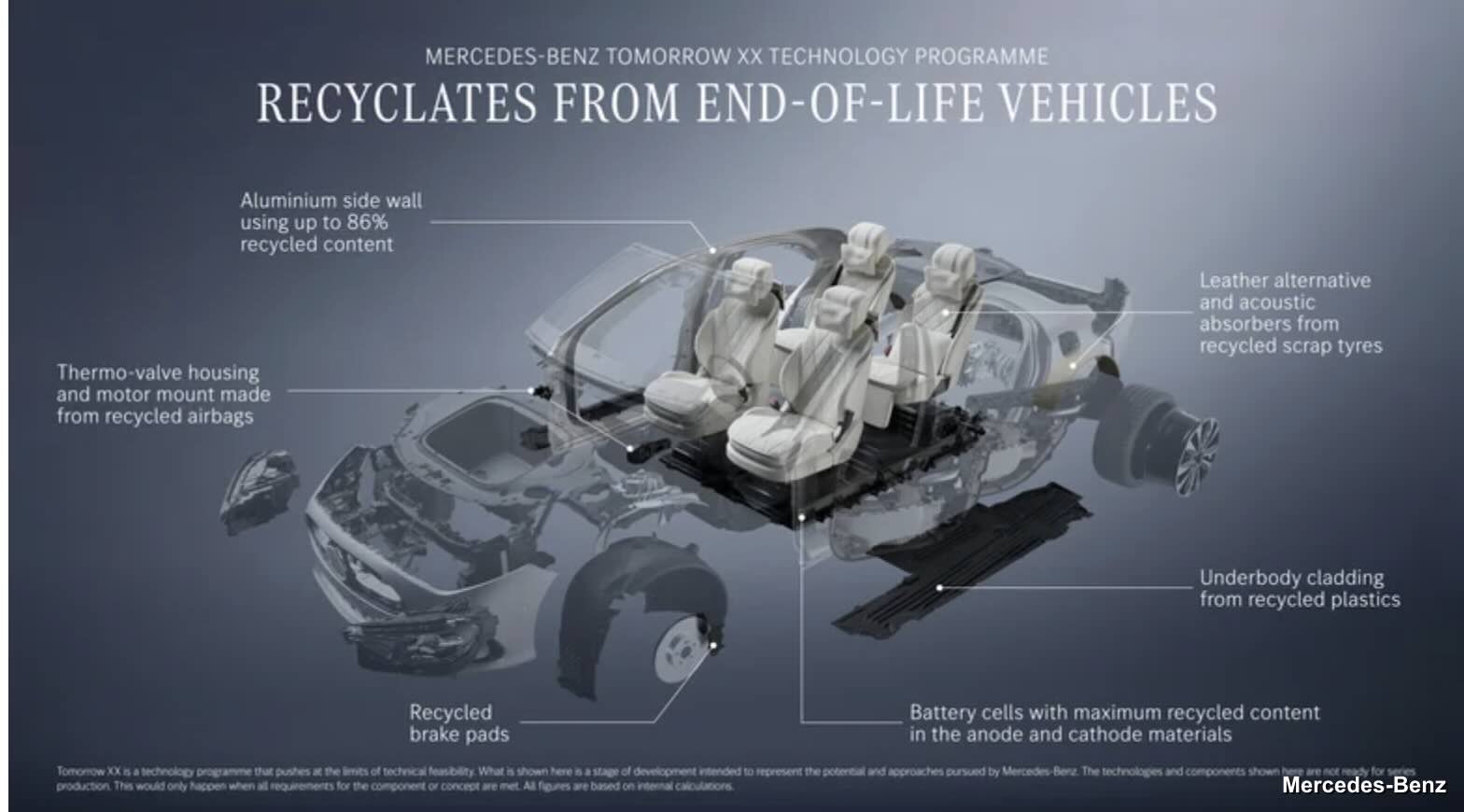

Well, sort of.
Apparently, Mercedes is going to try to make components more fixable – as opposed to disposable – by using screws rather than glue to hold certain components (such as headlight assemblies) together. But that’s incidental.
The real reason Mercedes is going with screws rather than glue is “sustainability.” Naturally. Mercedes has transitioned from being chiefly a car company to being a socially conscious company. This sounds all kumbaya-my-lord but “socially conscious” (like “sustainability”) is verbiage meant to manipulate the emotions (and thereby negate the thoughts) of the people confronted with it. Who, after all, could be against sustainability or not socially conscious?
What’s next? Kicking kittens?
No. Just something “greener.” Meaning – decoder ring! – more red. That is what ought to come to mind whenever you hear or read about anything being “green” – or “sustainable” or “socially conscious.” It means you – and the rest of the proletariat – must make sacrifice that the people pushing “green” and “sustainable” things will not themselves make. John Kerry and his class of people will not be doing Zoom or WhatsApp calls to their meetings in Davos. They will fly to them in private jets and be whisked to private hotel suites and eat foods that are not Ze Bugs they insist we must eat because it is “sustainable” and “socially conscious.”
By now, it ought no longer to be necessary to explain how it works. But it is – because words are powerful things. They can and do alter how people feel about what they think and what they think determines what they will do as well as what they will accept that is done to them. 
Wearing is caring. We are all in this together!
Still, it is some good news that Mercedes is at least elliptically going to try to make some of the bits and pieces of its vehicles more repairable. It is, as the saying goes, a start.
It’d really be something if they stopped making the bits and pieces unrepairable without access to a dealer computer. New/late-model vehicles – especially (though not exclusively) luxury-brand vehicles commonly have connected parts that can be physically replaced with new parts of the correct type that will not work, even if correctly installed, unless they are paired with the car and its computerized systems. This pairing can only be performed by a proprietary computer at the dealer, which means you have to go to the dealer to get even small bits and pieces such as new headlight assemblies and wiper motors to actually work, even if they are physically installed correctly. 
Your Libertarian Car Guy is friends with two professional mechanics who cannot work on certain brand vehicles anymore. Not because they lack the tools or the skills but because they cannot afford to spend the $$$$ on the special-access diagnostic machinery and software needed to work on them. 
If Mercedes – or any other car company – were genuinely interested in promoting sustainability they would promote fixability. They would engineer their vehicles to be easier-to-work-on, so as to reduce ownership costs and – thereby – encourage the longer use of the vehicles they make. Instead of a vehicle becoming a throw-away at 12 years or so – which isn’t very “sustainable” – cars that second and third owners could viable keep driving for 15-20 years or even longer than that.
The problem there of course is it’s not very green – in terms of the money to be made. So we get red masquerading as “green” instead.
. . .
If you like what you’ve found here please consider supporting EPautos.
We depend on you to keep the wheels turning!
Our donate button is here.
If you prefer not to use PayPal, our mailing address is:
EPautos
721 Hummingbird Lane SE
Copper Hill, VA 24079
PS: Get an EPautos magnet or sticker or coaster in return for a $25 or more one-time donation or a $10 or more monthly recurring donation. (Please be sure to tell us you want a magnet or sticker or coaster – and also, provide an address, so we know where to mail the thing!)
If you’d like a Baaaaa hat or other EPautos gear, see here!








Real environmentalism is building durable and repairable goods. Which is why I’ve always know sustainability and climate change were just nonsense to crush the middle class while engineering and managing society. It’s always about compelling people to throw away their working old machines and replace them. That’s about crony profit and making people poorer, not sustainability.
Nice comment there, BrentP. It’s too bad more people don’t, ‘get it’.
I.e. made once in 1950 vs. made hundreds of times and thrown away since then. Many car guys (and a few chicks) know about it.
Another example: cheap vacuum cleaners, this guy, ‘gets it’:
https://www.youtube.com/@PerformanceReviews
Ha. I hadn’t seen the bit before, ‘Green, is the New, Red’.
I like the idea of using screws, it’s right up there with building satellites out of wood. It’s practical, sensible & makes the minds of Water-melons, explode. [Is that a prison offense to say in the idiotic U.K.?]
because it is now on Carfax.
I just dropped a comment on the E350 wagon review. This seems like a good place to expand on it.
The early/mid 80s Mercedes diesels are the epitome of what a car ought to be. With minimal care they will run 300000 miles and last 25 years. With regular care that is a lifetime car which will run a million miles and last well over 50 years.
Nothing like this is available today, society has somehow lost the concept of a car being a capital investment which should give lots of reliable service.
Even stuff like Bentley and Rolls are electronic crap. Mercedes and BMW are even worse with user serviceability a lost thing. And the Fords, Chevys, VWs are the same but at least they used to be affordable to the mass market.
“Mercedes and BMW are even worse with user serviceability a lost thing.”
Nonsense. There are multiple forums dedicated to BMW DIY including the modern stuff. I assume the same is out there for MB. Certainly the majority of the BMW and MB demographic aren’t doing their own service but that’s related to the demographics not the mechanics of the vehicles.
It also depends on what the definition of user serviceability is.
Is a modern BMW as easy to work on as a 1970s car? In some ways it’s easier due to OBD and diagnostics. In other ways like physical access to parts it’s more difficult due to packaging more components in roughly the same space.
If you are expecting all vehicles to be as serviceable as a 1947 Chevy, sure I guess you will be disappointed.
Let’s not forget that even in 1947 there were still service stations where those that weren’t mechanically or electrically inclined had to have their vehicles service.
Unfortunately OBD is like an oracle, giving codes which are misleading or just wrong. A code for a sensor could be a problem with the sensor (implied) or a problem with a wire, or a connection, or a related system, or a seemingly unrelated system. Between OBD and my 50 plus years of judgement, I can use it to make diagnoses with a high probability of first time success.
Yes there were and are service stations for people to pay to get their cars worked on, but they are like me, a dying breed due to design philosophies based around greed, not “leaving money on the table”, and in defiant opposition to giving the customer a great deal.
My point above was that a car is a major (capital) investment for the buyer and should last like it. And with cnc machines and robotics it is entirely possible to make stuff to last better and cheaper than the hand assembled stuff I love. But it isn’t so.
BMW and Mercedes have always been a bit harder to work on, until you had the tools and learned the tricks, but it’s a whole nother level now.
Ernie
I don’t think we are saying anything too fundamentally different with respect to a desire for more durable and easy to service vehicles.
Wrenching takes skill and experience. Always has. Unfortunately, no one values that skill and good techs aren’t paid what they are worth by a society that doesn’t value blue collar labor.
I envy your flathead stories and appreciate the simplicity of old iron. My hobby projects are largely from the 60’s and early 70s. My tractor is a 1948.
The flip side (for me) is that I sort of enjoy the challenges the modern stuff presents too and don’t shy away from it just because it’s complicated.
Each has its place.
I’ve worked as an automotive design engineer for 30 years and have yet to work for or with anyone with “design philosophies based around greed”. There are decisions made based on package space, compliance to regs, function, warranty, and a need to build to a profitable price point. Yes, even serviceability is a part of those design discussions. The idea that a 6% – 10% margin on an automotive sale is “greed” is absurd.
Yeah, my day job is industrial automation, so when I’m working on cars I want nothing to do with electronic controls. Decades ago I was putting EFI back on type 3 VWs which had been carb swapped, and I did enjoy that challenge. So I take your point.
As to the philosophy of being greedy, it likely isn’t coming from engineering. Unfortunately far too many of us would spend 100k in developing a clever system vs spending 8k for a known good one. Geek chic and all that.
Whereas if the biz major types can squeeze a penny out of every product at the eventual expense of the customer, they always will.
Interesting you would mention the old Merc diesels. I have an old VW (1982) 1.6 N/A diesel in my Suzuki Samurai. It’s going on 43 years old and still starts and runs fine with basically NO electronics. It has a mechanical injector pump, no engine computer, no ABS, no power steering, no power windows, no turbo, manual transmission, etc. I guess the only “electronics” are the radio I added and the starter battery. The neat thing is this motor can be bump started. It’s a real dinosaur. These newer vehicles can only dream about lasting this long.
I remember there were lots of complaints back in the day about “planned obsolescence” so that you needed/wanted to buy a new car every 3-5 years. That ended in the late 80’s/early 90’s when some very reliable cars were manufactured but now that’s come to an end thanks to FedGov saaaaafety and compliance regulations. Thanks, a-holes.
> “planned obsolescence”
For that, you can “thank” the late, and much reviled, Alfred P. Sloan:
https://en.wikipedia.org/wiki/Alfred_P._Sloan
I just read someplace that I think BMW is making fasteners that BMW only has a tool for and they ain’t selling the tool to you or me. Just another Frytag in the soup of German self-destruction.
Hi Hans.
I wouldn’t be surprised if in 6 months you couldn’t buy that special tool from Harbor Freight, Amazon or Temu at a discount price. Besides Hans I suspect very few of Eric’s readers would buy a new German compliance car.
The Germans doing things a unique way is not recent. I drive an 24 year old VW Golf. There’s the factory technician working on a brand new car in a lab coat way to do a job and there’s the way the real world does it after years of abuse and road salt. Even dealerships don’t always do it like Wolfsburg said it should be done. Whenever you’re faced with a German car repair spend some time researching on forums first. You might need a special tool here or there but someone has very likely figured a way to use a standard Craftsman wrench and a hammer instead.
Same complaints as when external Torx became common on German vehicles.
Didn’t stop anyone from doing DIY service.
If some of the guys here had their way, we would still be using square nuts, slotted screws and split ring lock washers everywhere.
MB’s issues that you describe is one of the big reasons we did not get another MB. Our first MB, a E350, was a nice car. We did it’s first service at the dealer, and an oil change was around $500. We couldn’t believe it. The next time the oil change light came on we took it too our good local mechanic and he said he can’t cancel the light out. OMG.
Granted the ‘dealer experience’ was very nice, but we don’t want to be hanging out at a dealer.
See ya MB.
Buddy has a small motor home (class C?) on a Mercedes chassis, diesel motor. Oil change and fuel filter $900 estimate at the dealership when he called. That would be a “no”!
Ford offered a diesel in their very popular Transit vans for about 5yrs. IDK why they don’t anymore.
BTW, our company bought 2 Ford Transit vans, knowing that MB service costs are outrageous.
I’m reminded of the story of a Texan visiting Ireland. Upon seeing the large expanse of grass at a country estate he couldn’t help but compare it to his own brown and always dying front yard. He tracked down the caretaker of the property and asked what his secret was to such a rich lush lawn. “Oh, it’s quite simple actually.” said the caretaker. “Simply water it for one hundred years.”
The Japanese have shinto shrines that are said to be one thousand years old. These wood and paper structures obviously cannot possibly have survived this long, but because they’re constantly repaired they look new.
A sustainable car is one that can continue to be repaired ad infinitum. That flies in the face of modern marketing though, where part of the enticement to the dealership is that the new model is somehow better than the old one, and if that’s not enough of a motivation we’ll just build stuff that breaks.
I just put about $4000 worth of suspension parts into my Cherokee. The vehicle is only worth about that much, and I’m certain I won’t get that money back if/when I trade or sell it, that’s OK. I have no interest in selling and taking on a car loan especially one that might stretch out to 7 years. The economist might say I’m suffering from the sunk cost fallacy or that it is illogical to spend money on a car that’s already depreciated and especially not when the amount was nearly equivalent to the current market price.
Hi Ready.
One of the upsides of keeping your old Cherokee running is that you already know how everything works. In my case I don’t know if I could adjust to owning a new car as everything would be radically different compared to what I drive now.
I agree, RK!
Let’s say I had to replace the entire drivetrain – engine, transmission and most of the peripherals – in my ’02 Nissan pick-up. I coul do that for around $10,000. Let’s say I needed to repair rust/cosmetics on top of that for another $10,000. That would still be easily $10k less expensive than any new truck on the market and I’d have a truck that would be good to go for another 25-plus years.
And – in the real world – I’d only need to replace some of the components, over time. An occasional and relatively small cost, once every decade or so. Or three. My truck has its original engine, transmission and clutch (yes, really). So far, other than routine maintenance, I have only had to replace the water pump and radiator.
It is – as the saying goes – a no-brainer.
Heater core too. . .
Sunk cost fallacy requires that the better course is to abandon the effort. Keeping your car serviceable is a worthwhile goal and saves money like you described.
The idea that you should trash instead of repair may be desirable in the scenario of a car that keeps breaking and isn’t in the best working order, but that example is used to justify spending the excess money on a new vehicle that people prefer to do anyway.
It is one of the lynchpins in our fake economy – borrow, borrow, borrow. Never save.
Right on target. Another folk saying is never throw good money after bad. There are cases where continuing to repair makes sense, there are times when you just cut it loose and start new. It’s not an absolute fixed calculation. You have to evaluate the whole of the “thing” you’re working on.
You need to be an honest accountant in this case.
I’ve owned a lot of cars, many old that I’ve rebuilt engines, transmissions, transfer cases, axles. I’ve done drivetrain swaps to V8s. I’ve done a whole body swap to put an old body on a more modern chassis. I also keep our newer cars going, these having ECUs.
Assuming $10K for a drivetrain replacement is maybe true 20 years ago and even then that might only be if you value your own time as free.
A gotcha in keeping old vehicles (or anything really) is the value of labor. Whether you do it as your hobby or out of necessity the opportunity cost of your time has to be considered. If you don’t want to spend a couple hours after work everyday for weeks or months (or when you get really bogged down a project that drags on for years) doing the swap then you have to involve someone for whom it’s their day job. You’ll hit $10K in a shop these days in 40 hours. So a professional doing the drivetrain swap is a $20K or $30K proposition.
The trade-off comes if you make good money at your own day job or simply value doing something other than rolling around your shop on a creeper.
I have not addressed that it has taken decades to arrive at a place where I have the space (I built a dedicated, detached, heated shop) and a lifetime of accumulating tools. If I was writing a check to replace it all at once I estimate we’re talking $250K or more without blinking an eye. Even if you’re not into it as a hobbyist you will have already or will need to have some space (even if temporary, you have a garage) and some baseline of tools.
Then material cost, just scrolling car-part.com for suitable repair options is the smaller fraction of the total cost to do these things. You have to tack on a significant budget to refresh that used engine’s seals and wear parts (anything rubber). You’ll have a thousand little bits, connectors or bolts that broke, a sensor here or there that failed. You will always need a new tool or 20.
By the way, keeping a car with a computer isn’t some mythically difficult thing to do. You do need a laptop and interface, which can be costly ($500 to $1500) if you want professional tools. There are Chinese knock-off interfaces that often work suitably. The manufacturers of cars we own sell subscriptions to the software. As a pro it might be annually $5K per seat. If you are a shop that works on lots of brands and you outfit all your mechanics with all the tools this will indeed get very costly, which is why they tend to specialize. If you only do a few marques and you outfit mechanics with one or two brands your overhead for software is manageable.
But as an owner I’ve found they all sell 3-day subscriptions for around $70 or so. Once you’ve sunk the cost for an old laptop and the hardware interface you just get the 3-day deal to do the task you need to do. All of this is no different than needing to buy a lathe or press or welder or have a cabinet full of sockets – tools are not free. And you never have all the tools you need, there’s always a new adapter here, special tool there.
When you see that shop rate all of this is factored in, the cost of the building, the hand tools, the software tools, the knowledge.
Good summary anon
Sadly lots of guys don’t want to hear it or take action. Easier to complain about the ECUs & computers and act helpless. No different than having to learn to weld or machine parts from scratch if you want to maintain the old stuff.
People have been complaining about electronics and computers as long as there’s been electronics and computers in things. I do take for granted that I got in on the ground floor thanks to Uncle Sam and getting slotted as AFSC 2A9X3B and the post enlistment tuition assistance (thank you tax donkey for footing the bill for engineering school).
At this point there’s been computers in everything for so long that you either have to accept the reality or you’re going to butt heads with a lot of people over a shrinking number of totally analog options.
It’s the same in vintage audio, where people hold certain old receivers and such in ridiculously high regard. Paying many thousands of dollars for a 1970s Pioneer unit. I mean, that’s fine, I make a tidy little eBay side gig from the basement full of them I’ve collected over the years from yard sales and thrift stores. Honestly, learning what I do to them is within the grasp of a junior high kid. It’s not hard.
AFSC 304X0
All good points, but is would add that you always have to factor in the tax code, if it costs you 20k you have to gross 40k, maybe more, plus the vehicle taxes are much higher on shiny new stuff.
Plus tools are an asset/investment which pays many dividends and eventually are resold, usually for more than the purchase price due to inflation.
So by all means do the math, but do all the math.
My son and I just debated this issue. He has a ’19 Ram and went to trade it and was astounded to find that the little fender bender in the driveway reduced the value of his truck by approx. $8K because it is now on Carfax. The dealers do not want to put a carfax ‘accident’ car on their lots, so they only offer wholesale $. A little fender bender, jeez.
So he said that he’s just gong to run it into the ground. I commented that even if it needs a trans someday, that it would probably be worth it.