

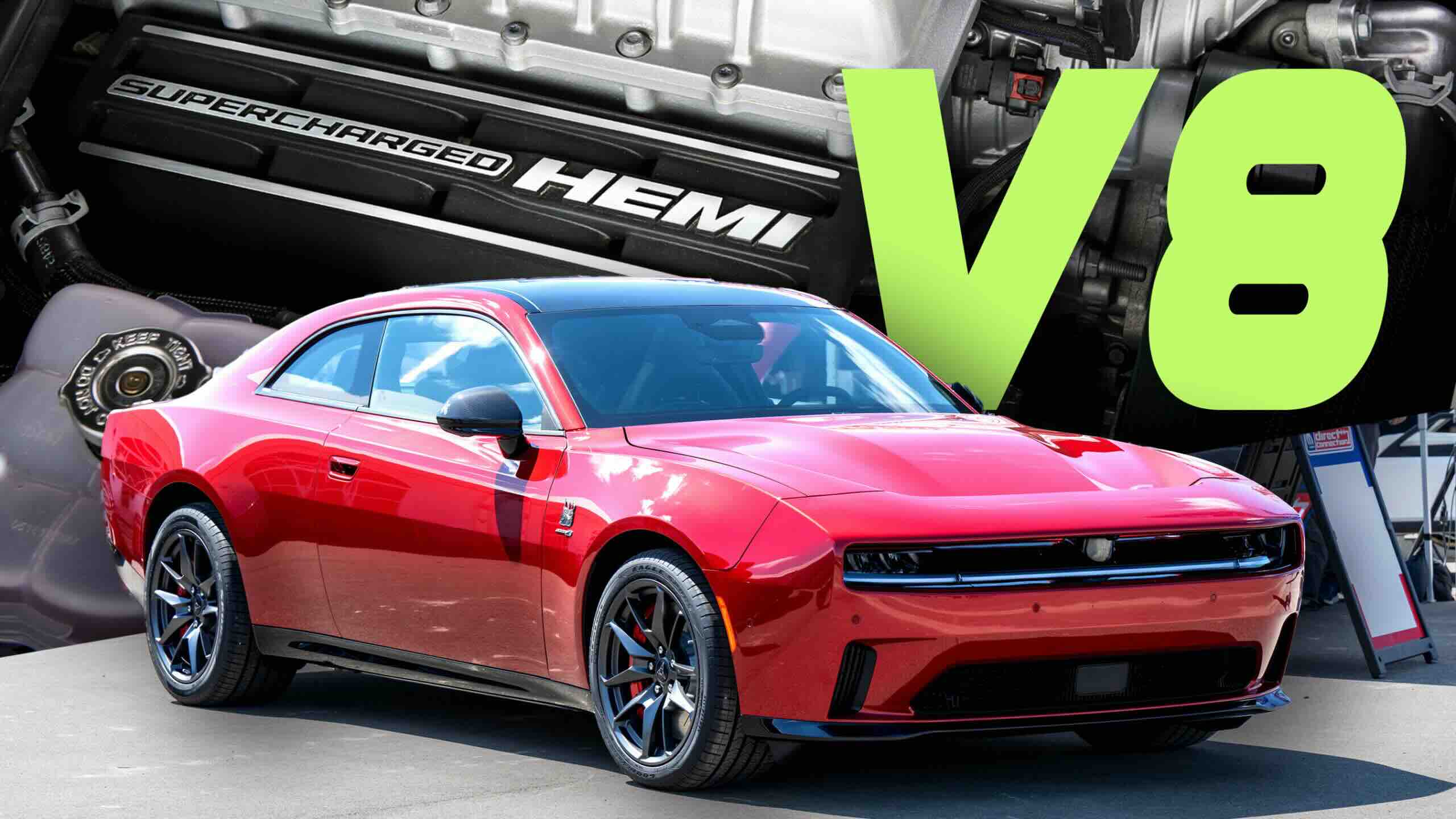

It was good news when Dodge realized what a mistake it had made in turning the Charger into a battery-powered device and rushed to put an engine into the car. The trouble is, it’s not the right engine – for a Charger. The 3.0 inline six that became available this year – after three years of disastrous non-sales of the battery-powered Charger – is a fine engine. It is a powerful engine.
But it isn’t a V8 engine.
That’s a problem, for a car like the Charger – because it is not a performance car (that’s what a BMW M3 is) but a muscle car, which is something nothing else that’s new is. Equipped with its 3.0 liter turbo’d six – which makes as much as 550 horsepower and 531 ft.-lbs. of torque – the Charger is more powerful than any previous-iteration of the Charger, excepting the supercharged Hellcat variants. Performance is not a problem. The problem is that performance is not the main draw, when it comes to muscle cars. Ask anyone who owns one – or aspires to.
It is the V8 that matters – and not merely because it is a V8, though that is key. The Charger would still have a problem if it were fitted out with say a small, DOHC V8 such as the ones made by Mercedes and BMW. They are wonderfully smooth and quiet engines, but that is a problem – for a muscle car. Smooth and quiet are not what is wanted, for basically the same reason a Harley aficionado does not want to sit on top of a smooth and quiet DOHC inline four. He wants a loud and rumbly big pushrod twin. If that were not the case, he’d buy a Japanese bike with a DOHC four.
The Charger – like all muscle cars – is a four-wheeled iteration of the same basic idea. Performance is secondary – and if you don’t believe that, check out the reaction of muscle car fans when they hear something like an SS 455 Chevelle or a Plymouth GTX with a 440 idling. Do you think it matters to them at all that both of those two cannot compete with a brand-new Hurricane Six-powered Charger as far as performance? The six cylinder powered Dodge runs the quarter mile in 12 seconds. Most muscle cars ran the quarter in the mid-high 14s. The Dodge’s top speed is 170-plus, easy. Few muscle cars were capable of exceeding 140 (chiefly due to their gearing and the lack of overdrive gearing).
None of it matters – even today. The affection for the muscle car is foundationally an affection for the V8 engine that is at the heart of every muscle car – and without which you have a performance car.
That’s fine, if that’s what you’re after – and if you want to compete with BMW M cars and so on. A muscle car stands apart; it has no competitors because no one makes them anymore. Except Dodge.
See the advantage there?
So it is excellent news that the V8 will be back, it looks like – maybe for 2027. The Hemi V8, it looks like – which is important, not so much because of the name but because of the size. The smallest Hemi available in a Stellantis vehicle (e.g., a Ram truck or a Jeep or a Dodge Durango) is the 5.7 liter unit, which is already larger than the more polished small V8s made by Mercedes, BMW and other luxury-performance brands. This matters for the same reason that a battleship has got to have big guns. It does not matter that a missile frigate is more powerful. Look at those guns! Just seeing the turrets rotate is a thing that evokes something watching a missile fired out of a tube can never evoke.
And it looks like the Hemi that the Charger’s going to get will be the supercharged version, which at 6.2 liters is just about the biggest V8 available in a new vehicle, excepting the 6.4 liter Hemi that is available in some current Stellantis vehicles, such as the ’26 Durango 392 (the numbers refer to the actual displacement in cubic inches rather than the vaguely effeminate “liters” we’ve all gotten used to).
It will be supercharged and will reportedly make more than 700 horsepower, which would make it more powerful than the most powerful iteration of the 3.0 inline six that’s currently available, cementing its supremacy as well as its appeal. Apparently, the pending supercharged Hemi Charger Hellcat will also get bodywork inspired by the Daytona Superbird Chargers of the early ’70s. It will be even more wonderful if Dodge offers this monster without the AWD system that is currently standard in all Chargers. AWD is a wonderful performance enhancement but it is also something a muscle car isn’t because reducing wheel-slip is something like reducing the alcohol content of your favorite beer. It is at odds with the point. (The current Charger’s AWD system has a RWD “mode” but that is not the same thing as being RWD, which means being without the safety net that AWD provides in a high-powered car.)
There is likely to be just one hair in the soup. The price. Probably – almost certainly – the revived Hellcat V8 Charger will start around $90,000 and maybe more than that. Back in 2023, the last time a Hellcat Charger was available, the base price was $78,895 – and that was three years ago. By 2027, it’ll be four years ago. Four years of inflation later. Also, Dodge will likely not want to sell too many of these things – because 12 MPG (in city driving) isn’t very good for CAFE fleet averages. Orange Man has dialed back the fines; but the fines are still there.
But at least this car will be here, soon. Not many of us will be able to do more than look and lust – but that’s better than having nothing to look at or lust for, isn’t it?
. . .
If you like what you’ve found here please consider supporting EPautos.
We depend on you to keep the wheels turning!
Our donate button is here.
If you prefer not to use PayPal, our mailing address is:
EPautos
721 Hummingbird Lane SE
Copper Hill, VA 24079
PS: Get an EPautos magnet or sticker or coaster in return for a $25 or more one-time donation or a $10 or more monthly recurring donation. (Please be sure to tell us you want a magnet or sticker or coaster – and also, provide an address, so we know where to mail the thing!)
If you’d like a Baaaaa hat or other EPautos gear, see here!










I drove the new charger I6tt. The lower hp version i think it’s called the GT? You’re right, it’s not a muscle car, but it’s a hell of a big sedan. Could have put a caddy badge on it and it would hold up to a big sedan that caddy should have but doesn’t. Maybe not the looks but the bones are there.
I would have bought it but for one small detail. No receiver hitch available for my mountain bike rack. I’ll can wait.
It’s no where near the same car the old one was, and the pricing reflects it.
For the practical guy who absolutely needs the awd, it works for me.
Real question does anyone care about anything made by Chrysler with there shit quality and stupid high price
At least the 2023 Charger/Challengers were relatively cheap with crap build quality. These new Challengers are beyond the reach of most except if you are upper middle class and higher. Buying this new V-8 Challenger means we basically need to be wealthy or take out a really expensive loan.
Some here proudly proclaim their lack of faith in God. What I see is that His antithesis, Satan, is hard at work using his favorite tool, GovCo.
Satan’s acolytes relish the idea of treating others like something that’s sticking to the bottom of their shoe. The Safety Nazis demand enormously costly “protections” while the Enviro-Commies treat the planet as though it all has the air pollution of the LA Basin.
See the light, Brother! Tear down the Satanic institution of GovCo. Utopia is not an option but, we don’t have to give Evil a secure home in GovCo.
For further edification see 1Samuel8.
IOW the cock fight wont resume till after the uncertified goat roast.
A fine article to be sure but not your typo which was “SS 455 Chevelle” as it should be Chevelle SS 454 .
One problem I see with an expensive V8 option is that whilst the super rich can easily afford them they tend to buy more “refined” vehicles while a V8 Charger was more of a working mans car.
Time will tell of course.
V8 or not – these turds aren’t gonna save Dodge, Stellantis or whatever you wanna call it.
Hi Blighty,
You may be rigth about that. Dodge is in trouble; Jeep also. Ram – like GM and Ford – is going to have trouble selling big $70k trucks to broke Americans. Chrysler is effectively dead already.
“Chrysler” and all of its brands has been dead since Daimler bled them dry with the merger.
What you see since is just a zombie.
It still seems alive but it is nothing more than the walking dead looking for a final resting place.
I went by the Auburn Hills headquarters “CTC – Chrysler Tech Center” this same time last year on a Thursday at 2pm. Almost zero activity. The acres and acres of parking lots and parking decks that used to accommodate thousands of employees was virtually empty. No significant traffic going to & fro with suppliers, deliveries, car haulers, nothing. Nada.
Yea, there still may be some work from home going on in 2025 but the reality is the labs, the dynos, the test track, there wasn’t enough cars there to staff those activities that require in-person work.
It’s already dead. Put a fork in it.
I think you may be right, Sampson –
And it’s sad. Chrysler had a fine car in the 300 – on that sold well, for years. It was ruinous to cancel it, just as it was ruinous to turn the Charger into a device (and jack up the base price by $20k). I hate to see it happen. Because I am a guy who actually does like cars.
What we need are more mandates!
There ought to be a law mandating those!
Is the hellcat version the only way a Hemi will be available?
No more RT versions etc?
Morning, Rich –
Yeah, that appears to be the plan. The V8 will be the ultra-exotic option. It’ll be the “halo” car. Which may help sell lesser/six-cylinder Chargers. I don’t think so, though.I say that because I use myself as a barometer of the appeal of the Charger. I’m a high church muscle car dude. I think I understand the muscle car appeal deeply. I have zero interest in a six cylinder performance car. No offense meant. No real criticism meant. I respect their performance. But a six cylinder-powered car can never be a muscle car, no matter how powerful/quick/fast. Those are metrics that define performance cars. Muscle cars are defined by their big V8s and their big V8 rumble. The distinction matters.
To people who want a muscle car.
‘It is the V8 that matters.’ — eric
Here we are entering into arcane matters of automotive theology. The most fundamental fact is that the specific output of internal combustion engines has tripled during our lifetimes.
As a kid, I changed the spark plugs on the flathead V8 of an old school bus. It was wonderfully simple and accessible. But it wouldn’t even match the power output of a 72-cubic-inch (1.2 liter) three-cylinder engine of today.
Which brings us to the eternal question of that object of desire, the V8. Every car my family owned since I was four years old — after we ditched the dowdy, seafoam green Plymouth Business Coupe — was V8-powered. I know V8s, and I know the secret firing order password, 1-8-4-3-6-5-7-2 (though unlike millennials, I don’t have it tattooed on my pecs).
But the fact remains — as shown by every vehicle on the market now — that with tripled specific output, you don’t need no massive, lazy, 85-IQ V8.
Like Eric, I balk at putting the ubiquitous 2-liter four into luxury cars, despite the fact that it can power them adequately. The happy medium, I submit, is the 3-liter inline six. It features inherent primary and secondary balance, which neither fours nor V8s offer.
I loved those big lazy V8s. But I also loathed them, for their crude, blacksmith-level technology of gasoline-stained carburetors, lumpy idle, and piss-poor fuel economy. In the 1970s, those big V8s were parked in houses with minimal insulation, single-pane windows, and high-maintenance exterior siding. We wouldn’t tolerate that today.
Enzo Ferrari praised the Jaguar XKE, with its 4.2 liter DOHC inline six, as the most beautiful car ever made. One ride in an incomparably bad-ass XKE seduced me away forever from my Pontiac GTO with its great thumping 400-cubic-inch V8. And I have never looked back.
Hi Jim,
Yes – as regards sophistication, smoothness – and power-per-liter. But would a car like my Trans-Am be as appealing with a smooth, quiet, in-line six, even if it made twice the power and got twice the gas mileage of my 455 V8?
Not to me!
As my father once said, there are a million ways to skin a cat. The best diversity is under the hood. I love the buzzsaw sound of a smooth DOHC Honda 4-banger when it gets on the VTEC lobe as the tach needle swings north of 7,000 RPM. I love the blatty sound of Subaru’s brilliant boxer 4’s and the growl of a Porsche’s boxer 6. The scream of a Ferrari cross-plane crank 8 or Lambo’s vicious V-10 gives me a warm and fuzzy feeling in my heart. The inline 6 vroom of an Aston, the whoosh and roar of a Nissan RB25DET on full boost and the smooth, effortless growl of a Jag V-12 are all awesome.
But nothing sounds like an American pushrod V-8 at idle. Chugga chugga chugga. The Hemi, the LS and Coyote each have a distinctive roar under the lash that is unmistakable and unique.
I’m sure the Hurricane is powerful, but that’s not the point. It’s like having coconut cake with NO coconut! A muscle car has a big V-8 driving the rear wheels. That’s the formula.
I saw one of the newer Chargers. I think the design looks great, it just needed the right plant under the hood!
18436572 is SBC. That’s all I need to know. I don’t have it tatted but I DO have the T-Shirt.
Enzo was right about the looks of the XKE. But in my experienced opinion that same XKE is vastly improved by a small block Chevy (or Ford) swap. About the same weight, much better torque and horsepower, sound is a matter of taste. I wouldn’t do it today because the price of XKEs is so high and they’ve become rather rare. That twin cam Jag 6 is a pretty motor, but she dont put out like she ought to.
Sounds like an engineering resource issue in getting it done.
The bread and butter of any muscle or pony car was it’s six cylinder (or later 4 cylinder) base model. It’s what makes the money such that the V8 version remains affordable.
I would have made the same decision, the six cylinder first. That will get sales back up.
What’s even better is that it’s an inline 6. The proper way to have a six. It’s all good news, except needing to wait, which is a hell of a lot better than not having it again ever.
A *normally aspirated* inline 6 “secretary car” priced in the low 30s.
GM, Ford, and Chrysler all forgot about that market segment
The last generation Camaro had a normally aspirated six cylinder engine, but that vehicle became rental car fodder because it wasn’t safe to drive wearing knee boots with a heel.
Don’t ask how I know.