

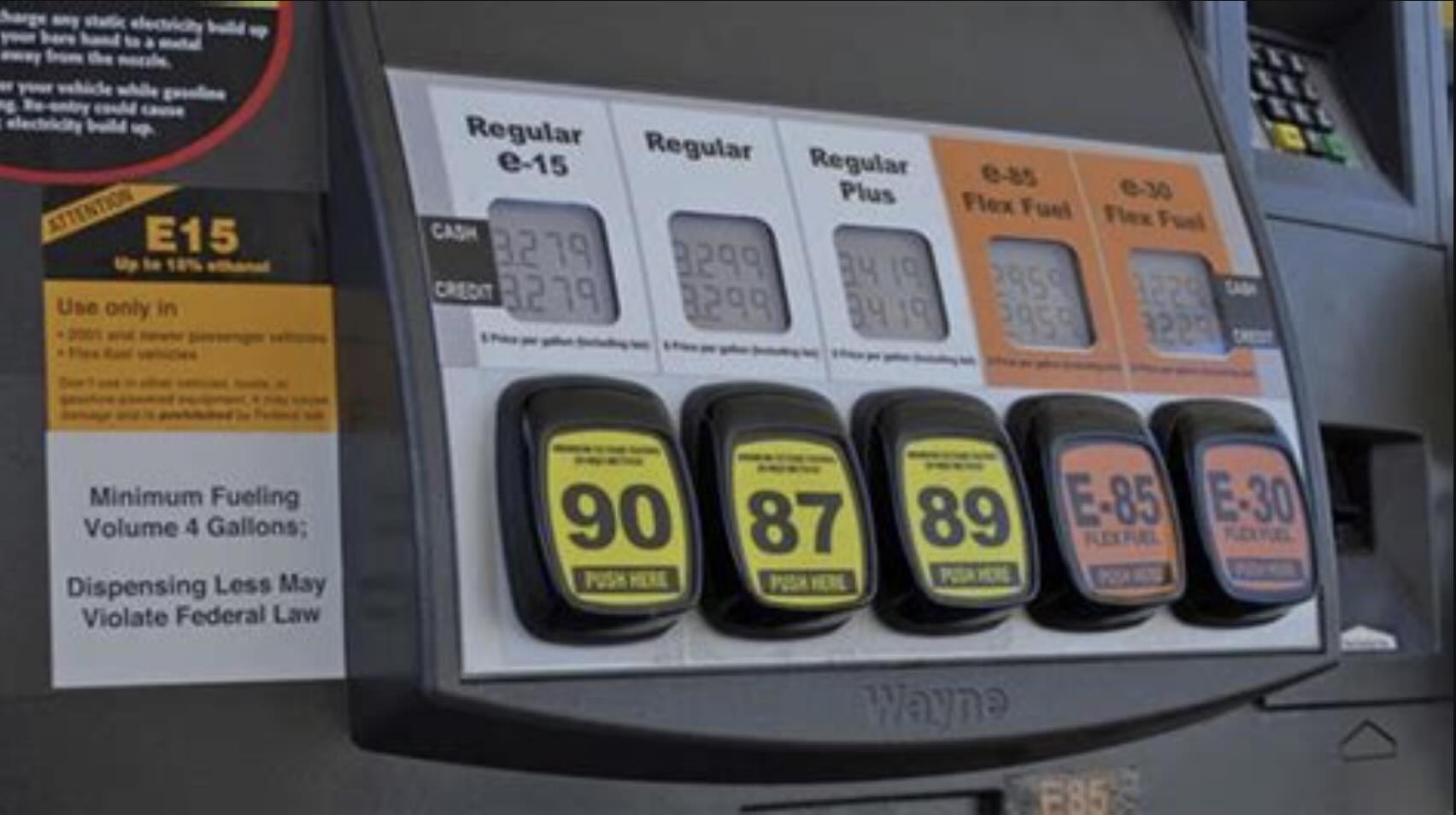

There’s a term you don’t often hear anymore – probably because there’s too much truth in it: Gasohol. It is “gas” that’s adulterated with alcohol. We put this adulterated fuel in our tanks as a matter of course, since almost all the “gas” that is commonly available is at least 10 percent alcohol. It is sold as “E10,” which translates as “gas” that’s 10 percent ethanol (ethanol is alcohol).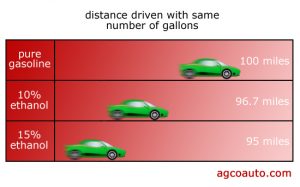
E15 is 15 percent alcohol. It is becoming commonly available and people are being wheedled into buying it because it costs less than E10 (and a great deal less than actual gasoline, if you can still find it) and $4.10 per gallon sounds great to people who are having to pay $4.50 for E10.
The catch is it’s another grift, the defining characteristic of Stage 5 America.
It costs more to burn ethanol – because alcohol isn’t as energy-dense as gasoline. Put another way, you have to burn more alcohol-laced gas to get a car to travel a given distance; this is true of E10 as well as E15, only more so in the case of E15. People don’t generally notice, though – because they don’t have an easy way of making a direct comparison. The adulteration of the fuel supply began decades ago, back in the 1980s. The idea at first was that this would serve as a kind of pour-in emissions control because alcohol-laced gas leaned out the fuel mixture; the problem was this made carbureted engines run hotter and it did nothing to reduce the emissions of fuel-injected engines because their computer controls simply richened up the fuel mixture to compensate for the alcohol.
But it was a boon-grift for Big Agra – aka the corn lobby – which has been making fat stacks peeing in our gas tanks (so to speak) ever since.
It is arguably one of the greatest con jobs ever. For more than 40 years, people have been effectively forced to buy adulterated fuel and getting reduced gas mileage as a result. The cost isn’t trivial.
The fuel economy of an engine that burns E10 is reduced by about 3-4 percent. Using E15 increases that reduction to 6 percent, if not more. Given a vehicle that averages say 30 miles-per-gallon – burning gasoline – you’d lose about 1.2 MPG burning E10. The same vehicle would only go about 28.8 MPG. Given a typical 13 or so gallon gas tank, the loss would be about 16 miles of driving range. If you filled up this car four times a month, the loss would be about 64 miles of driving range per month. Factor that out over a year and the loss comes to about 768 miles of lost driving range, the equivalent (roughly) of two full tanks of gas, which – at today’s $4.50 or so per gallon – amounts to a cost to you of (roughly) $117. Factor that out over 20 years and it gets to be a pretty considerable cost doesn’t it? About $2,400, to be precise about it.
That sum would pay many people’s gasoline bills for close a year.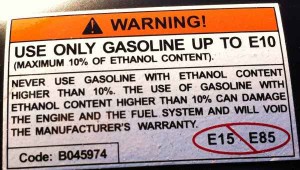
E15 increases that cost – and not just in terms of your car going less far than it used to. “Gasoline” with that much alcohol in it – 15 percent, remember – is too much alcohol to be safely burned in engines not specifically made to burn it because it’s more than just a matter of adjusting the air-fuel ratio to compensate for the high-alcohol-content “gas.” Most vehicles made before the early-mid 2000s were not made to safely use E15 and in many cases, the vehicle’s manufacturer warns not to use E15 “gas” due to potentially catastrophic materials failure caused by the alcohol, which breaks down rubber seals, plastics, gaskets and so on. Regardless of the vehicle’s vintage, if it has steel gas lines and a steel gas tank, the alcohol will tend to egg-on rust inside the lines and the tank, because ethanol absorbs moisture (water) from the the air and water plus steel equals rust. The flakes will then slough off and get sucked down the line into your fuel injectors and engine.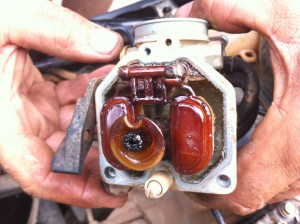
Carbureted engines (which almost all modern outdoor power equipment engines still have and almost all cars made before about 1982 also have) are more vulnerable because the fuel system is open to the air and because carbs (in automotive applications) generally predate alcohol-laced gas and were never designed for it. To avoid problems, it is necessary take the carburetor apart and replace all the soft parts – gaskets, seals and so on – with ethanol-compatible parts and also to re-jet the carburetor to compensate for the “leaner” fuel. Steel gas tanks and lines should also be replaced with stainless steel parts. This gets into money. It also assumes the replacement parts are available. In many cases, they are not.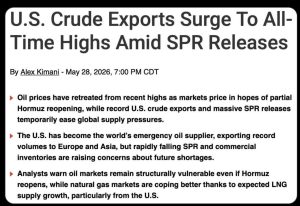
It is likely that E15 – if it becomes the new E10 (replacing E10 as the mass market fuel) – will accelerate the demise of all vehicles made before about ten years ago and especially vehicles made before about 25 years ago, when few were designed to be able to handle E15 fuel. While this might not be deliberate, it will nonetheless the end result of this pushing of alcohol in ever-higher-concentrations into the fuel supply. Given that there is no longer an “emissions” justification and hasn’t been, for more than 40 years (since the widespread adoption of self-adjusting electronic fuel injection) one wonders why they keep pushing alcohol into the fuel supply.
Especially in view of the fact that we have plenty of gasoline – because there is more than enough oil right here in the United States to provide for all of our domestic consumption needs. But we don’t actually – because much of this oil is exported – which is why Americans are paying $4.50 per gallon for gas adulterated with 10 percent alcohol and are being peddled “gas” adulterated with 15 percent alcohol. It is a cheap way to replace the gas that’s been taken out of the fuel supply and fool the rubes into thinking they’re getting less expensive “gas.”
Ah yes, my little chickadees!
. . .
If you like what you’ve found here please consider supporting EPautos.
We depend on you to keep the wheels turning!
Our donate button is here.
If you prefer not to use PayPal, our mailing address is:
EPautos
721 Hummingbird Lane SE
Copper Hill, VA 24079
PS: Get an EPautos magnet or sticker or coaster in return for a $25 or more one-time donation or a $10 or more monthly recurring donation. (Please be sure to tell us you want a magnet or sticker or coaster – and also, provide an address, so we know where to mail the thing!)
If you’d like a Baaaaa hat or other EPautos gear, see here!










Just like a speed governor in vehicles puts a restriction upon how fast that vehicle can drive, it appears the modern purpose of government is to restrict those upon whom they are above. There is now very little effort made by those in government to allow for the freedoms of the people under its yoke to operate themselves WITH freedom.
The government which is best is that which governs least.
That’s all I ask of those in government. But they can’t resist doing the exact opposite.
[…] The Gasohol Pushers — Eric Peters Autos […]
“Release the ‘Skeeters!”
“This is for your own good, you understand, because Google loves you and wants you to be happy — in much the same way that Fauci had to torture all of those Beagles in offshore labs by strapping their heads into mesh cages and siccing ravenous sand flies to gnaw on their flesh until they mercifully died, or in the way that the Australian Public Health™ authorities had to massacre all of those ostriches on that family farm down under for bird flu even though none of them actually had bird flu.”
https://www.zerohedge.com/news/2026-05-31/google-dump-32-million-diseased-ai-bred-mosquitoes-florida-and-california
this can only last about a year or 2, the price of corn will go up with no fertilizer and expensive diesel so eventually ethanol will be expensive too
Corn in the engine is like vaccine in the body.
99% of farmers are leeches who suck off the government’s tit.
Hi Alvin,
Yes, but in defense of farmers, it is damned hard to make a go of it anymore unless you “go big” – and that means going in hock. You become a tenant on your own farm. The only way to do it is small scale and then it’s going to be hardscrabble, though there are some exceptions (viz, Joe Salatin).
Eric,
Though cars may have been E15 capable for about a decade now, the same doesn’t apply to motorcycles. I have a 2021 Royal Enfield that can’t accept anything more than E10.
Do we export the stuff? Seems like we need to “educate” Europe and Asia about the benefits of watering down your fuel to save the planet.
Why?
Drive I-29 north out of Kansas City, MO, heading towards Council Bluffs, IA. About midway between the two locations, you will see the reason why. You can’t miss the plant.
Don’t bother looking for it on Google Maps, however. Google has been cooperating with the owners to hide the facility for about a decade.
What is it exactly? Sounds like some stuff those types would do, hide their crimes.
Ethanol plant, one of the largest chemical facilities I’ve ever seen.
The only larger plant I’ve seen first hand is the refinery/town of Sinclair, Wyoming, but the output of that facility is real gas and other oil-based products.
It’s been more than 10 years since I’ve made that particular drive.
However, I know there are a bunch of ethanol plants in NW Iowa. Used to drive past some of them, was acquainted with a triathlete who worked at one.
“I’m already against next war.”
“The indictment of Castro is a page taken from Trump’s playbook on Venezuela from earlier this year…”
https://www.commondreams.org/opinion/manufacturing-consent-cuba
Notice how every presidential election cycle the first place all the candidates go traipsing through is bumf*ck Iowa. Kissing the asses of the corn farmers to get their early votes and their bribes aka “campaign contributions” from Archer Daniels Midland. Never going to end except maybe by a failure of the corn crop, but even then the PTB would probably prioritize ethanol over food and let the peasants starve.
ADM developed HFC in the 80s. That company is about putting corn syrup in everything we eat.
For years I read ADM production cost of ethanol was greater than what they sell it for, the taxpayers are subsidizing production of corn to make ethanol.
taxpayers are subsidizing production of corn to make ethanol.The system of taxpayer-funded support for corn ethanol is a central piece of American agricultural and energy policy. While direct consumer-level cash payouts for ethanol production are not how the system currently operates, billions of taxpayer dollars flow into the industry through a complex web of agricultural safety nets, federal blending mandates, infrastructure grants, and tax credits extended through 2029
taxpayers are subsidizing production of corn to make ethanol.
The system of taxpayer-funded support for corn ethanol is a central piece of American agricultural and energy policy. While direct consumer-level cash payouts for ethanol production are not how the system currently operates, billions of taxpayer dollars flow into the industry through a complex web of agricultural safety nets, federal blending mandates, infrastructure grants, and tax credits extended through 2029.
How Taxpayers Subsidize Corn EthanolThe federal government supports the corn ethanol industry through several mechanisms:
The 45Z Clean Fuel Production Credit: Extended through 2029, this tax credit shifts billions in taxpayer support to fuel producers based on the lifecycle greenhouse gas emissions of the fuel.Direct Farm Subsidies: Corn is historically the most heavily subsidized commodity crop in the United States.
Taxpayers fund crop insurance, safety nets, and price loss coverage that artificially stabilize and lower the financial risk of growing corn, roughly 40% of which is diverted to ethanol production.
Infrastructure and Equipment Grants: Agencies like the USDA use taxpayer money via programs like the Higher Blends Infrastructure Incentive Program to fund the installation of ethanol blender pumps and storage tanks at gas stations.
The Renewable Fuel Standard (RFS): While not a direct cash subsidy from taxpayers, this government mandate forces oil refiners to blend billions of gallons of corn ethanol into the nation’s fuel supply each year. This creates an artificial, legally guaranteed market that keeps corn demand and prices high
Midwest corn farmers are currently driving this They get a big fat check from the feds for diverting crops to gasohol use. In the meantime, this diverts HUGE amounts of food corn used by poorer people in the Americas, driving up their food price and causing shortages.
Regular E0 gasoline is expensive because the refineries aren’t making a bunch of it anymore. To get 87 octane in the good old days, you had to refine it to 87 with the minimal octane boosters at the time.
To get 87 E10, you can use degraded stock and simply boost octane to 87 with the ethanol, a natural octane enhancer.
It will be interesting to see if they dial back the E15 octane to 87 from 88. That may not take place in a few years (if we have that time).
However, the main reason that real gas costs what it does is not because of the difference in refining costs (likely less than 5 cents a gallon), but because of natural market allocation.
It’s a grift. It’s malicious.
The E0 around here (Austin) is 90 octane.
I recently discovered that CENEX gasoline is a Top Tier fuel, and that includes their 91 octane non-ethanol gas, too. I gathered up a bunch for the small engines and filled up the Mazda 3 just for fun. Next trip it got 46 mpg, whereas it usually gets 41 mpg at best.
Yep, the cheap fuel is in my opinion why the EPA had to change all the MPG ratings down.
“The old EPA ratings for the Geo Metro were approximately 53 city, 58 highway, and 55 combined, while the new ratings are around 43 city, 51 highway, and 46 combined. This reflects a decrease in estimated fuel efficiency over time.”
this is the official bullshit answer from Goolag Ai:
The difference between “old” and “new” Geo Metro MPG is not due to updated vehicle designs, but rather a major overhaul of the US EPA testing methods in 2008. When factoring in these more realistic driving standards, the fuel economy estimates drop notably across the board.
bullshit, it was a change in the fuel heat value. I asked
what is the btu’s per gallon of 87 octane gasoline vs 91 with no ethanol
“A gallon of 91 octane ethanol-free gasoline contains significantly more BTUs than a standard gallon of 87 octane gasoline containing 10% ethanol (E10)
91 Octane (Ethanol-Free / E0): ~114,000 to 120,200 BTUs per gallon.
87 Octane (Standard Pump / E10): ~111,800 to 115,000 BTUs per “
Eric take note of this change in EPA MPG ratings was really due to the cheapening of the fuel
Hi Jack,
Yup. No doubt one of the reasons why so many economy cars – back in the day – could exceed 40 MPG was a function of the fact that gas was still they fuel they burned.
So it is not just a fuel scandal, it is also an EPA scandal.
“The Late 1970s: The term “gasohol” was coined in the Energy Tax Act of 1978, prompting widespread commercial use of ethanol-blended fuel as a result of oil embargoes and the phase-out of lead in gasoline”
“The EPA instituted a downward math correction to account for the gap between lab tests and actual on-road driving. City MPG ratings were mathematically cut by 10% and highway ratings by 22% from the raw laboratory data”
another cohencidence
Corn is difficult without modern Petro-chemical inputs. It requires multiple feedings to be successful. For a hobby farmer like me I only plant it if I’m bored, have extra space, or someone gave me some new heirloom strain I’m interested in. Would never think to waste it making it into fuel. Thats akin to the EV grift. The one where the inputs are 3-5 times greater than the savings from the finished product. No one can be that stupid. Once famine arrives on our shores, this will be exposed as the theatre of the absurd it truly is. Loosen the standards and build a myriad of different types of refineries. From Deadhorse to Tiera del Fuego, America is swimming in oil, coal, and gas.
“one wonders why they keep pushing alcohol into the fuel supply.”
Actually, one doesn’t wonder. Just another corporate-K street-congressional grift. The question remains: who or what built Stage 5 (whatever that means) America, and what are we going to do about it?
Because if we didn’t burn it the senators would drink it, and DC is bad enough as it is?
The “corn lobby” pushes gasohol, which damages our vehicles, and high fructose corn syrup, which damages our bodies.
Don’t know why, but here in the rural west central Wisconsin county I live in that doesn’t even have a stop light in the entire county, all our gas stations have 91 RON and 87 RON with zero alcohol. I burn nothing but pure gas in all my engines.
Priorities take precedent. Perhaps its because every drop of alcohol in that area services its overwhelming alcoholism ?
Umm. Is this supposed to be funny, or do you treally hink we’re all drunks out here? If this was joke, a smiley would’ve been nice. If not, well then Bless Your Heart! We’re hard working farmers around here putting food in your mouth.
Aw cmon, Joe. “Drink Canada Dry” isnt just an advertising slogan, it’s a challenge for Irishmen and Cheeseheads…
To be fair, I live in a nearby county from you (I’m guessing I know which county you live in based on your description,) and I’m from a small county up by Lake Superior, there’s a lot of drunks in and around these parts – more so up north, though.
Fun fact: growing corn to make ethanol requires diesel –which is now very expensive thanks to the talmudic oligarchy & their war on Iran.
All it takes is water to effect phase separation to remove water from E-10 or E-15 gas.
Small engines are relatively insensitive to octane numbers. This is doable by anyone. There are youtube videos explaining the process.
All is OK. We can just throw out all our lawn equipment, cars, generators, etc and replace them with polar bear friendly battery powered equipment. It will be free.
This will ensure world peace and the return of Jesus.
There will never be a shortage of polar bears.
Why not?
Because you can always create a polar bear from a cylindrical bear, or even from a Cartesian bear, by a simple coordinate transformation. QED.
(Nerd joke)
Ohhh. Well played.
Jesus already swung back by in ’47 and chose a familiar rest area to take a massive dump.
E85 was 3.85 regular was 4.38 so who the hell would buy that crap banned that corn gas it’s fucking stupid
So they adulterate our fuel, which results in poorer gas mileage. Which they then blame on the very people who did not want this in the first place.
For limited use vehicles you can try Stabil brand gas stabilizer. Project Farm’s You Tube channel tested a lot of different fuel stabilizers and found that while they didn’t stabilize much the Stabil brand did prevent corrosion in the metal samples tested.
Raising the alcohol content shows how much GovCo hates us. It’s like we can’t have nice things anymore.
WHO are the gasohol pushers? Let’s be perfectly goddamned clear:
‘On March 25, 2026, the U.S. Environmental Protection Agency (EPA), headed by ‘Lee Zeldin’, issued a temporary nationwide fuel waiver authorizing the year-round sale of E15 (a blend of 15% ethanol and 85% gasoline) for the summer driving season.
‘This action was spurred by President Trump’s January 20, 2025, Executive Order 14156 (“Declaring a National Energy Emergency”), which mandated that the EPA consider issuing these waivers to meet projected fuel shortfalls caused by ongoing geopolitical tensions [sic] in the Middle East.’ — AI Overview
F*ck Zeldin. F*ck Trump. And f*ck their stupid, evil war for little Shitrahell.
Trump and brethren billionaires are making billions,,, trillions from us uneducated, I don’t care, fool proles he could care less what he is called.
Chances are if we took the ethanol out of all the gasoline, gas would most likely be $1.00 cheaper per gallon. Of course we can’t have that in the USSA, Soviet America where everything is fake and a rip off.