

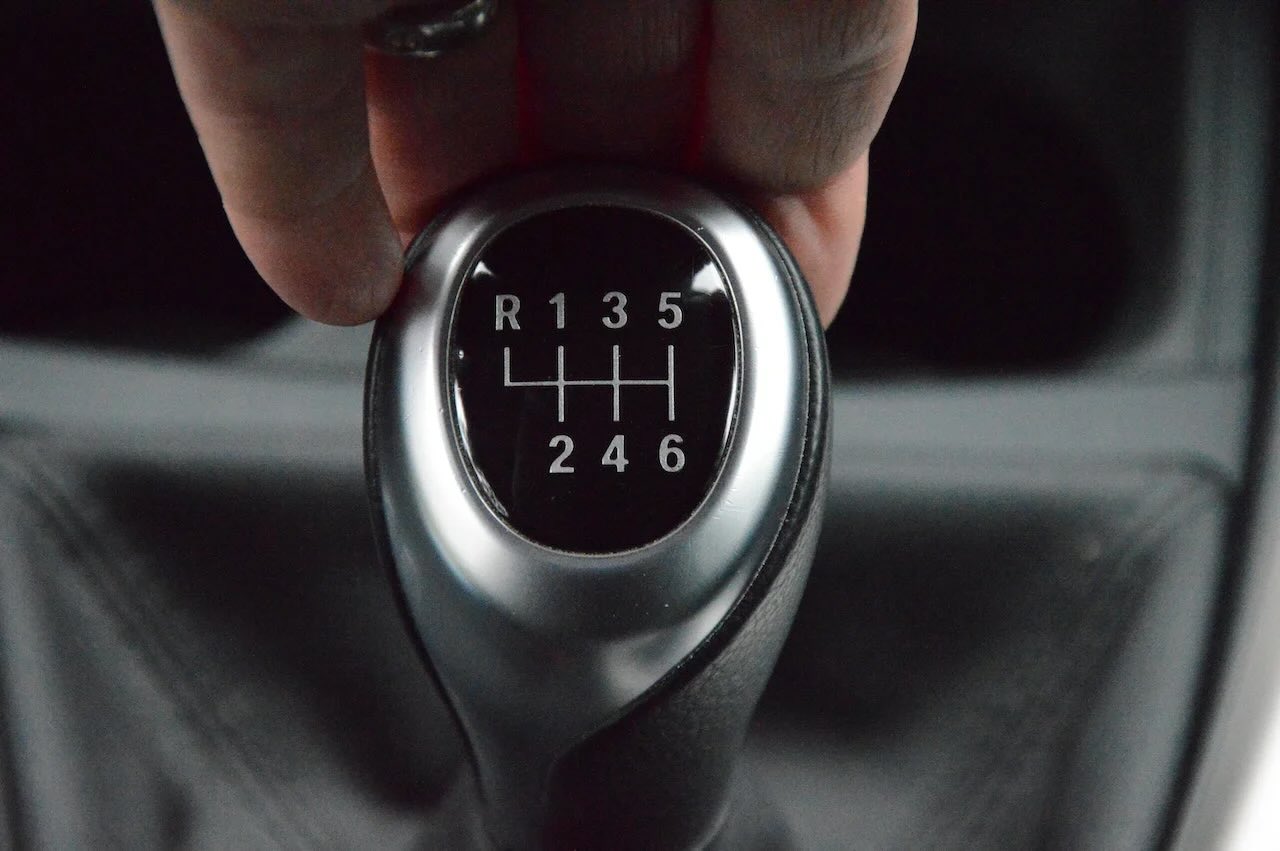

Manual transmissions are like politicians who support the Bill of Rights in that both are becoming pretty hard to find.
Manuals have become scarce for two mutually-reinforcing reasons. The first is that manuals can’t be programmed to shift in such a way as to optimize a vehicle’s “performance” (if you want to use that word) on government fuel economy and “emissions” tests, which they are required to pass. An automatic can be programmed to shift up at exactly the right compliance moment to eke out a slight gas mileage uptick (vs. a manual) on the test that determines whether the vehicle’s overall Corporate Average Fuel Economy rating is high enough to jibe with the “standard” – as the mandatory minimums are styled. The same goes for the “emissions” tests, which now include the “emissions” of C02, which people are assured is a “pollutant,” even though it does not cause or worsen smog. Even though it cannot be smelled.
Manuals, in brief, are too individualized.
The and result is that they are are now uncommon, even in cars that used to come standard with them (such as the Corvette, which is automatic-only now). That, in turn means fewer people buy them because the great bulk of vehicles that are on the market don’t even offer the option. This means fewer people even know how to drive a vehicle equipped with a manual transmission because they’ve never even been in one. When they buy a car, they get an automatic-equipped one because that’s what’s available and that’s what they know how to drive.
That, in turn, reduces demand for manuals.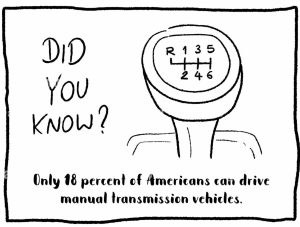
That manuals are fun is a thing those who have never driven a car so equipped do not know, for the same reason that those who have never gone on a date (with someone they’re attracted to) have no idea how fun that can be. But more than just fun is on the table. There are things you can do with a manual-equipped vehicle that you can’t do with an automatic-equipped vehicle. The first thing being that you can start the engine without using the starter. You can roll-start a manual equipped vehicle, which can be a godsend if your battery is dead or your starter has croaked.
All you need is a downhill Or a fried willing to push. 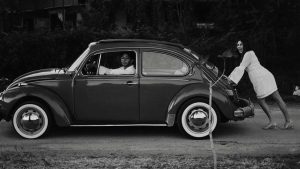
With the ignition on – don’t forget! – and the transmission in gear (use second or third) let the vehicle roll downhill – with the clutch depressed, so the vehicle will roll – and then, once you’ve gotten rolling, let the clutch out. You can also do this on a flat road by getting a friend to push the vehicle while you “drive.” What you’re doing here – when you let the clutch out – is using the transmission to turn the engine over, which effectively does the same thing as using the electric starter to do that. If the ignition is one and everything else is ok, the engine ought to start. It works because in a manual-equipped vehicle, when the transmission is in gear and clutch is out and the vehicle is moving, the rotational movement of the wheels is transferred through the transmission to the engine.
Voila! You are back on the road rather than stuck by the side of the road.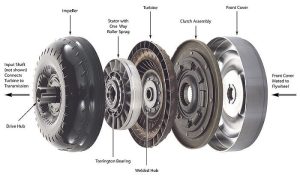
The reason why you can’t (generally) do this with an automatic is because of slippage – through the torque converter. In an automatic, power from the engine is transferred to the drive wheels via a fluid coupling – the torque converter – which slips a little by design. This is why you can leave an automatic-equipped vehicle in Drive with the engine running and not kill the engine, as would happen in a manual-equipped vehicle if you left it in gear and didn’t push in the clutch when you rolled to a stop.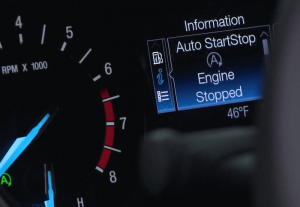
Another great thing about manuals is it’s harder to make them work with ASS – the wonderfully spot-on acronym for Automatic Stop Start “technology,” that system everyone hates that automatically shuts off the engine (in an automatic-equipped vehicle) pretty much every time the vehicle stops rolling and then re-starts it (automatically) when the driver takes his foot off the brake pedal. The stopping-and-starting can be synced to work fairly smoothly because it’s all automatic; i.e., it is done without any driver-involvement. That is harder to do with the variable of a driver who is manually controlling the transmission and specifically, the clutch. It’s not predictable whether he’ll push it in or leave it out (with the transmission in neutral, of course, so as to allow the engine to idle with the vehicle stationary).
It’s fun to get around government-imposed nonsense and manuals do just that. The operation of the transmission – the gear you’re in and the next gear you choose – is entirely up to you and so entirely under your control, as opposed to computer controls.
Manuals also have the ability to make otherwise boring vehicles fun because they give you something more to do than just sit there and drive. They involve you in the drive. This brings up what is arguably the most important thing about manuals, which is that they make drivers safer by obliging them to be actively involved in the drive.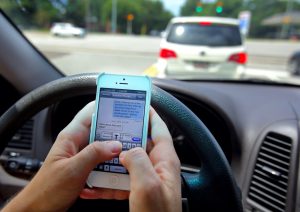
It is more difficult to text while driving and work a clutch and gear shifter at the same time. You tend to pay more attention even when you’re not working the clutch or shifting because of the always-there possibility that you might need to work the clutch of shift due to changing conditions. The involvement in driving one experiences while driving a manual-equipped cars develops a habit of being involved in driving, even if you happen to be driving a car with an automatic. Because good habits once learned tend to stay with you.
Contrariwise, bad habits that are learned are much harder to unlearn. Especially if you’ve never learned better ones.
. . .
If you like what you’ve found here please consider supporting EPautos.
We depend on you to keep the wheels turning!
Our donate button is here.
If you prefer not to use PayPal, our mailing address is:
EPautos
721 Hummingbird Lane SE
Copper Hill, VA 24079
PS: Get an EPautos magnet or sticker or coaster in return for a $25 or more one-time donation or a $10 or more monthly recurring donation. (Please be sure to tell us you want a magnet or sticker or coaster – and also, provide an address, so we know where to mail the thing!)
If you’d like a Baaaaa hat or other EPautos gear, see here!






Newer Ford Mustangs offer a fake, gay and Jewish** feature known as rev-matching for manual transmissions so that women and wimpy men can pretend to be skilled drivers.
“The 2019 Ford Mustang (and subsequent model years through at least 2025) equipped with a manual transmission includes an optional or standard (depending on trim and package) feature known as rev-matching, which automates the process of blipping the throttle during downshifts to synchronize engine RPM with the lower gear’s speed. This mimics the effect of a manual double-clutch downshift but is handled electronically by the vehicle’s powertrain control module (PCM) without requiring the driver to perform a heel-toe technique. Below, I’ll describe how it works, its benefits, how to enable/disable it, and some relevant notes.
How the Rev-Matching Feature Works
Basic Mechanism: When you downshift (e.g., from 5th to 4th gear), the driver depresses the clutch pedal and moves the gear lever to the lower gear. Sensors in the transmission (including a gear position sensor) detect the shift and the vehicle’s current speed. The PCM then automatically commands a brief “blip” of the throttle—essentially a quick burst of fuel and ignition timing—to raise the engine RPM to match what it would be in the new, lower gear at your current road speed. This happens in a fraction of a second, creating a seamless transition without the typical jerk or lurch that can occur if RPMs don’t match.
What It Simulates:
In traditional manual driving, a double-clutch downshift involves disengaging the clutch, shifting to neutral, blipping the throttle to raise RPMs (matching the lower gear’s speed), then shifting into the target gear and re-engaging the clutch. The Mustang’s system replicates this electronically, so the engine “revs” (blips) precisely without driver input on the accelerator. It’s not a true mechanical double-clutch but achieves the same smooth result, reducing stress on the drivetrain.”
** The Times of Israel spells it out:
Israel is the gayest country on earth
One of the reasons many people who “master” manually shifting gears and using a clutch don’t know how to double clutch is because of the “dashpot” that the Jews and their Tikkun Olam allies forced on us. Grok explains:
“What is a Dashpot in Automotive Context?
Basic Design and Operation: A dashpot consists of a cylinder filled with fluid (e.g., oil), a piston, and a shaft or rod connected to the throttle linkage. When the throttle (accelerator pedal) is released, the dashpot’s piston moves slowly through the fluid via a restricted orifice, cushioning the motion. This prevents abrupt changes in engine airflow. It often includes a one-way valve for quick opening but slow closing.
…
Role as a Pollution Control Device
Primary Function for Emissions Reduction: The dashpot acted as a deceleration valve or throttle positioner in carbureted engines (common until the mid-1980s, before widespread fuel injection).
When the driver suddenly releases the accelerator:
Without a dashpot, the throttle plates snap shut abruptly, restricting airflow while fuel remains in the intake manifold. This creates a rich fuel mixture (excess unburned hydrocarbons, or HCs) that passes through the exhaust, spiking emissions and contributing to smog formation.
The dashpot slows the throttle’s return to idle, allowing a calibrated “extra shot” of air (typically for 1-2 seconds) to lean out the mixture and burn more fuel completely. This reduces HC emissions by 10-20% during deceleration, a key source of urban air pollution.”
The dashpot ruined double clutching for a decade due to this delay. Blipping the throttle during a double clutch was impossible due to the 1-2 sec time delay in throttle positioning.
Eric Peters likes mechanical carburetors, but the advent of fuel injection and catalytic converters is what saved the manual transmission for those of us who enjoy making the perfect down shift.
I know that Eric removed the catalytic converters from his TA. With an automatic there is no need to remove the dashpot.
Millenial anti-theft device. Also, many years ago, I drove my 1970 Chevy 3/4 ton, 454 CID, manual transmission Silverado from Montana to California. In San Francisco, stopped at lights, heading uphill, with the trans in neutral, I’d take my foot of the brake, shift into first, then start smooth as you please, in the second or so, before the truck rolled backwards.
Back in my day, when I was entering adulthood in the 1970’s, one of the important design issues of the then modern cars was pedal placement. People who drive only cars with automatic transmissions will never understand this.
“Heel and Toe” was a skill that young men, and perhaps a very small minority of women, spent years perfecting. In order to accomplish this the pedals had to be placed just close enough so that the brake and the gas could both be operated simultaneously in order to allow braking while blipping the throttle to match the gear speeds in the transmission on the driveline side and the engine side of the transmission.
It was a well known fact that German manufacturers, as in many other aspects of automotive design, were the leaders in this. The Japanese and other European manufacturers caught on quickly, but arrogant US manufacturers were slow to figure this out. In fact, most US muscle cars of the 60’s and 70’s had very poor pedal design. Porsche was non-plus-ultra of pedal placement. I know because my oldest brother read Road and Track whose arrival every month I would wait eagerly for.
I know, because my 1965 Mustang with a 170 cu in six and a 3 speed without syncros had pedals so far apart you literally had to use the “heel” and the “toe” to double clutch, or as Antione describes, hold on the brakes while starting on a hill. In order to do this on a 1970 chevy truck in San Francisco would have required a lot of skill.
Another item that set European cars in general, and German cars specifically, was the type of hand brake. A pull out, ratcheting hand brake of that era, especially one with a foot release as was common on American cars and pickups, would have made those hills starts in SF even more difficult.
My Mustang, and I did drive it occasionally in SF, had a twist handle release so at lease you could pull out the under dash hand brake and let it out slowly as you skillfully gave gas and slipped the clutch out. Today almost all the manual transmission cars come with electronic hill holder clutches that keep the brake on on a hill until the car starts moving forward, making this skill obsolescant.
All this required lots of coordination, and very few women could ever master it. It was one thing that set men apart from women.
The superiority of German automotive engineering was one of the reasons I jumped at the chance to take a job in Germany in 1987. Unfortunately the Jews who own and operate Germany have decided that there is no need for IC engines or the quest for automotive excellence in their Noahide empire of dumb downed and carmelized Kalergi shitizens. Thanks AG. Thanks Jews.
I dunno, RE: ” Thanks AG. Thanks Jews.” …Maybe, it’s not just, “Da Jews”? Maybe, it’s more than that?
Have you ever considered that? …Maybe, widen your scope a bit?
Not all, is as it seems.
I see the most depraved and sadistic holocaust in the last 1000 years, if not all of history, being conducted by blood thirsty and greedy Jews who actually revel in the suffering they are causing. It is orders of magnitude worse than even what the Jews accuse the Germans of.
The cat is out of the bag for all to see. Hertzl told the world what the Jews were up to in 1897 in Basel. It has all come true. Millions upon millions dead in the first Jewish world war. Millions upon millions more in the second. Now Jews pushing the planet over and over to the brink of nuclear armageddon claiming that they have no nukes.
If you can’t figure out that the destruction of our civilization is part of their plan and you cannot see how the destruction of European automotive excellence relates to that then your opinion is not worthy of consideration, and likely you are Jew or at least a philo-Jew.
You are quite welcome. I can sell you my share of Germany for a penny if you are interested
The only thing Jews care about more than shekels is murdering Palestinian children.
Dunno about that. I drink the blood of christian children in the morning for my digestive health. Do you know if the Phalestinian blood taste better? I may switch
Once again AG feigns ignorance. Jews lie.
The Bloody Passovers of Dr Toaff
“Dr Toaff is the son of the Rabbi of Rome and a professor in the Jewish University of Bar Ilan, not far from Tel Aviv. He made a name for himself by his deep study of medieval Jewry. His three-volumed Love, Work, and Death (subtitled Jewish Life in Medieval Umbria) is an encyclopaedia of this admittedly narrow area. While studying his subject he discovered that the medieval Ashkenazi Jewish communities of North Italy practiced a particularly horrible form of human sacrifice. Their wizards and adepts stole and crucified Christian babies, obtained their blood and used it for magical rituals evoking the Spirit of Vengeance against the hated Goyim.”
You can read the entire book here:
Blood Passover, English Version
The Bloody Satanic Sacrifice Rituals of the Jewish Race
Brosi, I will disagree with collectively accusing all Jews with being murderous. There are many that are speaking out against it. That said, the Israeli government sure seems to be exceptionally murderous. It also seems to be doing it on the US’s dime.
You really ought to listen to some videos by E. Michael Jones, a Catholic Priest. Jones has written several books which have all been black listed by “the Jews”. Jones goes into detail about how Jews love to confuse goyim like yourself by conflating categories.
Jews explains that talking about “The Jews” is a category. It is just as legitimate as talking about “The English”. It does not mean that “every Jew” behaves that way, even though an appalling number do.
Here is his channel:
https://rumble.com/c/EMichaelJones
My last manual was a 1995 Mustang GT manual in Deep Forest Green. Had that car for a short time, traded it in mostly due to the 302 developing a rear main leak that I didn’t didn’t want to hassle with.
I just bought a one-owner manual ’95 GTS in the same color. The GTS was a one-year-only de-contented GT with no spoiler or power windows, but all the same mechanicals. The Rockford edition, if you will.
This one was a bit neglected and I now have more money in it than it is worth. But there is just something about a pushrod V8 with a manual.
Excellent, EDDO!
One of my best memories is the week I got to play with a Cobra R back in the summer of ’94. No carpet, even – or AC. But it did have a 351 and a Tremec. I drove that thing through the Baltimore Harbor Tunnel at 140 MPH. I can still hear the reverb off the tile walls.
Sorry Ace,
But doing 140 mph…NOT KM…….What are you smoking Slickarooney????
There is Bullshit…And there is Whisky bullshit….looks like you “inhaled” some.
WELCOME TO EARTH……
Did an ave 92 mph with a 93 “turbo Starion” from San Antonio to Houston…on open highway!
But honest Bro….140 mph……Hey coming on 69 years get real ..Is crack as kool as the addicts say?
Just sayin…
Odd comment, expat. Are you doubting he did 140 m.p.h.? [Calling the man, a liar?] Or, do I misunderstand?
Anyway, that’s all weird. I may have driven 125 m.p.h. several times here in cow-shit country. Once, in an 80’s Celica, then in a 90’s Firebird (Kit).
Fun as heck, but not all that special. IF, it happened. It may, or may not, have. Maybe, it was a dream?
…I almost can’t imagine – in a tunnel – that must’ve been, glorious.
Hi Helot,
I generally tell the truth – except to cops. 140 is not especially fast in a modern car. I’ve gotten a Prius close to 120. Just need the room to do it. My 1200 cc sport bike can get to 140 pretty easily on a straight stretch of road about three miles down the road from my place. I have ridden it faster than that there several times.
Morning, Expat,
Well. believe it – or not! The Cobra R was more than capable of it. And I did it. Two in the morning one night, on the way to NYC to meet a girl. True story.
140 isn’t all that fast, by the way. A sport bike can get there remarkably quickly. And then some!
“This one was a bit neglected and I now have more money in it than it is worth.”
I can relate!
Caddy blackwings still offer manuals.
Wife wants manual next time.
Something else you can do with a manual: stall the engine when the ignition switch and key was stuck in run and I couldn’t turn it off. Then I disconnected the battery (quick disconnect switch). I could start the engine with the key, but couldn’t turn it off. Fortunately this is an older truck (1991), so my redneck fix was to rewire the ignition system to a universal switch. Kind of like hot-wiring it, but with a switch. Looks strange, but works.
It should be required for all young men (and some enterprising young women) to experience the thrill of pushing your own vehicle up to a brisk 5 MPH, then dangerously hopping in the open door, scrambling to get the thing in 1st or 2nd gear before it slows too much, and quickly popping the clutch to get it fired off.
It’s sad to think how many have not and never will, but you ain’t living until you accomplish this feat.
Here’s a story about popping a clutch:
In 1984 I was going to CU, Boulder and playing baseball for the Buff’s. However, I didn’t care much about my studies, so my father made a deal with me that if I achieved a B average, he’d buy me a car. So I did just that. We lived in Newport Beach and this was before the 55 extension was put in place so the only way to get to the 405 was to drive on Newport Blvd. On the right was a gardening company that also had some cars on the lot for sale that he sold on consignment. We drove by and I saw a car that struck me, a yellow ’75 914 2.0 with American Eagle rims and “Porsche” spelled along both sides at the bottom of the doors. It had AC and a tan interior and the upgraded gauge package. I drove it and loved it but the price was a bit high. I told my dad that he could just by me a Hyundai and I meant it. He yelled, “I’ll not have my son driving a Hyundai!” So the 914 was mine and I had a Porsche that matched the same colors as my baseball uniform at CU.
I loved and hated that car. It was so much fun but was a service hog. I spent all my free dough and my father’s dough fixing it. I’m in Ski heaven and my free cash was taken up on this car rather than skiing. But I’d skip class and just blast up in the mountains. However, It had one major flaw, and that was that after driving it non-stop for about 3 hours, it would burn out the starter motor. The thought was that this was related to the closeness of the Cat, so I had the Cat taken out and a straight pipe put in and while I was at it, I had the engine bored out for more power.
On a different note, a year later, I was in CA getting my smog done when I suddenly remembered I’d removed the Cat. This is a major offense in CA, I stood tensely while he printed the report. “You passed” he said. I couldn’t believe it and got out of there fast. But removal of the Cat however, did not solve the problem. Every time I drove from Boulder to Newport Beach or back, the starter motor would be dead unless I stopped every couple of hours to let it cool down.
But I learned not to care, I could easily get the car moving a bit and would hop in the car and I’d easily pop the clutch. I went 6 months once without a starter. I even remember my girlfriend and I leaving Chili’s and she, in her pink blouse, pink purse, pink heels and pink mini-shirt bending over the car in front and pushing it ever so much so that I could pop the clutch in reverse. I was not hobbled in the least by this lack of a starter.
So, after leaving CU for home during winter break in ‘85, I took I70 West to I15. I stayed overnight in Cedar City, UT. I parked on top of a hill in the dirt parking lot so that I had plenty of runway to pop the clutch. But the next morning I couldn’t do it. 3 or 4 times I tried and it wouldn’t work. So I attempted to push the car back up the hill to try again, but it was a bit too steep and I was struggling. And older man, out of shape with a red face offered to help and he and his wife pushed me up the top of the hill and again I tried 3 or 4 times and couldn’t get the car going.
He offered again to help, but they were terribly out of breath and I was genuinely concerned for his health. So we tried pushing along the flat part. 2 more times he and his wife pushed while I tried to pop the clutch, but nothing. I told him, “Let try one more time!”. Suddenly, it occurred to me… sheepishly I checked the key and turned it, the lights came on the dash and the fan came in the engine bay. I said, “OK!”. He did and the car popped to life, I waved and drove off. I was too embarrassed to tell him I had forgotten to turn the car on.
To this day, I still wonder what he was thinking when I drove off. “That freak’in idiot had us pushing the car all around this lot and hadn’t turned the key”.
“That manuals are fun is a thing those who have never driven a car so equipped do not know…”
This is pure opinion. I know how to drive a manual and have done so, but I don’t find them “fun” in any sense of the word. They turn driving into a chore. Hard pass.
Hi Jim,
That’s fair enough. It is matter of opinion. But you’re the first person I’ve encountered who doesn’t find driving stick fun!
I think it’s maybe regional. I have always had trucks and grew up on a ranch in the midwest Plain, so the idea of “spirited” driving is foreign to me and when we did want to rip we did it on dirt bikes. So I don’t really care either way. Using a clutch was just a necessary thing for us and sometimes I did envy people with automatics that wouldn’t stall when you’re pulling stuff around or going through rough roads. If you ask any serious off road driver, like rock crawlers over in Colorado and stuff, they’ll tell you an automatic is almost mandatory. Not that you can’t drive a stick in rocks but you will stall and have to deal sometimes with how to start and drive out of a bad situation in gear, where a stalled engine is holding from rolling backwards. Doing this is a fairly advanced technique of hard(er) core 4WD driving.
I have always found driving manuals to be fun, Eric. And as I have said in times past, during the Winter months I prefer them over automatics. But yeah, the side note: My old WRX did not have a governor on it, or any of the fancy, saaaaftety stuff in it. I believe it was due to the manual transmission-ha ha! Give the rat bastards some time, though, I am sure they will figure out how to include such crap in manuals eventually.
If I had a dollar for everyone that said they can drive a stick . . . But really can’t with any proficiency . . . I’d be rich.
And that includes both auto industry executives and automotive journalists (not speaking of Eric – don’t believe he and I have ever met).
Hmm, so I am curious, Burn. For those who claim they can drive a stick but really cannot. What do such drivers do that show they really cannot drive a stick? I am not here to poke a stick or anything, I am genuinely curious as to what said drivers do that show they clearly have no idea how to drive a manual. Other than popping the clutch or griding the gears.
Shadow,
Stalling at launch is the most obvious.
Buck & bobble due to lack ability to modulate clutch and throttle simultaneously. Jerking, lurching uncontrollably as the vehicle oscillates and the positive feed back to the throttle pedal makes it worse and they don’t have the common sense to push in the clutch or back out of the throttle.
Wrong gear for a given speed & lugging the engine.
Inability to down shift and/or trying to accelerate without downshifting then complaining of poor performance & acceleration.
Inability to match engine speed to road speed and gear selection on a downshift – then letting the clutch out so quickly it either risks exceeding redline or severely upsets the chassis on corner entry.
Money shifting on an up shift. Usually the result of trying to speed shift & banging the gears aggressively for no reason.
The inability to launch on a hill without resorting the park brake or modern driving aids like hill hold assist (automatic brake hold for about 3 seconds when vehicle detects it is on a grade)
The inability to heel and toe a downshift.
Inability to drive in stop and go traffic.
Inability to be the first at a stop light and to not hold up traffic while they try to launch the car without holding everyone else up.
The list goes on . . .
“Stalling at launch is the most obvious.”
One time while driving my 4-speed Firebird in busy city traffic, it backfired through the carb. I thought nothing of it, but next time I took off at a stoplight, the car bucked and stalled. In an intersection. So embarrassing. When I got home, I opened the hood and realized the backfire through the carb blew off one of the vacuum caps on the back of the carburetor so it had a huge vacuum leak which was causing a super lean condition off the line.
I’ve been driving this car for about 3 years now and have mastered some of the more advanced shifting techniques. When I first bought the car, I made the seller chuckle as I tried to “figure it out” heading down the road after the purchase. It had been a good 20 years since I drove a stick.
The only one I can relate to was popping the clutch as a youngster when I was first learning how to drive a manual. Never mind the then-terrifying exercise of stopping at the top of a steep hill. And the parallel parking as well. Which I hear many new vehicles will do for you. Good grief…sit in driver’s seat…unplug brain.
Yep, the steep hill is the tell. If you can’t go from foot on the brake to seamless syncronysation of the clutch and pedal, propelling yourself up the hill, you cant drive a stick.
Here is another reason, but on that the vast majority of people are likely unaware of. Use the Ford Mustang as an example. Since 2015 both the transmission and differential gearing has been lowered in the name of saving the planet for a bunch of queer whores to the Jews.
Transmission Gear Ratio Comparison
2015 Mustang GT (Getrag MT-82) vs 2025 Mustang GT (Tremec TR-3160)
1st
3.66:1 vs 3.237:1
2nd
2.43:1 vs 2.186:1
3rd
1.69:1 vs 1.507:1
4th
1.32:1 vs 1.180:1
5th
1.00:1 vs 0.874:1
6th
0.65:1 vs 0.656:1
Final Drive (Common)
3.31:1 (std) vs 3.15:1
On a 2025 Mustang GT already 5th gear is overdrive, and the axle ratio is down to 3.15:1. Even worse, 1st gear is so high unskilled drivers are constantly stalling the car and even skilled drivers have to slide and munge the clutch or drop the clutch and lay a skid.
Why even bother with 6th gear any more? Basically the 2025 Mustang GT transmission is a 4 speed, or one couold even call it a three speed since 4-5 are useless for anything but freeway cruising.
This sucks the fun and vitality out of a manual transmission, and it is deliberate.
Thanks AG. Thanks Jews.
I thought Toyota screwed up the gearing on the 2005-2015 6MT stick. It’s the same transmission they used in some Camaros and Cadillacs of the timeframe with two OD gears.
Nevermind the wisdom of using a car-derived close ratio transmission in a 4WD truck. In any case, they used a 3.73 final drive ratio with them, which also seemed too tall. Normally a Toyota truck would have 4.10 gears. Keeping mind that a 4.0L V6 does indeed have more power and a lower torque peak than the traditionally used 4 cylinder inline they’d have used.
But it became clearer and perhaps even not stupid when I went to a slightly taller (went from stock 31″ to about 33″) tire on my truck and re-geared. This isn’t unusual, some people going much larger but I just went up about a size or two when I moved from a passenger car (P rated) to light truck (LT) tire to get a higher load range. I finally got around to the axles with a more appropriate ratio for the tires and use of my truck 4.56 gearing. What I call “real” trucking has widened the spread of ratios nicely.
Now instead of two ODs I have an underdriven 5th gear (ideally I’d like 1:1 and it’s close enough depending on actual circumference of the particular tire) and still have a usefully overdriven 6th. Just like I wanted originally. My 1st gear is now usefully low and I often start from lights in town in 2nd. Which, if you go back far enough, trucks used to have a granny 1st for pulling stumps and moving shit around the farm and you’d only use 2nd, 3rd, 4th (it so equipped with a 4-speed and maybe 5th if you had an OD transmission) in town or on the highway. It’s not SM465 1st gear low, but it’s also low enough to be nearly impossible to stall and can pull through a set parking brake unless the shoes are brand new.
So honestly, my initial (and I just drove the truck for 10 years before modifying it) criticism of Toyota was not fair. I think what seemed to be compliance nonsense was actually not completely without the wink-wink understanding that the truck could fairly simply be modified into a capable utility truck while meeting diktats.
I enjoy driving manual transmission. Have driven manual shift cars half of my driving life.
So what’s your point? That you are maniacally obsessed with Jews? That’s old nuze. You begin to sound like a broken record
Having an automatic hasn’t seemed to deter motorheads and shade tree mechanics over the years. The two things are not mutually exclusive. Guys would do shift kits, clutch packs, aux coolers and lock up torque converters back in the 80s.
Even a lot of very good mechanics generally can’t set up their own differentials either. Sometimes you have to seek out a specialist, transmission shop, machine shop, etc, for a task. Or dive into a junk yard. Or just learn how it works and do it yourself. Some one engineered and built it originally and the wrench at the shop learned how to repair it. So you can too. It’s an excuse to go to a library and get new tools.
You CAN push start automatic transmissions. It was very common early on. GM’s Hydramatic and Powerglide could be until 1966, Chrysler’s Torqueflite and Powerflite could be until 1965, Fordomatic could until 1968.
It has nothing to do with the torque converter. Those will work just as well in either direction, just a fluid coupler. It the engine can spin the drivetrain there’s no reason the drivetrain couldn’t spin the engine.
At least with the 2-speed Powerflite what made it possible was the gear selector (a set of 4 buttons on the upper left of the dash) used cables instead of a solid linkage to actuate the transmission and most importantly there was a second hydraulic pump mounted on the output. They removed the output pump to reduce costs, it was only there so you could push start. Also, over time automatics got more complex with electronics and vacuum to control them and it became less practical to keep features such as this.
It wasn’t compliance for any of it back then. It was convenience. People drove stick shift because that was what we had. When we could afford it we optioned autos or moved up in models. That desire goes back to the late 1940s, when the first automatic shifting transmissions came on the market.
The elimination of push starting was economic. As quality and technology improved the chance of being stranded got smaller. You could rely on electric starters, battery, fuel, ignition and everything to just work so the need to push start for the average owner diminished to essentially zero.
Yes, now, meeting the EPA demands for driving cycles and all that have made manual transmissions more rare and forced the 8 and 10 speed transmissions but that’s the tail wagging the dog more recently, like the last decade or so.
I recall reading an article 10-15 years ago about why the Dodge Challenger was available with the manual, but it’s Dodge Charger platform mate was denied that option.
The alleged reason was that since they had 2 different floorpan designs, Chrysler/Cerberus didn’t want to cough up the cash to have the Charger crash-certified with the manual transmission.
This is all true and it also leads to the question on the why. It is true that manual transmission vehicles now get less gas mileage than their auto transmission counterparts, hence “compliance.”
The second reason is that automakers themselves don’t want to give their customers any options. They are responsible for the death of the transmission. One subtle way they did that is to gear the manual differently than the auto. They gave them higher numerical axle ratios and less steep overdrive gearing, gimping their fuel efficiency at speed. This started sometime around the late 2000’s. Prior, manuals got the same gas or better mileage than automatic in all driving cycles, especially before the advent of overdrive transmissions and electronic controls.
Make no mistake, gas mileage was simply a convenient excuse to kill the manual transmission off to the approximately 10 percent of people who want that option.
Some state that manuals are hard to drive in traffic. That may be true with 60s-80’s vintage American cars, but Japanese and German cars shift as smooth as butter.
Automakers should be held responsible for their economic crimes against their customer base. They deserve to be exposed for the boot licking douchebags they are
Well-said, Antinader!
I’ve driven manuals regularly (for years) in DC area traffic. If that’s a “chore” then the person who believes it is probably ought not to be driving.
A third reason why manuals are nearly impossible to find is that buyers don’t want them anyway. Let’s face it, us rural, mostly male folk who do our own wrenching and want to be intimately involved with our vehicles are rare.
We are outnumbered by people who live in suburbs on cul-de-sacs and urban side streets leading to four or six-lane divided-highways and crowded commercial strips where driving is a massive chore and traffic is heavy but typically stop-and-go.
I HATE driving in that shit. And it can be very difficult in a manual — unlike my small-town, backroad and cornfield two-lane roads, where a manual is an utter joy.
The last thing that millions of people who live in such crowded areas want is the responsibility of being a more self-reliant driver. Many are woman and all they care about is finding the closest parking spot to the Target or the Bed, Bath and Beyond. They like back-up warning sensors and keep-lane assist. All they give a shit about is air conditioning and Apple car play.
I ruminated on this a few weeks ago when I made a rare excursion from my little burg to such an area, head on a swivel and fighting the heavy traffic. Everyone else was crammed into their little three-cylinder turbo SUVs, sitting in 5-minute oil change lanes and drive-up fast food restaurants where you never even get out of your car. The last thing they want to do is shift a manual.
The Pete Seeger song “Little Boxes” where “they all look the same” is spot-on.
Not for me, but I am outnumbered, and the Detroit marketing teams know it.
You nailed it. Unfortunately, nobody wants them in this country, so they don’t bother making them anymore. Been on the decline for decades now. Just like wagons. If you go to Europe or most other countries, you will see plenty of them in all sorts of cars. For your average American it will also make it too hard to text or make a Tik Tok if they have to worry about shifting.
That they are still common in Asia and Europe show it’s not a technical or even compliance. It’s demand. People in the US don’t want them and haven’t for a long time. By the 80s there were people who were not learning how to drive them and those of us who could were in demand to get a drunk friend’s car home. By the mid 90s cars that got them, in the US here, were specific niches – cheap, entry level, economy or performance. The bulk of “regular” vehicles – family cars, mid and high end – were automatics. Have you ever seen a manual shitbox Corsica, Lumina or any of those kinds of 1990s cars? When’s the last Buick or Mercury that had a manual? Trucks hung on to them longer but even those started to get less common in 70s and 80s. By 2000 or so it was fairly uncommon to see them in pickups and almost never in SUVs, especially as they became the family car alternative instead of just hunters using them.
One thing’s for sure –it’s a heck of a lot easier to tow a heavy trailer with a manual than an auto (even with the comical tow/haul button engaged). An auto’s constant upshift/downshift, even with the “tow/haul” button engaged, is annoying and I can imagine not good on the engine & drivetrain.
Good point, MH!
The Tow/Haul button generally locks the OD out and that’s all.
In the ‘things you can do with manuals’ category, one is using engine braking on downhill grades.
On mountain roads, which typically have a maximum downhill grade of 6 percent, I downshift to minimize the need for braking. When automatic-shift vehicles are ahead, their brake lights come on at every curve. Usually I can avoid tapping the brake.
This is the manual-trans equivalent of the regenerative braking used in EeeVees. Funny how EeeVee pushers enthuse over the benefits of regenerative braking, but never mention the benefit of downshifting the hydrocarbon-fueled vehicles they so detest.
Some sport-oriented cars, I’m told, have paddle shifters to facilitate downshifting — so that poseurs can pretend they’re shifting for themselves. But I wouldn’t try that in a typical appliance vehicle with a shift lever, or worse, stupid push buttons. Push buttons are for issuing commands to your microwave oven, not controlling a damned car.
I drive manuals and always have and I live in a mountain state. But I have had to rent vehicles with automatics. They’ve all had a way to select a gear manually and you can engine brake. It’s not always as immediate or efficient as a manual but it works. Do the controllers for engines and transmissions kick in and override your manual choice? Maybe rev limiters or something? I’m genuinely curious.
I’ve also racked it up to poor skills, since I see people even with manuals not knowing about this and riding their brakes. When I have to slow descending I do what I was taught, which is the hard brake for a short period. So you scrub 20 MPH in a few seconds rather than constantly tapping or weakly pushing. You generate a lot of heat but give the brakes long periods to cool down instead of slowing cooking them.
I tried to get downhill braking across to my daughter – nope, the champion of warped rotors. Forget manual downshifting the automatic transmission.
“Scrub off speed, then let up on the brakes, on / off, don’t ride the brakes downhill you’ll overheat the rotors and everything else, got it?”
“Yea yea sure sure.”
Decades in I’m still working on “set the parking brake, trans in neutral, check for no roll, THEN put it park”. Testament to modern engineering – the transmission parking pawl / pin. How they survive the Dufus Americana is amazing.
The world has become too safe, weak genes aren’t taken out of the pool nearly as efficiently as when there was immediate effect for going face-to-face with a grizzly unprepared. We might need to go back to brakes boiling and failing so that there’s consequence to poor decisions.
Commander Savant has never engaged the park brake in 35 years, manual or electronic. She would park at the crest of Mt. Washington and not put it on.
This newer vehicle I have, Jim, has the “Manual Mode” to it, which include the paddle shifters, and the up & down (+/-) shifter option. Shift the gear from “Drive” to the left, and you are in “Manual Mode”. I tried it once, after a bad snow and ice storm on the one smaller, main road when there were not a lot of people out that morning. I was surprised, in that the Manual Mode did not do too bad, and it performed okay on the ice and snow. However, the engine is quiet, so you do not hear the engine revving higher, indicating the need to shift to the next gear. However, “manual mode” is just not the same. Like having decaff coffee first thing in the morning. For if “it” “thinks” you have “forgotten” to up or down shift, the engine (computer) will do it for you. On my old WRX, I could really push the gears and have some fun with it, no engine nanny to protest.